Is CrossFit Good for Beginners?
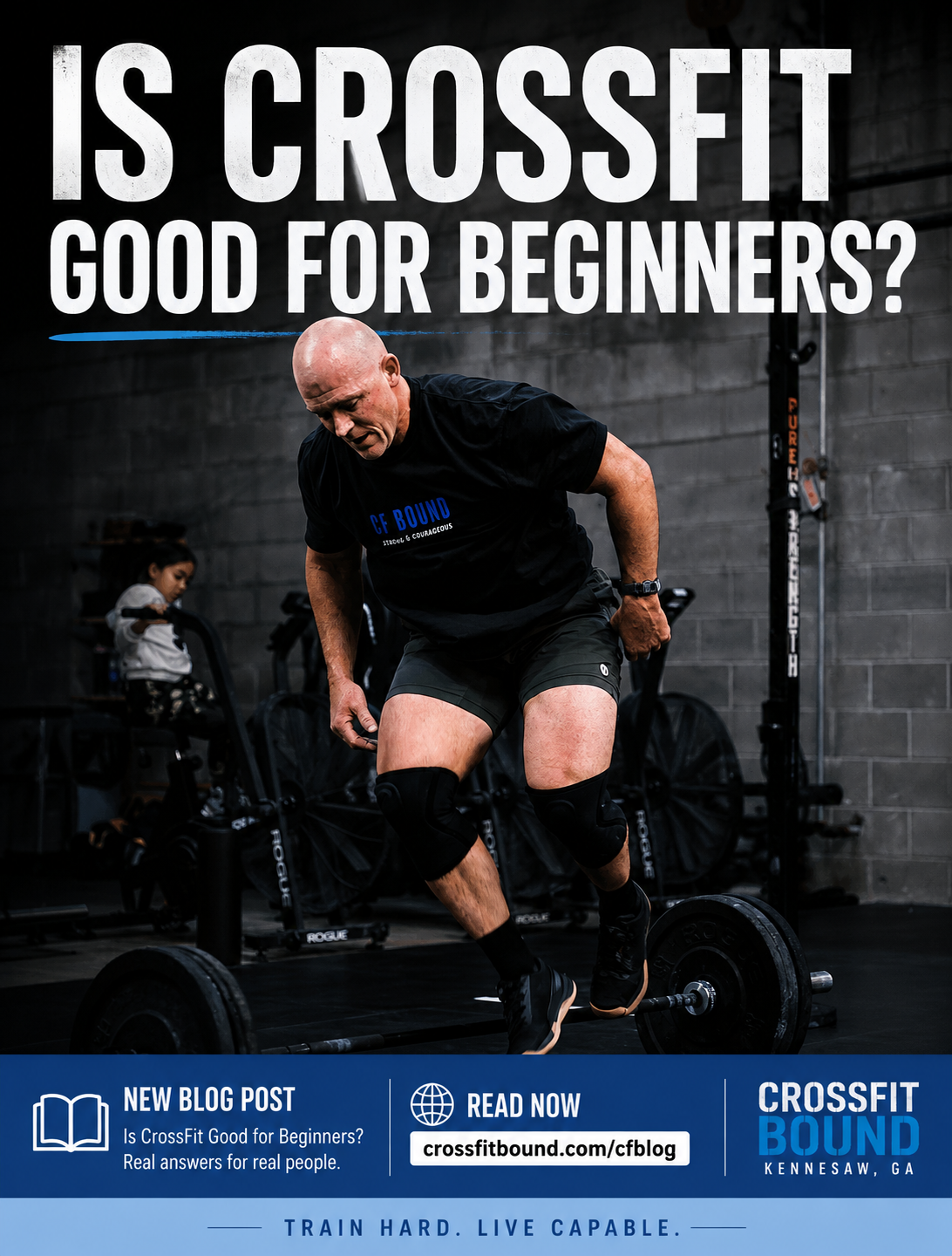
What I’ve Learned After Years of Training and Coaching
By Brandon Phillips | Owner, CrossFit Bound | Kennesaw, GA
If you’ve thought about trying CrossFit but haven’t walked through the door yet, there’s a good chance you’ve had one of these thoughts:
“I need to get in better shape first.”
“I’m too old to start CrossFit.”
“I can’t do pull-ups.”
“I haven’t lifted weights in years.”
“Those workouts look way too intense for me.”
After years of owning CrossFit Bound and coaching people from all different backgrounds, I can tell you that these are some of the most common concerns we hear.
And my answer is pretty simple:
You don’t need to get in shape before starting CrossFit. CrossFit is one of the tools you can use to get in shape.
At 42 years old, I look at fitness differently than I did in my 20s.
I’m a father of two. I run a business. I work as a firefighter. There are plenty of days when work, family, coaching, running CrossFit Bound, and everything else life throws at me are competing for my time.
I’m not training because I need fitness to be another full-time job.
I train because I want to be strong enough, conditioned enough, and healthy enough to handle all the other parts of my life.
That’s what attracted me to the CrossFit methodology in the first place, and it’s still why I believe in it today.
What Is CrossFit, Really?
If your only exposure to CrossFit has been social media, you might think it consists of incredibly fit people lifting huge weights, doing muscle-ups, walking on their hands, and collapsing on the floor after brutal workouts.
That's one version of what an experienced athlete might be capable of doing.
But it misses the point of CrossFit.
CrossFit is a strength and conditioning methodology built around constantly varied functional movements performed at an intensity appropriate for the individual.
In practical terms, we squat, hinge, carry, push, pull, run, row, bike, lift weights and learn to control our own bodies.
Those movements are trained in different combinations, loads and durations so that we develop broad fitness instead of specializing in one area.
But one of the most important pieces for a beginner is this:
The workout is supposed to meet you where you are.
The goal isn't for a beginner to perform exactly what an experienced CrossFit athlete is doing.
The goal is for both people to receive the appropriate training stimulus for their current ability.
Is CrossFit Actually Good for Beginners?
Yes—when it's properly coached and appropriately scaled.
In fact, I think beginners can benefit enormously from CrossFit because you aren't expected to figure everything out yourself.
Think about what happens at a traditional gym.
You walk in.
There are machines, dumbbells, barbells, treadmills and dozens of other pieces of equipment.
Now what?
What exercises should you perform?
How many sets?
How many repetitions?
How heavy?
How long should you rest?
Should you do cardio before or after lifting?
How do you know whether you're getting better?
Most people aren't lacking access to exercise equipment.
They're lacking a plan, coaching and consistency.
That's where a good CrossFit gym should be different.
At CrossFit Bound, we write the programming. We teach the movements. We help determine the appropriate weight and movement variation. We coach the workout. We track progress.
Your primary responsibility is much simpler:
Show up and be willing to work.
“But I'm Not in Shape Yet.”
You aren't supposed to be.
This is probably the objection I'd most like to eliminate.
Saying you need to get in shape before joining a CrossFit gym is a little like saying you need to become stronger before you start strength training.
Wherever you are today is the starting point.
We've coached experienced athletes, people who haven't exercised consistently in years, busy parents, professionals, first responders, and people walking into a gym environment for the first time.
They shouldn't all perform exactly the same workout.
That's what scaling is for.
If today's workout includes pull-ups and you can't perform a pull-up yet, we'll choose a pulling variation appropriate for you.
If the workout calls for a 135-pound barbell and that's too heavy, we'll reduce the weight.
If running isn't currently appropriate, we can change the movement.
If the prescribed number of repetitions would be excessive for a brand-new athlete, we can reduce the volume.
Changing the workout doesn't mean you're failing the workout.
It means we're coaching.
What Does “Scaling” a CrossFit Workout Mean?
Scaling means adjusting the workout while trying to preserve its intended purpose.
That distinction matters.
We aren't simply making everything easier.
We're asking:
What does this person need today to get the intended benefit from this workout?
Imagine that an experienced athlete can complete a particular workout in 12 minutes.
If we give a brand-new athlete movements and weights that take 35 minutes, we haven't necessarily given that beginner a better workout.
We've probably given them the wrong workout.
Instead, we might decrease the weight, modify a movement, reduce repetitions, or adjust the difficulty so that both athletes experience the intended stimulus at their respective fitness levels.
That's one of the things good coaching should accomplish.
CrossFit's own methodology emphasizes learning sound movement first and then progressively adding intensity. That's particularly important for beginners.
What Should You Expect During Your First CrossFit Class?
Your first experience shouldn't involve somebody pointing at the whiteboard and saying, “Good luck.”
At CrossFit Bound, we want to know something about you first.
What is your training background?
What are your goals?
Have you lifted weights before?
Do you have movements you're unfamiliar with?
What are you hoping to change?
From there, your coach can help you understand the workout and determine the appropriate version for you.
A typical CrossFit class will include some combination of:
A coached warm-up
We'll prepare you for the movements you're going to perform that day.
Strength or skill work
Depending on the day, this could include squats, deadlifts, presses, Olympic lifting, gymnastics, or another movement we're developing.
The workout
This is the conditioning portion many people associate with CrossFit. It might be short and intense, longer and aerobic, or somewhere in between.
Coaching throughout the session
You're not just following instructions on a television screen. Your coach is watching movement, providing feedback, and helping adjust the workout when necessary.
Most importantly, you aren't expected to know everything when you arrive.
That's why we're here.
What If You Can't Do a Pull-Up?
Then you don't do a pull-up yet.
You train toward one.
That's another reason I love this methodology.
Fitness becomes measurable.
Maybe today you can't do a pull-up.
Maybe you squat an empty barbell.
Maybe running 400 meters without stopping is difficult.
That's okay.
Those things establish your starting point.
Then you train consistently.
Months later, something changes.
The empty bar has weight on it.
You run the 400 without stopping.
The movement you couldn't perform becomes something you can do.
Eventually, maybe you get that first pull-up.
Those moments matter because they represent something much bigger than a score on a whiteboard.
They're evidence that your body became more capable.
CrossFit at 42 Looks Different Than It Did in My 20s
This has become increasingly important to me.
At 42, I'm not trying to prove that I can train like I'm 22.
I want to train hard.
But I also want to train tomorrow.
And next year.
And ten years from now.
I need to be physically capable for my job as a firefighter.
I want enough energy to run a business.
More importantly, I want to be able to do things with my kids.
I want to lift heavy things.
Run.
Hike.
Work around the house.
Travel.
Play.
And continue doing those things as I get older.
That's what functional fitness means to me.
Fitness shouldn't exist only inside the gym.
What you build inside the gym should improve your ability to live outside of it.
You Don't Need Two Hours a Day
Another reason CrossFit continues to work well for my life is efficiency.
I'm busy.
Most of our members are busy.
Between careers, children, marriages, school schedules, youth sports, and everything else adulthood brings, very few 25-to-40-year-olds are looking for another two-hour commitment every day.
A well-designed CrossFit class allows us to train multiple aspects of fitness within roughly an hour.
Strength.
Conditioning.
Power.
Stamina.
Movement quality.
Different days emphasize different qualities, but over time you're developing a broad base of fitness.
For me, that's far more useful than being incredibly good at one thing while ignoring everything else.
How Many Days a Week Should a Beginner Do CrossFit?
For many beginners, three days per week is a great place to start.
You don't need to go from doing nothing to training six days a week.
I'd rather see someone train three days every week for the next year than train six days a week for three weeks and disappear.
As your fitness improves and your body adapts to training, frequency can increase depending on your goals and recovery.
But initially, focus on something much less exciting:
Consistency.
Three good training sessions every week adds up.
That's 12–13 workouts per month.
Roughly 150 workouts per year.
Do that for several years and you'll be amazed by how different you can become.
Is CrossFit Too Intense for Beginners?
CrossFit can be intense.
That's part of why it works.
But intensity is relative.
My appropriate training intensity after years of CrossFit shouldn't necessarily be your intensity during week one.
And your intensity six months from now shouldn't necessarily look like your intensity today.
One of the biggest mistakes a beginner can make is looking across the gym at someone who has trained for eight years and thinking:
“I need to keep up with them.”
You don't.
You need to train appropriately for you.
Your job isn't to win your first CrossFit class.
Your job is to come back for your second one.
What I Would Tell Someone Thinking About Starting CrossFit
Don't wait until you're lighter.
Don't wait until you're stronger.
Don't wait until work slows down.
Don't wait until the kids' schedules get easier.
There will probably never be a perfect time.
At some point, taking care of your health has to become one of the things that stays on the calendar instead of being the first thing removed from it.
I understand that differently now than I did when I was younger.
Being fit isn't the only important thing in my life.
Fitness helps me show up better for the things that are important in my life.
As a father.
As a husband.
As a firefighter.
As a business owner.
And hopefully someday, as an older man who still wants to do things younger people assume he can't.
That's why I train.
And that's ultimately what I want CrossFit Bound to provide for our members.
We're not trying to turn everyone into a competitive CrossFit athlete.
We're trying to help people become stronger, healthier, fitter, and more capable versions of themselves.
Ready to Try CrossFit in Kennesaw?
If you've been thinking about trying CrossFit but aren't sure whether you're ready, come talk to us.
You don't need CrossFit experience.
You don't need to know how to lift a barbell.
You don't need to be able to do a pull-up.
And you definitely don't need to “get in shape first.”
We'll meet you where you are, talk about where you want to go, and help you determine the right place to start.
Train Hard. Live Capable.
CrossFit Bound | Kennesaw, Georgia