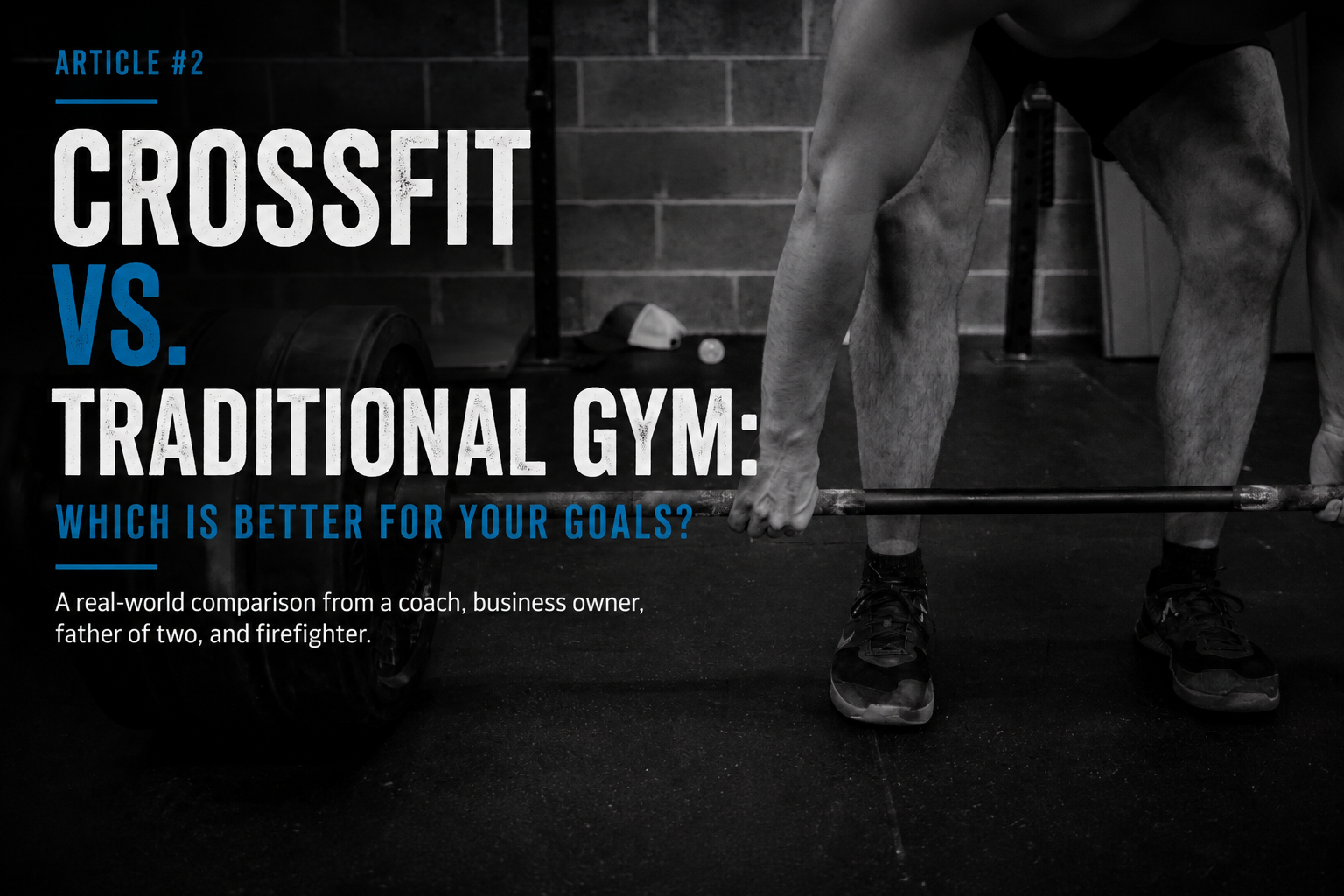
CrossFit vs. a Traditional Gym: Which Is Better for Your Goals?
By Brandon Phillips | Owner, CrossFit Bound | Kennesaw, GA
I've spent most of my adult life around fitness.
I'm 42, a husband and father of two, a firefighter, and a business owner. I also own CrossFit Bound, so you can probably guess which style of training I personally prefer.
But I'll tell you something that might sound strange coming from a CrossFit gym owner:
CrossFit isn't automatically better than a traditional gym.
The better question is:
Which environment gives you the best chance of actually accomplishing your goals?
Because access to exercise equipment isn't the problem for most people.
There are gyms everywhere.
There are workout apps, YouTube videos, home gyms, running trails, and thousands of free workouts online.
Yet millions of people still struggle to train consistently.
After years of coaching, I think the difference often comes down to three things:
Direction. Accountability. Consistency.
And that's where CrossFit and a traditional gym are very different.
What Do You Actually Get From a Traditional Gym?
A traditional gym primarily sells access.
You pay your membership and receive access to:
weights
machines
cardio equipment
locker rooms
amenities
For the right person, that's fantastic.
If you already know how to train, know how to program your workouts, understand proper technique, and have the discipline to train consistently, a traditional gym can give you everything you need.
The freedom can actually be an advantage.
Train whenever you want.
Spend as much time as you want.
Choose exactly what you want to work on.
But there's another side to that freedom.
Nobody is necessarily waiting for you.
Nobody tells you what to do.
Nobody adjusts your workout when something doesn't feel right.
Nobody notices that you haven't been there in two weeks.
And that can be a problem.
What Are You Paying for With CrossFit?
A good CrossFit gym is selling something different.
You're not primarily paying to use barbells and rowing machines.
You're paying for coaching and a training system.
You walk through the door and the workout has already been programmed.
A coach leads the class.
Movements are taught.
Weights and movements are adjusted to your ability.
Your progress can be tracked.
You train alongside other people.
Then you go home.
For someone with a busy life, there's a lot of value in that simplicity.
That's a major reason I still train this way myself.
I run a business.
I work at the fire department.
I'm married.
We have two kids.
There are plenty of decisions I have to make every day.
When it's time to train, I don't need another hour of decision-making.
I need to train.
Coaching vs. Access
This is probably the biggest difference.
Imagine you want to get stronger.
At a traditional gym, you might Google:
“Best strength workout.”
Now you have to determine:
What exercises?
How many sets?
How many reps?
How much weight?
When do I increase the weight?
What happens when I plateau?
Is my technique correct?
A CrossFit gym should answer most of those questions for you.
That doesn't mean you stop thinking.
It means you have a coach and a structured program helping guide the process.
For many people, that's the difference between having a gym membership and actually training.
What About Accountability?
This is where I think group training is incredibly powerful.
If you miss a Tuesday at a large commercial gym, nobody knows.
If you're normally at the 5:30 class at CrossFit Bound and suddenly disappear, people notice.
Your coach notices.
Your friends notice.
That's not punishment.
It's accountability.
As I've gotten older, I've realized that motivation is incredibly unreliable.
There are days I don't feel like training.
That's normal.
The goal isn't to build your fitness around constantly feeling motivated.
Build routines and environments that make consistency easier.
That's something CrossFit does extremely well.
Is CrossFit Better for Building Strength?
CrossFit can build tremendous strength, particularly for someone coming from limited or inconsistent strength training.
We squat.
Deadlift.
Press.
Bench.
Clean.
Snatch.
Perform accessory work.
But if your only goal is maximizing a powerlifting total or bodybuilding development, specialized training may eventually be better.
That's important to understand.
CrossFit is designed to develop broad fitness.
I don't want to be strong but unable to run.
I don't want incredible endurance but very little strength.
I want both.
As a firefighter, that's particularly important to me.
My job doesn't ask me to specialize.
Neither does being a dad.
Life doesn't tell you:
“Today's task will perfectly match your specialty.”
You have to be capable.
What About Cardio?
This is another advantage I see with CrossFit.
Conditioning isn't an afterthought.
We run.
Row.
Bike.
Ski.
Jump rope.
Carry things.
Combine movements.
Sometimes workouts are short and intense.
Sometimes they're longer and aerobic.
The goal is to build an engine capable of handling different demands.
That's much closer to what I want from fitness than simply adding 20 minutes on a treadmill after lifting.
Which One Costs More?
A traditional gym will almost always win on price.
You can find commercial gym memberships for a fraction of what coached group training costs.
But they're different products.
One primarily sells access.
The other primarily sells coaching.
So I wouldn't ask:
“Which membership costs less?”
I'd ask:
“Which one am I actually going to use?”
A $30 membership you rarely use isn't necessarily a better investment than a more expensive program you attend 150 times per year.
Who Should Choose a Traditional Gym?
I'd seriously consider one if:
You enjoy training alone.
You already know how to program.
You understand the movements you're performing.
You're extremely self-motivated.
You need unrestricted scheduling.
You have highly specialized training goals.
There's nothing wrong with that.
Who Should Consider CrossFit?
CrossFit may be a great fit if:
You struggle with consistency.
You don't know what workouts to do.
You want professional coaching.
You want strength and conditioning.
You like training around other people.
You want measurable progress.
You're tired of starting over.
And that last one matters.
Fitness works when you keep doing it.
The best training program isn't the one that looks perfect on paper.
It's the one you can consistently follow.
What I Choose at 42
At this point in my life, I'm not interested in fitness taking over my life.
I want fitness to improve my life.
I want to stay strong for my job.
I want enough conditioning to perform when I'm tired.
I want to be able to do things with my kids.
I want to stay healthy for my wife and family.
I want to run my business without feeling physically exhausted all the time.
And I want to still be doing difficult physical things decades from now.
For me, the CrossFit methodology gives me the combination of strength, conditioning, efficiency, competition, and community that keeps me coming back.
That's why I train this way.
And that's why I've built a business around helping other people do it.
Looking for a Gym in Kennesaw?
Don't choose a gym because someone on the internet tells you it's the “best.”
Visit it.
Meet the coaches.
Ask questions.
Look at the members.
Find out how beginners are treated.
And ask yourself:
“Can I see myself consistently training here?”
If you'd like to see whether CrossFit Bound is the right fit, come meet us.
Train Hard. Live Capable.
CrossFit Bound | Kennesaw, Georgia