Bound Newsletter 1.11.2026
A Letter Between Brothers: Why Staying in the Gym Matters
Sometimes the most powerful motivation doesn’t come from a coach, a program, or a new goal—it comes from someone who knows you well enough to see both your struggles and your potential.
This letter was written from one brother to another. Not to shame. Not to push ego. But to remind a man why continuing to show up in the gym matters far beyond reps, weights, or aesthetics. It’s about responsibility, longevity, and being capable for the people who depend on you most.
Here is the letter in full:
Dear Brother,
I wanted to write this because I know how much weight you carry on your shoulders—and how seriously you take that responsibility. You’re a father to three kids, with a fourth on the way, and everything you do is rooted in being able to support, protect, and lead your family. That alone says a lot about the kind of man you are.
That’s exactly why I hope you don’t quit going to the gym.
The gym isn’t just about lifting weights or staying in shape. For you, it’s one of the few places where you actively invest in your strength—physically and mentally. It’s where you sharpen the edge that lets you show up calm under pressure, patient when things are chaotic, and confident when your family needs stability. That strength doesn’t just appear on its own; it’s built, one workout at a time.
Life is only going to get busier. More responsibility, less sleep, more demands on your time and energy. That’s all the more reason not to let go of something that keeps you capable and resilient. The gym isn’t taking time away from your family—it’s helping ensure you’re healthy enough, strong enough, and mentally grounded enough to be there for them for years to come.
Your kids may not notice it now, but one day they’ll understand what it meant to have a dad who took care of himself so he could take care of them. You’re setting an example of discipline, consistency, and self-respect. You’re showing them that strength is something you maintain, not something you assume will always be there.
You don’t have to be perfect. You don’t have to train like you did at 25. You just have to keep showing up. Even on the days when motivation is low. Especially on those days.
You believe in being strong for your family. Don’t walk away from one of the things that helps make that belief real.
I’m proud of you—and I’m rooting for you to keep going.
With respect,
Your Brother
For anyone reading this who feels stretched thin, tired, or tempted to put themselves last—let this be your reminder: training isn’t selfish. It’s preparation. It’s how you stay capable for the long road ahead.
Keep showing up.
Check Out our Weekly Training Highlight Reel Below

Athlete of the Month: Sergio Rivera
Sergio Rivera’s Athlete of the Month Q&A highlights what long-term commitment, discipline, and purpose-driven training can produce. A member of CrossFit Bound since 2013, Sergio originally joined looking for a new challenge after feeling stalled in his fitness. What he found was an environment and program that pushed him beyond expectations and kept him coming back for over a decade.
Over the past year, Sergio has undergone a major transformation—dropping significant bodyweight, improving endurance, and developing a stronger, more resilient mindset. Training has carried over into every area of his life, from his work ethic and problem-solving in his business to the way he shows up for family and friends. Inspired by endurance athletes and books that emphasize mental toughness, Sergio embraced running as a tool for growth, completing a sub–1:56 half marathon and setting ambitious goals for the year ahead.
His Q&A reflects a powerful shift toward training with intention—fueling properly, prioritizing recovery, and viewing fitness as a lifelong responsibility rather than a short-term goal. Sergio’s journey is a reminder that walking through the gym doors is often the hardest step, but consistency, discipline, and belief in the process can lead to meaningful change far beyond the gym floor.
1. What first brought you into CrossFit Bound?
I came to Crossfit Bound in 2013 looking for a bigger challenge, I already hand a few years of CrossFit under my belt but I was starting to plateau. I’d been told how good the programming was and about the training environment so I took my first class and it exceeded all my expectations.
2. Over the past year, you’ve made huge changes in your life. What do you feel has been the biggest transformation for you? (Physically, mentally, or lifestyle-wise)
Over the past year I would say my biggest transformations had been my physical appearance, mindset has been a huge transformation as well. Last year I was walking around at 215lbs and I ended 2025 weighing 185lbs with 10% body fat and a significant increase in endurance and stamina.
3. Discipline has clearly become a big part of your journey. How has training helped you build discipline outside the gym? (Work, family, habits, mindset, etc.)
The discipline that training has instilled in my everyday life has carried over into everything I do. The 10-14hr long days of washing houses no longer feel so draining, all the meticulous details no longer feel so bothersome, and when I start a job I don’t stop when it hits 5pm I continue until it’s completed. My relationships with family and friends have strengthened because of the habits I’ve built and people have started to be inspired by the journey I’m on. I heard somewhere that the better version of yourself that you can become, the better you can be for your family and friends.
4. You started running this year—something many people avoid. What motivated you to start, and how has it changed your fitness or mindset?
At the beginning of last year I was going through a big lifestyle change and felt a sense of identity confusion. I read 2 books which helped me put things into a better perspective and pushed me to take control of my situation. “Can’t Hurt Me” by David Goggins and “Endure” by Cameron Hanes. These 2 world class ultra runners talked a lot about the challenge and discipline it takes to run long distances, and how it helped shape their mindset to find better purpose in their lives. The therapeutic sense I received during my first 14miler was unmatched and I was instantly hooked, i also figured it would help me be better at CrossFit if i could cut enough weight and gain more endurance.
5. What PR or fitness accomplishment are you most proud of, and why? (This could be a lift, a run, consistency, or something unexpected)
I would say I’m most proud of completing a sub 1hr 56min half marathon, at the beginning of the year It took me 3hrs. Granted it was around Kennesaw mtn and 2,000ft of elevation but it took a lot of grinding to achieve.
6. How has your training at CrossFit Bound carried over into your personal business or professional life? (Confidence, structure, work ethic, problem-solving, etc.)
Training at CrossFit Bound has given me so much confidence to go out and tackle the real world in so many different ways. Tasks that seem labor intensive to mosts seem like a breeze, I feel more confident when speaking to clients and meeting new people, I find myself being more relaxed when it comes to finding solutions in times of need, and it’s also helped me be more efficient when strategizing for a big job or challenge.
7. What does a “good training day” look like for you now compared to when you first started?
A good Training Day (Tuesdays) for me consists of a carb loaded breakfast as fuel, plenty of water and electrolytes, hitting a cf class, a good foam roller and stretch session after the workout, more carbs, more electrolytes, and then a 5mile track workout focused on speed. A good training day used to be a poorly fueled cf workout usually ending with a headache and trying to recover for 45min after the workout.
8. What’s one habit or mindset shift you’ve developed this year that you plan to keep for life?
I saw this thing that said A lot of people say they would die for their family, but the question is would you live for them? Would you workout for them? Would you eat clean for them? Would you take care of yourself so they don’t have to take care of you later in life? And that really stuck with me
9. What would you tell someone who’s on the fence about starting CrossFit or committing to their fitness? (Especially someone who feels “too busy” or out of shape)
If you feel like you have to workout or be ready to come to CrossFit then you will never walk through those doors, if you want to change bad enough you will make the time and you will stick to it! Walking through those doors is half the battle.
10. What are your goals moving forward—inside and outside the gym? (Fitness, running, business, personal growth)
This year my goals are to run 1000miles, complete a sub 4hr marathon and string together muscle ups!
Bragging Board
Brian Lawler - 195 Clean and Jerk
Michael - 205 Clean and Jerk
Emily Conaster completed 5 Bar Muscle Ups!
Paullete showed up :)
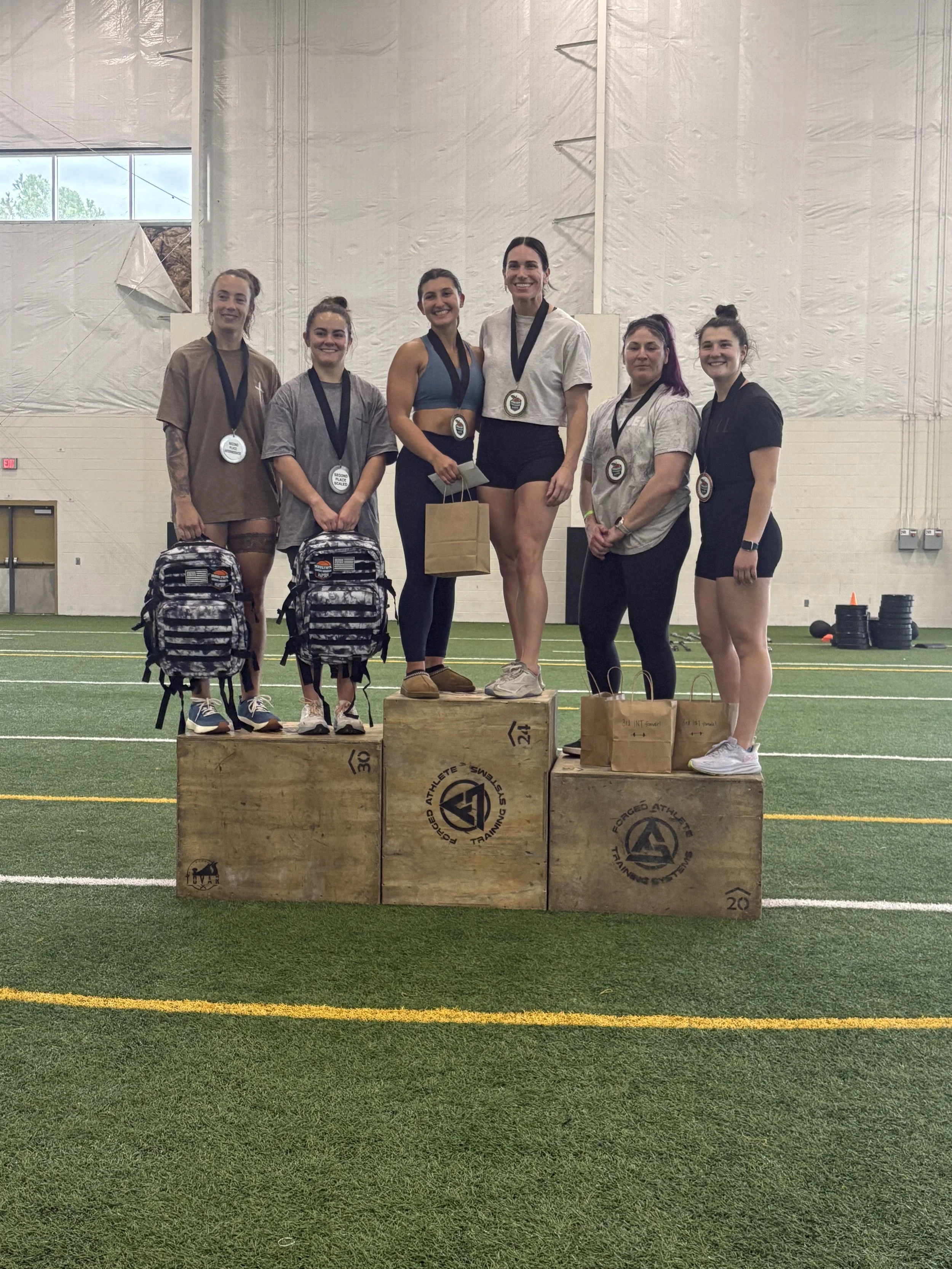
Jessica and Emily finished in 1st place at the Moultrie Classic in south georgia this past weekend.
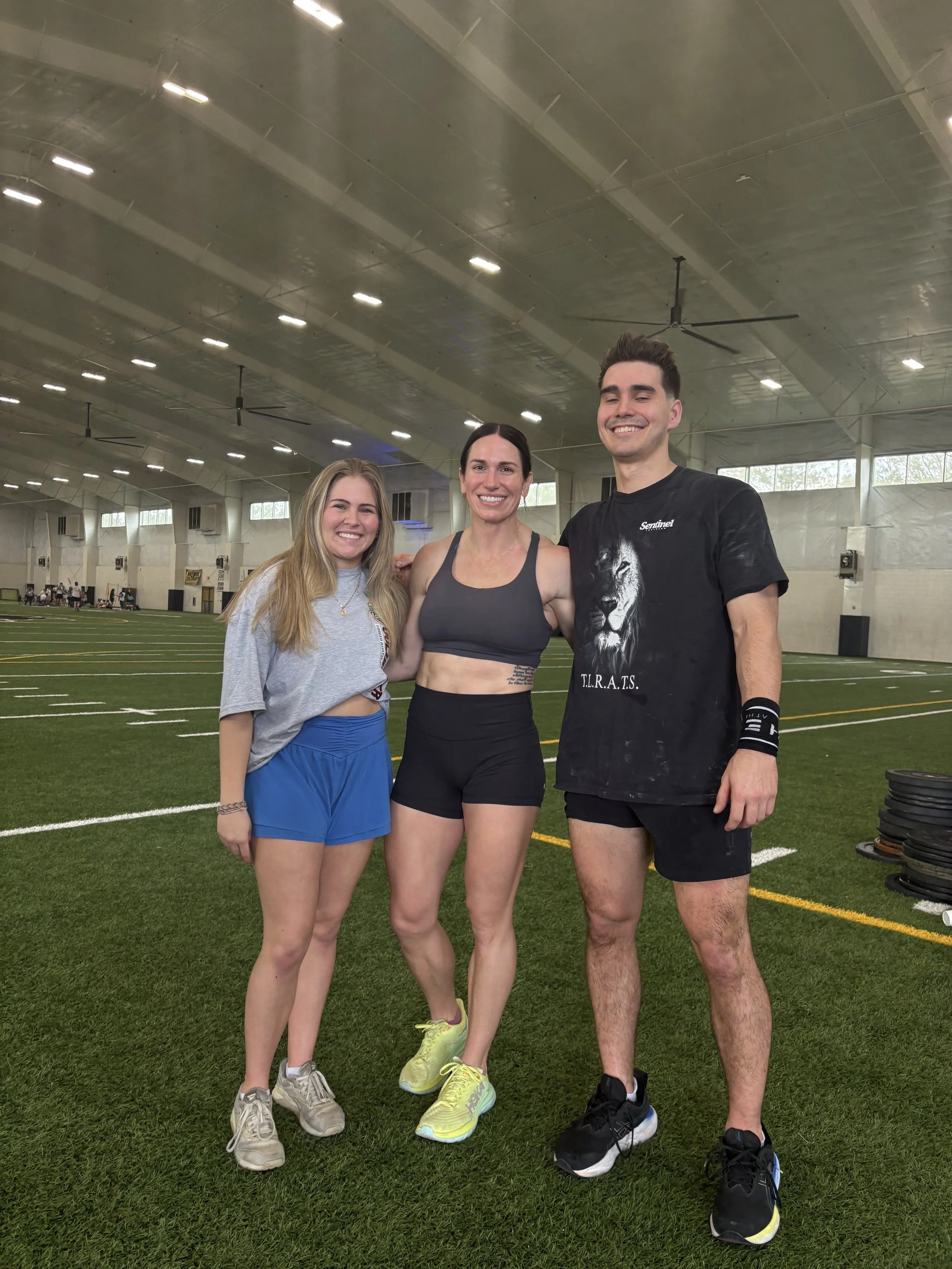
The Moultrie Classis was hosted by member Abigails gym in your hometown.
Grant Griffin filled in and his team finished 1st place as well.
Upcoming Brithdays
Anniversaries
1-year
Eric Ensley
Eric Robinson
Cole & Natalie Scott
Kamila Hernandez
Sabrina Melo
2-year
Randy Joering
Melanie Venable
BAM
Bryan Marichal
3-year
Ruben Rivera
Jeb Buffington
Autumn Ingham
4-year
Jennifer Valenti
6-year
Hunter (Jonathan) Palmer
Birthdays
Michael Guelfo Jan 11
Sergio Rivera Jan 24
Wilson Washington Jan 24
Ruber Rivera Jan 24
Amber Buettner Jan 29
Upcoming Schedule & Events
February 7th - In House Gymnastics Course with Coach Nicole Corey
10 am to 12 pm *following Morning Class
CROSSFIT OPEN - FEBRUARY 26 through MARCH 16
January 14th is the opening day for registration. Let’s represent this year!
HERE are more details.

Olivia Kates Path 5K in celebration of Olivia Pugh to benefit the Oliva Kate Pugh Strength and Shield Scholarship to Harrison High School Seniors
February 28, 2026 @ 8:30am
2025 Attendance Breakdown
17,654 Total Attendances
Class Breakdown
10.82 avg - 5:15pm
10.01 avg - 4pm
9.71 avg - 9am
9.34 avg - 12 pm
8.71 avg - 5:30am
7.14 avg - 6:30pm
4.95 avg - 6:30am
Members with More than 200+ Classes in the year 2025
Ryan Boone 223
Santez Kindred 220
Dylan Porter 219
Ruben Rivera 216
Julie Chambers 213
Casey Linch 212
BAM 209
Fernando Lawler 205
Christopher Kibbe 202
Matthew Kimm 202
Jeb Buffington 311
Mary Turner 288
Sheri Kindred 284
Matt Schuster 271
Kyle Rice 262
Brittany Karneol 248
Michael Jamorski 247
Natalie Gordon 245
Brian Lawler 243
Elysia Dunlap 241
Jen Wells 226
Melanie Venable 224
CrossFit Journal Article of the Week: “Active Shoulders: The Foundation of Safe and Strong Movement in CrossFit”
By Stephane Rochete, CFL3
If you’ve been doing CrossFit for a while, you’ve probably heard your coach say things like, “push up into the bar,” “shoulders active,” or “don’t let your shoulders dump forward.” But what does all of this actually mean, and why does it matter so much?
Active shoulders are one of the eight common movement themes taught in CrossFit’s Level 2 training, and for good reason. This concept applies to almost every upper-body movement you do. Understanding it can dramatically improve both your safety and performance.
If you’d rather listen to this conversation, you can do that here.
What Are Active Shoulders?
An active shoulder position means positioning your shoulder to maximize range of motion, strength, and joint stability. Essentially, you’re applying force with your shoulder opposite to the load, or resisting yielding to whatever force is acting on you.
Think about a barbell press: the barbell is pushing down on you with gravity, so you’re pushing up into the load while also externally rotating your shoulders. You’re not passively holding the weight; you’re actively engaged.
Why It Matters: Safety First
Your shoulder is often described as a ball-and-socket joint, but anatomically, it’s more like a golf ball sitting on a tee. There’s potential for a lot of movement, which is great for mobility, but when you’re supporting a load, you want to be locked in and stable.
When you externally rotate and push up with an active shoulder against a load overhead, you create that stable position. Without it, any downward pressure on your shoulder can cause it to slip and slide through the joint, and we don’t know how or where it might move. This instability isn’t just inefficient; it’s dangerous.
By maintaining an active shoulder position, you:
Reduce the risk of impingement
Keep your shoulder in its strongest, most stable position
Prevent the joint from moving unpredictably under load
Build confidence when supporting weight overhead
The Performance Advantage
Beyond safety, active shoulders put your muscles in the strongest, most efficient position. If your shoulder is at an angle when you’re supporting weight overhead, you’re losing power and wasting energy. A locked-in, active position allows for better force transfer and more efficient movement.
Active Shoulders Across Different Movements
Here’s where it gets interesting: active shoulders look different depending on the movement you’re doing. It’s not a one-size-fits-all cue.
Overhead Press
Push up into the bar while externally rotating your shoulders. Think about creating that stable, locked-in position at the top of the movement.
Ring Dips and Support Positions
Your shoulders push down and in toward the rings. You’ll also rotate your thumbs forward to optimize shoulder position. The direction changes, but the principle remains the same: you’re actively engaging against the load.
Olympic Lifts
Active shoulders play a role in two ways:
Overhead (like in the jerk): Same as the overhead press position
During the pull: Maintain good posture and don’t let the weight pull your shoulders forward. Keep your shoulder girdle engaged — think about all the muscles around your shoulder and upper back working together to maintain rigidity. This helps transfer force from the ground through your midline, through your shoulders, and into the bar.
Push-Ups and Planks
This is where many people (myself included) got it wrong for years. In the support position of a plank or at the top of a push-up, your shoulders should actually be pushing forward and down into the ground. Your shoulder blades protract (separate) at the top and retract (come together) as you descend.
Throughout the movement, generate torque by imagining you are screwing your hands into the ground. This builds external rotation and maintains active shoulders as you move through the full range of motion.
Hanging Movements
Pull your shoulders away from your ears slightly. Avoid the “shrug up” position and instead create that active engagement even when hanging.
Bench Press
While you’re moving through the range of motion, your shoulder position should remain relatively stable and locked in. The shoulder itself doesn’t move much; it’s locked into that strong position while your arms bend and straighten.
A Framework for Better Movement
Understanding active shoulders gives you a framework for analyzing any upper-body movement you encounter. Instead of just going through the motions, you can ask yourself:
Am I in the strongest, most stable position for this movement?
Am I applying force opposite to the load?
Is my shoulder locked in, or am I passively yielding to the weight?
For example, many people can do push-ups easily, but that doesn’t mean they’re doing them correctly. If you’re dumping into your shoulders and losing that stable position, you’re not only hampering your performance but also putting unnecessary stress on your tissues and potentially setting yourself up for injury.
Putting It Into Practice
The next time you’re in the gym:
Overhead movements: Push up into the bar, externally rotate, lock it in
Ring work: Push down into the rings, thumbs forward
Pulling movements: Keep your shoulders back, maintain good posture, don’t let the weight pull you forward
Push-ups/planks: Push forward and down, create torque, feel your shoulder blades moving properly
Hanging: Pull shoulders slightly away from ears, stay engaged
The Bottom Line
Active shoulders apply to virtually every upper-body movement in CrossFit. Whether you’re pressing, pulling, supporting your bodyweight, or hanging, understanding how to position your shoulders properly will make you safer, stronger, and more efficient.
The shoulder girdle — including your scapula, rotator cuff muscles, and all the musculature around your shoulder and upper back — works together to create these strong positions. When you train with active shoulders consistently, you’re building not just strength, but also the neuromuscular patterns that keep you safe under load.