Bound Newsletter 1.4.2026
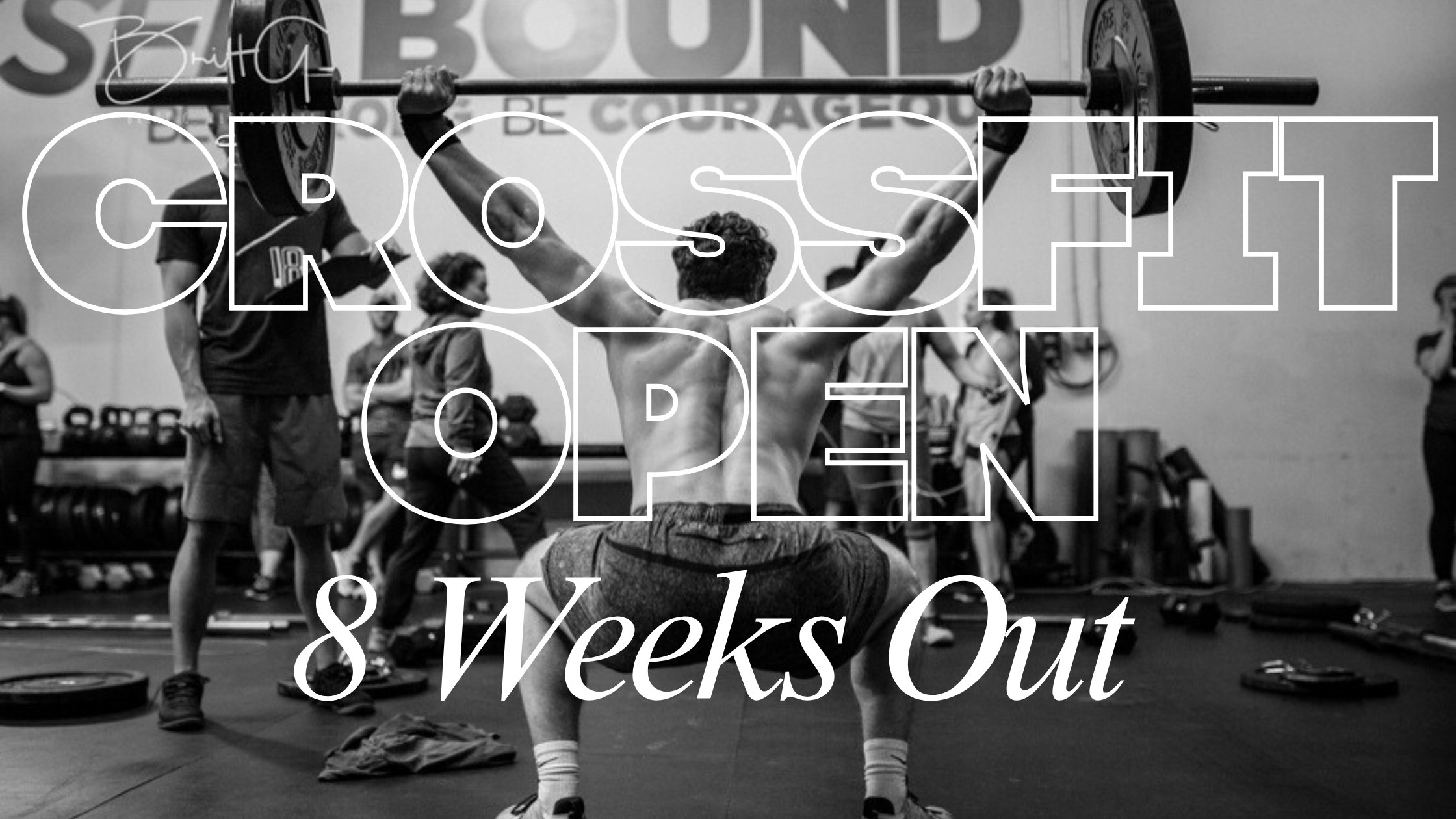
How an 8-Week Training Plan Helps You Peak for the CrossFit Open
The CrossFit Open doesn’t reward randomness.
It rewards preparation, consistency, and smart execution under fatigue.
That’s why our approach leading into the Open isn’t about maxing out every day or guessing what might show up. Instead, we’ve built a deliberate 8-week progression that develops strength, sharpens skills, builds an engine, and—most importantly—teaches you how to pace yourself when it counts.
Here’s how the pieces come together and why this matters for your success over the next 8 weeks.
1. Building Strength Without Burning Out
Strength matters in the Open—but only if you can express it repeatedly.
Our 8-week strength cycle is designed around:
Squats
Deadlifts
Upper-body pressing and pulling
Snatch
Clean & Jerk
Rather than maxing constantly, we use:
Moderate volume early to build consistency and confidence
Heavier, controlled loads in the middle weeks to raise your ceiling
Reduced volume in the final weeks so strength feels fast and accessible
This approach ensures you:
Get stronger without excessive soreness
Maintain good movement patterns
Feel confident with Open-style loads (not intimidated by them)
In the Open, strength rarely shows up as a one-rep max. It shows up as the ability to hit quality reps when your heart rate is high. That’s exactly what this cycle prepares you for.
2. Using Metcons to Practice Intensity—Not Just Suffer
Open workouts demand intensity, but intensity without control leads to poor pacing and blown workouts.
That’s why our metcons over the next 8 weeks follow a clear progression:
Early weeks: Longer, aerobic-focused pieces that teach patience
Middle weeks: Shorter, more aggressive workouts that mimic Open formats
Final weeks: Sharp, confidence-building efforts with reduced volume
Each conditioning piece is an opportunity to practice:
Smooth transitions
Repeatable barbell cycling
Smart break strategies
Staying composed under fatigue
Instead of guessing how hard to go on Open workout night, you’ll already know:
What “too fast” feels like
How long you can sustain certain paces
When to push and when to settle
The goal isn’t to win training workouts—it’s to learn how to perform.
3. Developing Skills That Hold Up Under Fatigue
The Open doesn’t test skills in isolation. It tests them when you’re tired.
That’s why skill work—especially Olympic lifting and gymnastics—is trained:
Frequently
At submaximal loads
With an emphasis on quality and efficiency
You’ll see snatches and clean & jerks worked in ways that reinforce:
Consistent setups
Smooth singles
Fast recovery between reps
This isn’t about hitting big lifts in training. It’s about making sure that when a workout calls for 30 snatches at a moderate load, you’re thinking:
“I’ve done this before—and I know how to pace it.”
4. Building an Engine That Supports Everything Else
Strength and skill don’t matter if your engine can’t support them.
That’s where the endurance track comes in.
Over the 8 weeks, endurance training:
Builds a deep aerobic base
Improves breathing and heart-rate control
Develops efficiency on the rower, SkiErg, Echo bike, and running
You’ll notice:
Faster recovery between barbell sets
Better composure during longer workouts
More consistent pacing across multiple rounds
This matters because most Open workouts reward athletes who can recover while moving, not those who rely on redlining early.
5. Discovering Your Personal Pacing Strategy
Perhaps the most important benefit of this 8-week structure is that it helps you learn how you perform best.
During this cycle, you’ll discover:
Whether you thrive on steady pacing or controlled surges
How long you can hold certain effort levels
Which movements spike your heart rate the fastest
How much rest you actually need between reps
By the time the Open starts, pacing is no longer a mystery.
You’ll walk into each workout with a plan—and the confidence to execute it.
6. Peaking at the Right Time
The final weeks of the cycle intentionally reduce volume while maintaining intensity. This allows fatigue to drop while fitness stays high.
You should feel:
Lighter on your feet
Faster under the bar
More confident attacking workouts
Excited to compete instead of exhausted
That’s what peaking is supposed to feel like.
The Big Picture
This 8-week approach works because it respects how fitness is actually expressed in the CrossFit Open.
It builds:
Strength you can use
Skills you can trust
An engine that doesn’t quit
Pacing strategies that win workouts
Whether this is your first Open or your tenth, the goal is the same:
Show up prepared, confident, and ready to perform.
Train with intention.
Trust the process.
And let the work you’ve done over the last 8 weeks show up when it matters most. skills, and develop confidence that carries far beyond the Open.
Check Out our Weekly Training Highlight Reel Below
Bragging Board
Sergio Rivera accomplished his 1st Bar Muscle Up
Calie Hadley accomplished her 1st Bar Muscle Up
Sheri Kindred accomplished her 1st Legless Rope Climb

Amber Buettner and Jen Wells set out to run 365 miles in 2025 and they did!
Hard to put into words of how proud I am of these women and to see how far they have come in their lives. Looking forward to hearing what there 2026 goals are!
Welcome New Members

Kelsey Merlo
What brought you to CrossFit Bound? (ex: fitness goals, friends, community, challenge, etc.)
I’m looking for a community/program that makes showing up to the gym fun again!
What’s your favorite movement or workout so far?
Anything cardio.
What’s one thing people might not know about you outside the gym?
My husband and I spend ~3 months each year living out of our camper and traveling the country.
What do you hope to achieve in your first year with us?
Pop out a baby and keep showing up!
If you had to describe yourself in one word, what would it be?
Optimistic.
Upcoming Brithdays
Anniversaries
1-year
Eric Ensley
Eric Robinson
Cole & Natalie Scott
Kamila Hernandez
Sabrina Melo
2-year
Randy Joering
Melanie Venable
BAM
Bryan Marichal
3-year
Ruben Rivera
Jeb Buffington
Autumn Ingham
4-year
Jennifer Valenti
6-year
Hunter (Jonathan) Palmer
Birthdays
FeFe Lawler Jan 5
Alex Willis Jan 8
Sarah Gwen Jan 9
Jennifer Valenti Jan 10
Michael Guelfo Jan 11
Sergio Rivera Jan 24
Wilson Washington Jan 24
Ruber Rivera Jan 24
Amber Buettner Jan 29
Upcoming Schedule & Events
January 10th - Onward “Shoulder Mobility Clinic” with Kristin Humphries
10 am to 12 pm *following the morning class
February 7th - In House Gymnastics Course with Coach Nicole Corey
10 am to 12 pm *following Morning Class
CROSSFIT OPEN - FEBRUARY 26 through MARCH 16
January 14th is the opening day for registration. Let’s represent this year!
HERE are more details.

Olivia Kates Path 5K in celebration of Olivia Pugh to benefit the Oliva Kate Pugh Strength and Shield Scholarship to Harrison High School Seniors
February 28, 2026 @ 8:30am
December 2025 Attendance Breakdown
1,346 Total Attendances
Class Breakdown
12pm - 11.6 avg
5:30am - 11.4 avg
4pm - 9.84 avg
9am - 9.12 avg
5:15pm - 8.63 avg
6:30pm - 4.31 avg
6:30am - 4.1 avg
Committed Club
BAM 18
Austin Willis 18
Dylan Dejesus 17
Dylan Porter 17
Jim Blackhall 17
Michael Rivera 17
Christopher Kibbe 17
Brian Lawler 17
Laura Rutland 16
Michael Jamorksi 16
Ryan Boone 16
Santez Kindred 16
Hannah Spratlen 16
Kyle Rice 25
Sheri Kindred 25
Mary Turner 24
Jeb Buffington 24
Julie Chambers 21
Matt Schuster 21
Matthew Kimm 21
Melanie Venable 20
Natalie Gordon 20
Brittany Karneol 20
Casey LInch 20
Elysia Dunlap 20
Elaine Dunbar 20
Nicolas White 20
CrossFot Journal Article of the Week: Creatine: Everything You Need To Know (And Why Your Diet Matters More)
By Stephane Rochete, CFL3
Creatine is having a moment. Again.
For those of us who remember its initial release to the supplement world 30 years ago, this feels familiar. Creatine exploded onto the scene, became a staple, then got overshadowed by flashier supplements making bigger promises. But it never really went away; it just quietly kept working while everyone else chased the next big thing.
Now it’s back in the spotlight, being touted as the wonder supplement we always thought it was. And this time, the science is backing up what early adopters suspected all along.
If you’d rather watch/listen to this conversation, you can do that here.
The Benefits Everyone’s Talking About
By now, most people know the basic benefits of creatine:
Physical performance gains. Increased muscle mass and strength. Better performance in activities that rely on the phosphocreatine pathway — that short-duration, high-power energy system you’re using during heavy lifts and sprint efforts.
Cognitive benefits. This is where the new research is getting really interesting. There’s mounting evidence that creatine may offer significant cognitive benefits, potentially helping with brain function and possibly even protecting against neurological decline.
We’re seeing discussions about brain degeneration — Parkinson’s, Alzheimer’s, dementia — being linked to what some call Type 3 diabetes. The theory is that a poor diet leads to insulin management problems and blood glucose issues over a lifetime that can manifest as brain deterioration. These conditions seem to be growing more prevalent, tracking alongside the obesity epidemic.
If creatine can help improve neurological performance or mitigate some of these issues, that’s worth paying attention to.
The Safety Question
There was a period when people questioned the safety of creatine. Those concerns have been pretty thoroughly debunked at this point.
That said, individual variation exists. If you take creatine and don’t feel good on it, it doesn’t work for you, or you experience adverse effects, don’t take it. People talk about cramping with creatine, though studies haven’t confirmed this. But if you’re that person who cramps on it, or you just feel off, adjust your approach or skip it entirely.
Don’t override what your body is telling you just because science says it should work. There’s always individual variation.
But Here’s the Thing You Need to Hear First
Before we get into dosage, timing, types, and all the minutiae people obsess over, let’s be absolutely clear about something:
How much creatine you’re taking, what kind, and all those other questions absolutely do not matter if you are not eating a diet consisting of whole, unprocessed foods in appropriate amounts.
Let’s be honest about where most people are. They’re spending hours researching supplements, scrutinizing labels at the nutrition store, agonizing over whether to take 3 or 5 grams of creatine, and then rushing to Taco Bell before their workout because they ran out of time.
If your diet isn’t dialed in, the supplement conversation is premature. Period.
You need to weigh and measure your food. Not forever, not as some obsessive ritual, but at least once to understand what appropriate portions actually look like. Most people have no idea.
Get your diet in order first. Then, and only then, does the supplement conversation have any value.
The Practical Guide (For When Your Diet Is Actually in Order)
Assuming you have your nutrition in order, here’s what you need to know about taking creatine. Spoiler: it’s simpler than you think.
What Type: Creatine Monohydrate
Skip the fancy versions with added beet juice, proprietary blends, or any other marketing gimmick that’s trendy. Creatine monohydrate is the most well-researched and respected form. That’s what you want.
Plain, basic, boring creatine monohydrate. No bells and whistles needed.
How Much: 5 Grams Daily
The old “loading phase” protocol — 20 grams per day for a week, then 5 grams maintenance — has been debunked. Just start with a consistent lower dose.
Five grams per day is a solid starting point. If you want to experiment with slightly higher amounts, go for it, but don’t overthink it.
Some people experience bloating or digestive issues with high doses introduced too quickly. Start reasonable, stay hydrated, and adjust if needed.
When: Whenever
Timing doesn’t matter. Before a workout, after a workout, morning, evening, it makes no difference. The key is consistency, not timing.
With What: Just Water
Remember the old advice about taking creatine with grape juice or dextrose? Forget it. You don’t need sugar with your creatine. Plain water works fine.
Additives: None Needed
If you want to combine creatine with other supplements in a specific protocol, that’s fine. However, realistically, if your diet is on point, a basic creatine monohydrate supplement does the job.
What Every Supplement Label Should Say
Here’s what the directions on every supplement bottle should read:
Step 1: Get your diet in order.
Step 2: Take one scoop per day.
That’s it. That’s all you need to know about creatine.
It’s very simple. And yes, it can be beneficial, so it might be worth trying. However, we’re not huge fans of supplements in general because most people put the cart before the horse.
The Bottom Line
Creatine works. The research supports its benefits for physical performance and increasingly for cognitive function. It’s safe for most people, and it’s simple to use.
But, and this is the critical point, it’s a supplement, not a substitute.
If you’re not eating well, sleeping well, training consistently, or managing stress, creatine isn’t going to fix those problems. It can’t overcome a poor foundation.
Get your diet dialed in. Whole foods. Appropriate portions. Consistency. That’s where the real gains come from.
Then, if you want to add creatine to the mix? Great. Five grams of creatine monohydrate per day, taken whenever, with water. Done.
Don’t overthink it. Don’t get caught up in the supplement research rabbit hole while ignoring the basics. And definitely don’t spend hours optimizing your supplement stack while grabbing fast food on the way to training.
The hierarchy matters: nutrition first, training second, recovery third, supplements fourth.
Creatine has earned its spot as a worthwhile supplement. Just make sure you’ve earned the right to benefit from it by handling everything else first.