Bound Newsletter 7.5.2026
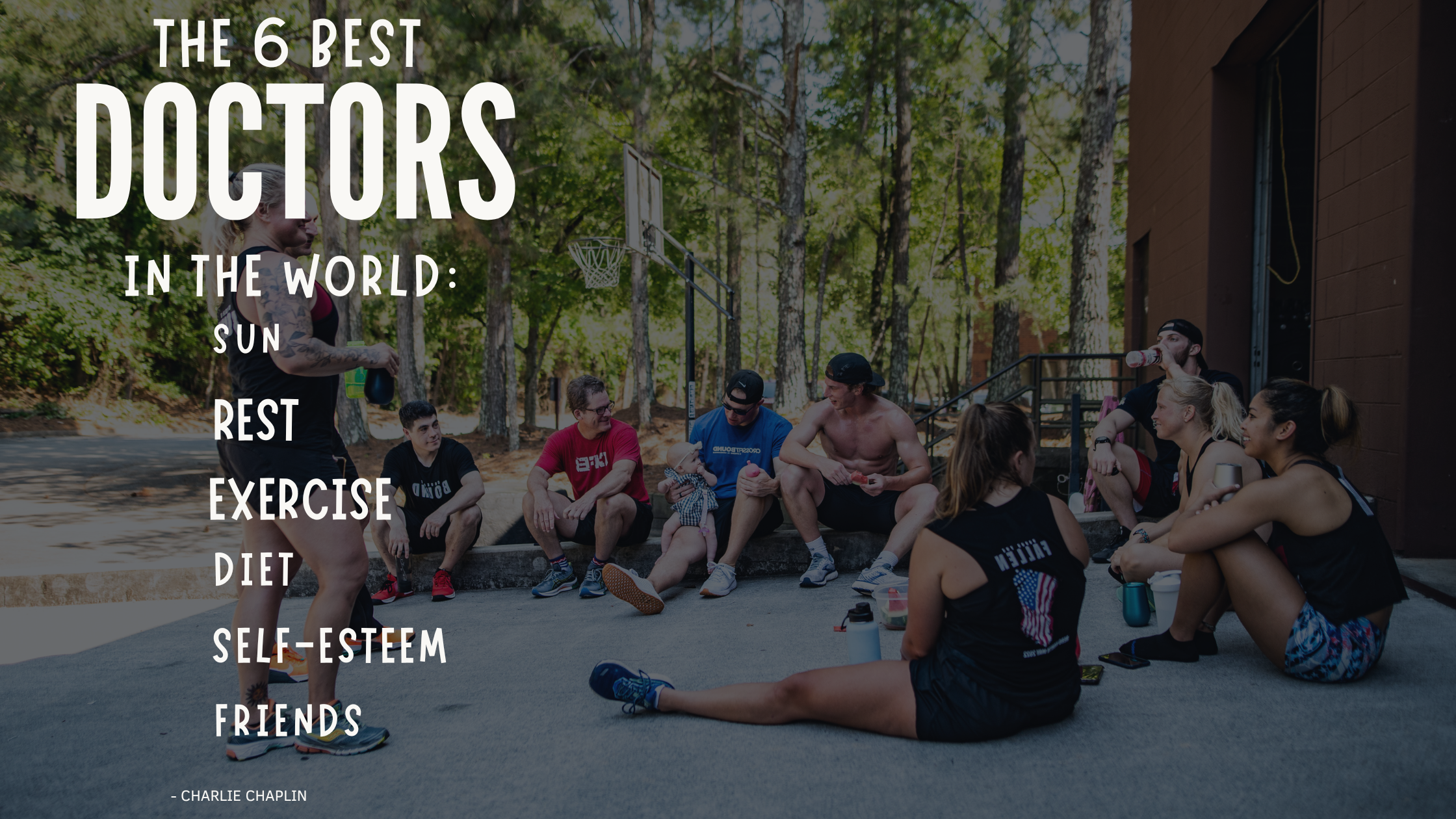
The Six Best Doctors in the World
In a world that often looks for the next supplement, medication, or shortcut, Charlie Chaplin shared a timeless reminder:
"The 6 best doctors in the world: Sun, Rest, Exercise, Diet, Self-Esteem, and Friends."
— Charlie Chaplin
Simple. Powerful. And remarkably aligned with what we strive to build every day inside our gym.
At CrossFit Bound, we don't believe fitness is just about lifting heavier weights or finishing workouts faster. Those are exciting milestones, but they're simply byproducts of something much bigger—a lifestyle built around habits that improve every area of your life.
Sun
Get outside.
Morning sunlight helps regulate your body's natural clock, improves mood, supports vitamin D production, and sets the foundation for better sleep and energy. Whether it's taking a walk before work, spending time with your family, or simply enjoying the outdoors after class, nature has a way of resetting our perspective.
Rest
Progress doesn't happen during the workout—it happens after it.
Recovery is where muscles rebuild, hormones rebalance, and your body prepares for the next challenge. Sleep isn't a luxury; it's one of the most effective performance enhancers available.
Training hard without recovering well is like trying to drive farther with an empty gas tank.
Exercise
Movement is medicine.
The CrossFit methodology is built around constantly varied, functional movements performed at an appropriate intensity. We squat, lift, carry, run, jump, push, pull, and climb because these are the movements that prepare us for life—not just the gym.
Exercise builds stronger bodies, but it also develops resilience, discipline, confidence, and mental toughness. Every workout is an opportunity to become a little more capable than yesterday.
Diet
You can't out-train poor nutrition.
Food is fuel.
Every meal is either helping your body recover, perform, and thrive—or making those goals harder to achieve. We encourage simple, sustainable nutrition built around lean proteins, vegetables, fruits, healthy carbohydrates, and quality fats.
Perfection isn't required.
Consistency is.
Self-Esteem
Confidence isn't something you're born with.
It's something you earn.
Every time you show up when you don't feel like it...
Every workout you finish...
Every healthy choice you make...
Every promise you keep to yourself...
You build trust in who you are.
That's real confidence.
One of the greatest transformations we witness isn't physical—it's watching someone walk a little taller, smile a little bigger, and begin believing they're capable of far more than they once imagined.
Friends
This may be the most powerful doctor of them all.
Community changes everything.
People stay consistent because someone notices when they're gone.
People push harder because someone is cheering beside them.
People overcome difficult seasons because they're surrounded by others who genuinely care.
CrossFit has never simply been about fitness.
It's about belonging.
Inside these walls, we celebrate victories together, support each other through setbacks, encourage one another through life's challenges, and become stronger—not just as athletes—but as people.
The workout may last an hour.
The friendships often last a lifetime.
Charlie Chaplin's six doctors aren't revolutionary because they're new.
They're revolutionary because they're timeless.
At CrossFit Bound, we simply give them a place to come together.
Move your body.
Fuel it well.
Recover intentionally.
Spend time outside.
Build confidence through discipline.
Surround yourself with people who make you better.
Those habits won't just improve your fitness.
They'll improve your life.
As Chaplin also beautifully wrote:
"If you look at the moon, you'll see the beauty of God. If you look at the sun, you'll see the power of God. If you look in the mirror, you'll see God's greatest creation. So believe."
— Charlie Chaplin
Believe in the work you're doing.
Believe in the person you're becoming.
And never forget that every healthy choice you make is an investment in the incredible person God created you to be.
Bragging Board
Hope Haugh with a 215lb Front Squat! 225 coming up!
Dylan Porter 305lb Split Jerk - too easy had more.
Matt Schuster 256lb split jerk
Kyle Rice 255lb split jerk
Austin Willis 225lb split jerk
Casey linch 205lb split jerk
Santez Kindred 195lb split jerk & 225lb Deadlift!
Amber Payton 155lb Split Jerk !!!
Natalie Gordon 145lb Split Jerk & 235lb Deadlift PR
Hannah Spratlen 140lb Split Jerk
Sarah PB 140lb Split Jerk (I didn’t say anything :)
Sheri Kindred 115lb Split Jerk
BAM 115lb Split Jerk
Welcome New Members
Carly Mitchell
Wildnei Queiroz
Justin Comer
Upcoming Birthdays & Anniversaries
Anniversaries
1- Yr
Jeff Mcdonald July 7
Susan Abell July 31
2- Yr
Kyle Sulkowski July 9
4- Yr
Casey Lynch July 25
Birthdays
Kyle Sulkowski July 6
Jamie Spratlen July 7
Sydney Hightower July 9
Brandon Brooks July 12
Steven Shaw July 12
Jason Callis July 15
Tyler Cory July 17
Abigail Gerleman July 17
James Studdards July 22
Natalie Schuster July 27
Rob Morgan July 30
From the CFB Member Vault - The CrossFit Bound Travel Discipline Guide
STEP 7: Movement While Traveling
Minimum movement standard:
30 minutes per day
OR
10,000 steps
OR
Hotel gym lift
No gym?
Bodyweight circuit:
3–5 rounds:
20 air squats
15 push-ups
10 lunges each leg
30-second plank
10 burpees
Movement maintains:
Insulin sensitivity
Energy levels
Routine
It also prevents the mental spiral.
STEP 8: Alcohol Guidelines
Alcohol impacts:
Sleep quality
Testosterone
Recovery
Fat loss
Travel rule:
Maximum:
1–2 drinks per night
Not every night
Dry wine or clear liquor + soda
Avoid:
Sugary cocktails
Late night drinking
Drinking without eating protein
If you drink:
Hydrate aggressively.
STEP 9: Hydration Rule
Travel increases dehydration due to:
Air travel
Sodium-heavy meals
Alcohol
Disrupted sleep
Minimum:
Half your bodyweight in ounces daily.
Add electrolytes if flying.
Hydration protects performance.
STEP 10: Sleep Protection
Travel sleep disruption:
Increases cortisol
Impairs recovery
Increases hunger hormones (ghrelin)
Protect sleep:
Dark room
Cool temperature
Limit alcohol
No phone 30 minutes before bed
Sleep protects discipline.
STEP 11: The 3-Day Reset Rule
If travel causes deviation:
Return immediately.
Do not wait until Monday.
Reset plan:
Day 1 home:
High protein
Lower carb
Lift heavy
Hydrate
Sleep 8 hours
That single day resets momentum.
Stay strong. Stay lean. Stay consistent.
Travel does not ruin progress.
Lack of structure does.
You don’t need perfection while traveling.
You need standards.
At CrossFit Bound, we follow 5 travel rules:
Protein never drops
Movement never stops
Hydration increases
Sleep is protected
Alcohol is controlled
If you maintain those five — you stay aligned.
STEP 1: Set the Standard Before You Leave
Before the trip:
Pack protein (bars, whey packets, jerky)
Book a hotel with a gym if possible
Look at restaurant options in advance
Decide your alcohol limit
Preparation prevents impulse decisions.
STEP 2: The Travel Nutrition Framework
Every meal while traveling follows:
🥩 Protein first (30–50g minimum)
🥦 Vegetables second
🍚 Carbs strategically (based on activity)
🥑 Fats controlled
🚫 No liquid sugar
If you follow this framework, you can eat almost anywhere.
STEP 3: Airport Strategy
Airports are calorie traps.
Avoid:
Cinnamon rolls
Smoothies with hidden sugar
Fast food combos
Pastries
Look for:
Grilled chicken salads
Hard boiled eggs
Greek yogurt
Protein snack packs
Beef jerky (low sugar)
Burrito bowls
Sushi
Pro tip:
Eat a high-protein meal before leaving for the airport.
Hunger destroys discipline.
STEP 4: Hotel Breakfast Survival
Skip:
Waffles
Muffins
Sugary cereal
Fruit juice
Build:
Eggs
Extra egg whites (if available)
Sausage or lean protein
Fruit
Black coffee
Protein anchors the day.
STEP 5: Business Dinners
You do not need to explain your choices.
Quietly:
Skip bread basket
Order steak, chicken, or fish
Ask for vegetables
Get sauce on the side
Control portion size
Discipline is silent.
STEP 6: Vacation Strategy (Relaxed but Structured)
Vacations are not prep phases.
But they are not free-for-alls.
Use the “One Upgrade Rule”:
If dinner is indulgent → breakfast and lunch are strict.
If dessert is planned → carbs earlier are reduced.
If alcohol is included → protein stays high and hydration doubles.
Structure creates freedom.
*If you are member and need access email info@crossfitbound.com to get the password*
Education: CrossFit Journal Article “CrThe Sickness-Wellness-Fitness Continuum: Building Your Hedge Against Decrepitude”
By Stephane Rochet, CF-L4
Your fitness today is insurance for tomorrow. Build a 20-year buffer so that one fall or one accident doesn't end your story.
You can be fit and unhealthy at the same time.
That’s not a contradiction. That’s just the reality of how the human body works, and it’s something most people miss when they think about training.
There’s a model that’s been part of CrossFit since the beginning that explains this. It’s called the sickness-wellness-fitness continuum, and understanding it might change how you think about your training — not for what it does for you today, but for what it does for you twenty years from now.
If you’d prefer to watch or listen to this conversation, you can do that here.
The Model: Three Zones
Imagine a line. On the left side is sickness. In the middle is wellness. On the right side is fitness.
Sickness is obvious. Chronic disease, medication, the low end of health. The medical model that treats disease once it shows up.
Wellness is the average. It’s the 95% of people who go to the doctor and hear “you’re doing pretty good.” You walk. You’re somewhat active. You eat some protein and some vegetables. You’re not on the standard American diet completely, but you’re not optimizing either. You’re fine. Just fine.
Fitness is super wellness. It’s the end of the spectrum where all your health markers are moving in the right direction. Blood work, body composition, cardiovascular capacity, strength, mobility. You’re not just fine; you’re thriving.
Here’s the key distinction: Fitness is a snapshot of where you are right now. Health is your fitness over the course of your entire lifetime.
The Surprising Connection: Performance Affects Health
For a long time, people thought fitness and health were separate things. You could be good at one without the other.
You lift heavy. Great. That’s fitness. But your blood pressure is high, and your cholesterol is bad. That’s separate from your “fitness.”
CrossFit changed that thinking.
Here’s what we discovered: Your performance markers and your health markers are connected. They’re not separate systems.
When you get better at your deadlift, when you improve your pull-ups, when you get faster at your 5K run, those things don’t happen in isolation. If you’re training intelligently, everything else follows along. Your blood work improves. Your body composition shifts. Your cardiovascular system gets better.
The reverse is also true: if you’re training but your health markers are trending in the wrong direction, something is wrong with your program. And it needs to be fixed.
What About the Fittest on Earth?
Someone asked on a live stream recently: “Where would you put Jayson Hopper on the sickness-wellness-fitness continuum?”
The question implies something: Hopper is incredibly fit. But maybe, with all that training volume, his health markers are slipping backward. So, where does that put him on the continuum?
The honest answer? We don’t know. We’d need to see his blood work, his body composition, and his actual health markers to tell where he is on this continuum.
Because remember: The continuum is primarily about health markers, not performance markers.
You can have an elite-level deadlift and bad cholesterol. You can have incredible work capacity and be constantly inflamed. You can be a Games athlete and have health markers that look terrible in the middle of a competition season.
And here’s the thing — in the short term, that might be acceptable. If you’re an elite competitor, there’s a time-bound sacrifice. You’re pushing hard for eight weeks to compete. Your health markers take a temporary hit. Then you back off and they recover.
But if you take that training volume and training style and turn it into your everyday fitness program for 10 or 15 years? The wheels fall off.
You can’t sustain that kind of compromise long term. Eventually, the degradation in health markers catches up, even if your performance keeps improving in the short term.
Why This Matters (More Than You Think)
Now let’s talk about why this actually matters for you, right now, in your life.
Fitness is a hedge against sickness.
That’s the most important part of this model. And it might be the most overlooked.
The idea is simple: If you build your health markers in the direction of fitness, toward super wellness, you’re creating a buffer and a hedge against the inevitable decline that comes with aging.
Let’s make this concrete.
You’re 45, and you’ve been training consistently, eating well, sleeping properly. Your health markers are solid. You’re fit.
Then at 75, you get injured. Maybe a fall, a car accident, or you just get sick.
If you spent the last 30 years maintaining that fitness hedge, you have something to work with. You recover faster, you heal better, and you bounce back. The incident that might have been catastrophic becomes something you overcome.
But if you spent the last 30 years living in the wellness zone, or worse, creeping toward sickness, that same incident might be the end. One fall, or one hospital stay for something “relatively minor,” and suddenly you’re in hospice.
When you build a 10- or 20-year buffer, you create space between fitness and sickness that takes decades to cross.
That’s the longevity piece, and that’s why this matters.
You Have More Control Than You Think
People talk about genetics. “My genetics will limit where I can be on this continuum.”
Maybe that’s true, but here’s the thing: it doesn’t matter.
Think of two boats crossing the ocean. One can go 35 knots max. One can go 20 knots max. But both only need to go 16 knots to reach their destination.
They both arrive at the same time.
That extra genetic potential? If you never call it into play, it doesn’t matter.
Most people aren’t making the consistent choices needed to reach their actual genetic potential. Not even close. They’re making choices that move them in the wrong direction.
So, regardless of genetics, you have control. You can make consistent choices to move yourself toward fitness, toward super wellness. Or you can make (often unknowingly) consistent choices that move you toward sickness.
Genetics might determine your ceiling, but most of us are nowhere near our ceiling. The gap between where you are and where you could be is huge. And that gap is controlled by consistent daily choices.
Build as big a hedge as you can. You don’t need to be a genetic elite or a Games athlete. You just need to build a substantial buffer between yourself and decrepitude.
This Is Actually What Fitness Means
Here’s something that gets lost: When we say fitness, we’re not talking about your deadlift or your 5K time.
We’re talking about being a capable human being.
Go back 1,000 years. If you were dropped into the world without modern conveniences, what would you need to do?
You’d need to lift heavy things, build a shelter, hunt and drag home food, walk and run and sprint, jump, climb, chase things, flee from things, and move in varied ways to handle all the different challenges life throws at you.
That’s fitness, and it’s what a human should be capable of.
Today, we call that “elite” because the average has dropped so far. But we’re not trying to create elite athletes. We’re trying to recreate what a human being should actually be capable of.
And when you look at people who die from car accidents or skiing accidents, they often aren’t dying from the accident itself. They’re dying because they don’t have the capacity to survive it.
The accident is the last trigger. The real killer is the decrepitude and the accumulated decline from years of not building capacity or maintaining fitness.
The Four Pillars (You Need All Four)
Here’s the thing: You can’t just train your way to fitness.
There are four nonnegotiables in the CrossFit methodology:
Variance – Moving in different ways, different ranges of motion, different intensities.
Functional movements – Movements that mimic real-world demands.
Intensity – Actually working hard, not just going through the motions.
Nutrition – Eating quality food to support your training and health.
The first three build your work capacity, enhance your muscles, and strengthen your tendons and ligaments. They’re important.
But they have to be supported by nutrition. You can’t out-train a bad diet. You can’t build health markers in the right direction if you’re eating garbage.
It’s not 90% kitchen and 10% gym. It’s not 80-20. It’s both. Both are required. Both are nonnegotiable.
And you have to do both consistently and persistently for the rest of your life.
What You’re Actually Training For
When someone asks you why you’re doing this work — why you’re squatting heavy, grinding through conditioning, tracking your food — here’s the real answer: You’re building a buffer for the future.
You’re creating the capacity to recover from injury, to survive accidents, to build a hedge against the sickness and decrepitude that come with aging and inactivity.
You might not feel like you need this hedge yet because maybe you’re young and healthy and fine, but you’re making deposits into an account you’ll desperately need when you’re 70 or 80 or 90. And the deposits you make now are worth way more than the ones you’ll try to make later.
The person who trained consistently from 35 to 75 has an unbelievable capacity at 75. The person who starts training at 70 is playing catch-up in a losing game.
The Continuum as a Tool
Use this model as a mental framework for your training.
You’re not training for your next PR. You’re not training for next month’s competition. You’re training to move yourself as far as possible along this continuum — from sickness toward wellness, from wellness toward fitness.
Every workout is a choice to move toward fitness or toward sickness. Every meal is a choice. Every recovery day is a choice.
You don’t need to be perfect. You don’t need to be elite. You just need to be consistent in the direction of fitness.
Build as big a buffer as you can. Because one day, when something bad happens, and something bad will eventually happen, you’ll be grateful for every deposit you’ve made.
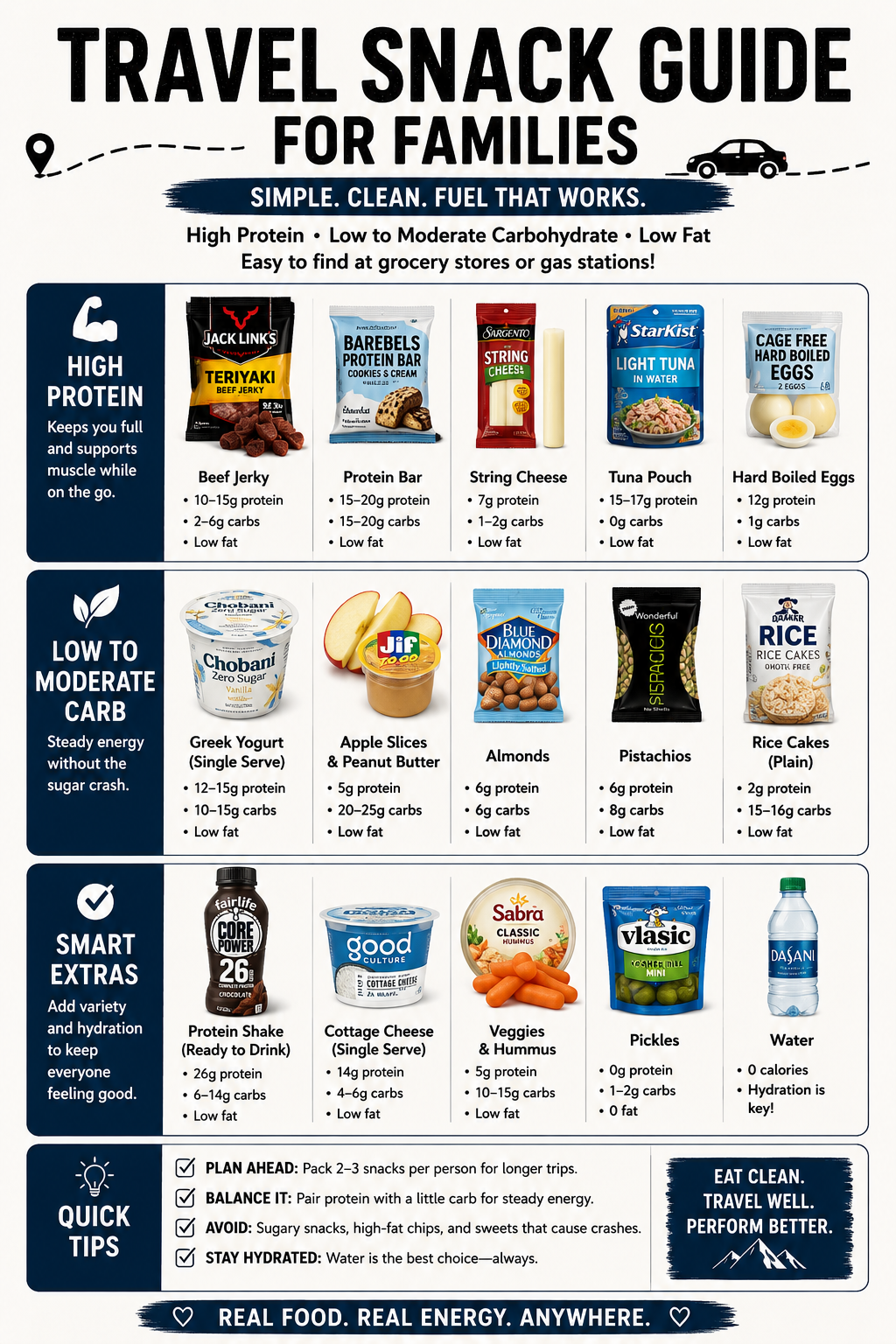
Travel Snack Guide for Families
Fuel the Adventure Without the Sugar Crash
Whether you're headed to the beach, the ball field, or on a cross-country road trip, travel days don't have to mean living on chips, candy, and fast food. A little planning can keep everyone energized, satisfied, and feeling their best.
Easy Snack Combinations
Option 1
Fairlife Protein Shake
Banana
≈ 30g protein
Option 2
Beef Jerky
Apple
≈ 18g protein
Option 3
Greek Yogurt
Berries
≈ 18–20g protein
Option 4
Cottage Cheese Cup
Rice Cakes
≈ 16g protein
Option 5
Tuna Packet
Whole Grain Crackers
≈ 20g protein
Option 6
Hard-Boiled Eggs
Grapes
≈ 12–14g protein
Tips for Traveling with Kids
Kids don't need a completely different snack strategy—they just need smaller portions and fun options.
Try packing:
Fruit
Cheese sticks
Turkey or beef sticks
Yogurt tubes
Rice cakes
Pretzels
Applesauce pouches
Popcorn
Protein milk (Fairlife Nutrition Plan or similar)
Avoid using sugary snacks as entertainment. Instead, offer small snacks every 2–3 hours and encourage drinking water throughout the trip.
Before You Hit the Road
Pack a small cooler with:
Protein drinks
Greek yogurt
Cottage cheese cups
Cheese sticks
Hard-boiled eggs
Fresh fruit
Vegetables
Ice packs
It takes just a few minutes to prepare and can save money while helping everyone feel better when you arrive.
Remember
Travel doesn't have to derail healthy habits. Every meal or snack is simply another opportunity to fuel your body well. Focus on eating enough protein, choosing whole foods when possible, and staying hydrated. Consistency—not perfection—is what keeps you feeling your best on the road.
Real Food. Real Energy. Anywhere.
The goal is simple:
✅ Prioritize protein to stay full longer
✅ Choose low to moderate carbohydrates for steady energy
✅ Keep fat moderate to avoid feeling sluggish on long drives
✅ Stay hydrated throughout the trip
Protein-First Snacks
These are easy to find at most grocery stores and many gas stations.
Beef or turkey jerky
Tuna or salmon packets
Hard-boiled eggs
Low-fat string cheese
Cottage cheese cups
Nonfat Greek yogurt
Ready-to-drink protein shakes (Fairlife Core Power, Premier Protein, Quest)
Roasted edamame
Protein bars (look for 15–20g protein and less than 10g added sugar)
Healthy Carbohydrates
Pair your protein with a small serving of carbohydrates for sustained energy.
Great options include:
Apples
Bananas
Grapes
Berries
Baby carrots
Snap peas
Plain rice cakes
Whole grain crackers
Pretzels
Individual oatmeal cups (great for hotel stays)
Smart Add-Ons
These foods add variety while keeping nutrition on track.
Pickles
Hummus snack packs
Cucumbers
Bell peppers
Mini oranges
Unsweetened applesauce pouches
Popcorn (lightly salted)
Sparkling water
Electrolyte packets (low sugar)
Gas Station Wins
Most major gas stations now carry healthier options if you know what to look for.
Grab:
✔ Fairlife Protein Shake
✔ Quest Protein Bar
✔ Beef Jerky
✔ Hard-Boiled Eggs
✔ String Cheese
✔ Greek Yogurt
✔ Pickles
✔ Fresh Fruit
✔ Bottled Water
Skip:
❌ Candy
❌ Sugary pastries
❌ Energy drinks loaded with sugar
❌ Large bags of chips
❌ Fried convenience foods
Weekly Training Breakdown