Bound Newsletter 8.2.2026
Summer Surge Results: 68 New Personal Records. Proof That Consistency Pays Off.
For the last nine weeks, our members showed up with one goal in mind: get stronger.
The Summer Surge training cycle wasn't built around chasing random workouts or testing fitness every day. It was designed with purpose—progressive strength work, quality accessory training, skill development, and consistent effort.
The result?
68 New Personal Records.
That's not luck.
That's hundreds of early mornings, late evenings, disciplined nutrition, showing up when motivation wasn't there, and trusting the process.
Summer Surge By the Numbers
Front Squat
· 24 New Personal Records
· Average PR:234 lb
Push Press
· 28 New Personal Records
· Average PR:170 lb
Deadlift
· 16 New Personal Records
· Average PR:292 lb
Total Personal Records Set:68
Those numbers represent far more than weight on a barbell.
Every PR represents someone becoming more capable in everyday life—whether that's picking up your kids, moving furniture, hiking mountains, competing in CrossFit, or simply building confidence that carries outside the gym.
Some Incredible Highlights
Several athletes crossed milestones in all 3 Lifts - Front Squat - Push Press - Deadlift.
· Casey Linch 285 F.Sq - 215 Push Press - 410 Deadlift
· Natalie Gordon 185 F.Sq - 135 Push Press - 240 Deadlift
· BAM 175 F.Sq - 135 Push Press - 305 Deadlift
· Sheri Kindred 150 F.Sq - 120 Push Press - 230 Deadlift
· Susan Abell 130 F.Sq - 125 Push Press - 235 Deadlift
And while the biggest numbers grab attention, we're equally proud of every athlete who added five pounds, ten pounds, or finally broke through a lift they've been chasing for months.
A 10-pound PR means just as much as a 100-pound PR when it's your victory.
Strength Is Earned
One of the biggest misconceptions in fitness is that progress should happen quickly.
It doesn't.
Real strength is built one session at a time.
One extra rep.
One better movement.
One more day of consistency.
Our programming is built around this philosophy. We don't just want members to work hard—we want them to improve.
The Summer Surge cycle proved once again that when athletes trust the process and stay consistent, incredible things happen.
Congratulations to Everyone Who Set a PR
Whether your name is listed with a 405-pound squat or your first 105-pound front squat, you accomplished something worth celebrating.
Every PR is another reminder that you're capable of more than you thought.
Thank you for showing up, putting in the work, encouraging one another, and making CrossFit Bound the community it is.
Now it's time for the next challenge.
Power Forge starts now.
Let's build on this momentum and see what the next training cycle has in store.
Train Hard. Live Capable.
— Brandon Phillips
CrossFit Bound
Front Squat | Push Press | Deadlift Personal Bests from this past week
Ryan Allen 405 F.Sq - 245 Push Press
Cody Cobb 365 F.Sq
Michael Jamorski 360 F.Sq
Matt Schuster 346 F.Sq - 240 Push Press -
Ryan Kangiser 345 F.Sq
Dylan Porter 345 F.Sq - 275 Push Press
Rep Lattimore 295 F.Sq - 515 Deadlift
Casey Linch 285 F.Sq - 215 Push Press - 410 Deadlift
Michael Rivera 255 F.Sq - 410 Deadlift
Hunter Palmer -275 Push Press
Stephen Wilson 255 F.Sq - 345 Deadlift
Miguel Chavez - 255 Push Press
Greg Difani 235 F.Sq
James Studdard 226 F.Sq
Davis Ureda -225 Push Press
Hope Haugh 225 F.Sq
Hayden Venable - 210 Push Press
Santez Kindred - 205 Push Press
Jen Wells 200 F.Sq - 130 Push Press -
Amber Payton 200 F.Sq
Kate Davis 195 F.Sq
Mary Turner 195 F.Sq - 165 Push Press
Austin Willis - 185 Push Press
Alex Falcon 185 F.Sq
Natalie Gordon 185 F.Sq - 135 Push Press - 240 Deadlift
BAM 175 F.Sq - 135 Push Press - 305 Deadlift
Ryan Boone - 165 Push Press - 370 Deadlift
Tyson Kimm - 165 Push Press
Julian Diaz 165 F.Sq - 140 Push Press -
Fatih Sen - 155 Push Press - 370 Deadlift
Augustin Vega - 155 Push Press
Sheri Kindred 150 F.Sq - 120 Push Press - 230 Deadlift
Abigail Gerleman - 145 Push Press
Carly Mitchell 140 F.Sq - 90 Push Press -
Susan Abell 130 F.Sq - 125 Push Press - 235 Deadlift
Riley Padgett -130 Push Press
Jim Blackhall - 130 Push Press - 255 Deadlift
April Zacharis - 130 Push Press
Julie Chambers - 127 Push Press
Katelyn 105 F.Sq
Jennifer Valenti - 100 Push Press
Autumn Ingham - 230 Deadlift
Hannah Spratlen - 205 Deadlift
Samantha Joering - 175 Deadlift
Calie Peterson-Hadley - 145 Deadlift
Emily Conantser - 235 Deadlift
Sprint Triathon - Sub 5 minute Time!
Dylan Porter 4:19 *this is mindblowing
Riley Padgett 4:49
Jessica Phillips - somewhere in the 4:40s to maybe sub 4:40
BAM 4:55
Natalie Gordon - 4:58
Mary Turner - 4:59
Jeb Buffington - 4:59
Performance: Tested
After an incredible Summer Surge filled with personal records, consistency, and hard-earned progress, it's time to answer the next question:
How strong have you become?
Welcome to Bound Performance: TESTED—a four-week training cycle designed to put your fitness to work. This cycle combines purposeful strength training with selected workouts inspired by the 2026 CrossFit Games, challenging you to apply the strength, endurance, and skills you've built over the past several months.
Rather than chasing new one-rep maxes every day, we'll focus on becoming stronger through balanced, functional training while proving our fitness in longer, more demanding workouts.
What to Expect Each Week
Monday – Upper Body Unilateral Strength
We'll build balanced strength with single-arm pressing and pulling movements to improve shoulder stability, eliminate imbalances, and develop better control and coordination.
Tuesday – Lower Body Compound Strength
Front Squats and Back Squats take center stage as we continue building total-body strength, power, and confidence under the bar with heavy compound lifting.
Wednesday – CrossFit Games Conditioning
Each week we'll tackle longer conditioning pieces, including select workouts inspired by the 2026 CrossFit Games. These sessions will challenge your engine, pacing, mental toughness, and ability to perform under fatigue.
Thursday – Upper Body Compound Strength
Heavy pressing and pulling movements like Bench Press, Strict Press, Push Press, Rows, and Pull-Ups will continue developing upper-body strength that transfers directly to gymnastics, Olympic lifting, and everyday performance.
Friday – Lower Body Unilateral Strength
Single-leg movements, lunges, hinging patterns, and posterior chain work will improve balance, athleticism, stability, and injury resilience while making you stronger from the ground up.
*Upper / Lower Body days will be alternating week to week to give everyone the ability to come in for each day regardless of workout schedule
Our Goal
This cycle isn't about comparing yourself to the athletes competing on the competition floor—it's about embracing the same mindset of preparation, resilience, and continuous improvement.
By the end of four weeks, you'll be stronger, more balanced, more durable, and better conditioned while experiencing a taste of the workouts that define the highest level of our sport.
Every workout is an opportunity to raise your standard, challenge your limits, and prove to yourself what you're capable of.
Train Hard. Live Capable. Get TESTED.
Build: Power Forge
4-Week Strength Cycle | 3 Days Per Week
Build Strength. Forge Power.
After spending nine weeks building a strong foundation during Summer Surge, it's time to turn that strength into explosive performance. Power Forge is a four-week strength cycle designed to increase maximal force production, improve barbell speed, and develop athletic power through a combination of heavy lifting, Olympic lifting, bodybuilding, and plyometrics.
This program centers around four foundational movements:
Deadlift – Build total-body pulling strength and a powerful posterior chain.
Bench Press – Develop upper-body pressing strength and muscle.
Power Clean – Improve explosiveness, coordination, and barbell speed.
Push Jerk – Learn to transfer force efficiently from the lower body into powerful overhead movements.
Each session is designed to fit within 45–60 minutes and includes:
Primary Strength Lift focused on progressive overload
Olympic Lift emphasizing speed, technique, and power
Bodybuilding Accessories to build muscle, improve balance, and reduce injury risk
Plyometric Training to convert strength into athletic explosiveness
Optional Conditioning Finishers to maintain work capacity without compromising recovery
What You'll Improve
Increase maximal strength in the deadlift and bench press
Build explosive power through Olympic lifting
Improve barbell speed and force production
Add lean muscle with targeted accessory work
Enhance jumping ability, acceleration, and athletic performance
Develop stronger shoulders, back, core, and posterior chain
Weekly Schedule
Day 1 – Pull & Power
Power Clean
Deadlift
Posterior Chain Bodybuilding
Jump Training
Day 2 – Press & Explode
Push Jerk
Bench Press
Upper Body Hypertrophy
Explosive Push Training
Day 3 – Dynamic Strength
Power Clean & Push Jerk Complexes
Speed Deadlifts
Full-Body Bodybuilding Circuit
Athletic Plyometrics
Who It's For
Whether your goal is to lift heavier, improve your CrossFit performance, dominate on the competition floor, or simply become a stronger and more capable athlete, Power Forge bridges the gap between raw strength and real-world performance.
Train Heavy. Move Fast. Build Muscle. Forge Power.
BOUND BUILD: POWER FORGE
Build Strength. Forge Power.

Endurance: Threshold
Build your engine where it matters most.
Threshold is a 4-week endurance cycle designed to improve your ability to sustain fast, repeatable efforts over time. Using a combination of running, SkiErg, RowErg, BikeErg, and Echo Bike intervals, you'll spend most of your training in the 3–6 minute range—the sweet spot for increasing aerobic power, raising your lactate threshold, and improving race pace.
Each week includes:
🔥 4 interval-focused sessions (single and mixed modality)
🏃 1 longer running interval day
📈 Progressive volume and intensity over four weeks
Whether you're training for HYROX, CrossFit, an endurance race, or simply want to improve your conditioning, this cycle is built to help you move faster, recover quicker, and maintain higher outputs for longer.
Train Hard. Live Capable.
Welcome New Members
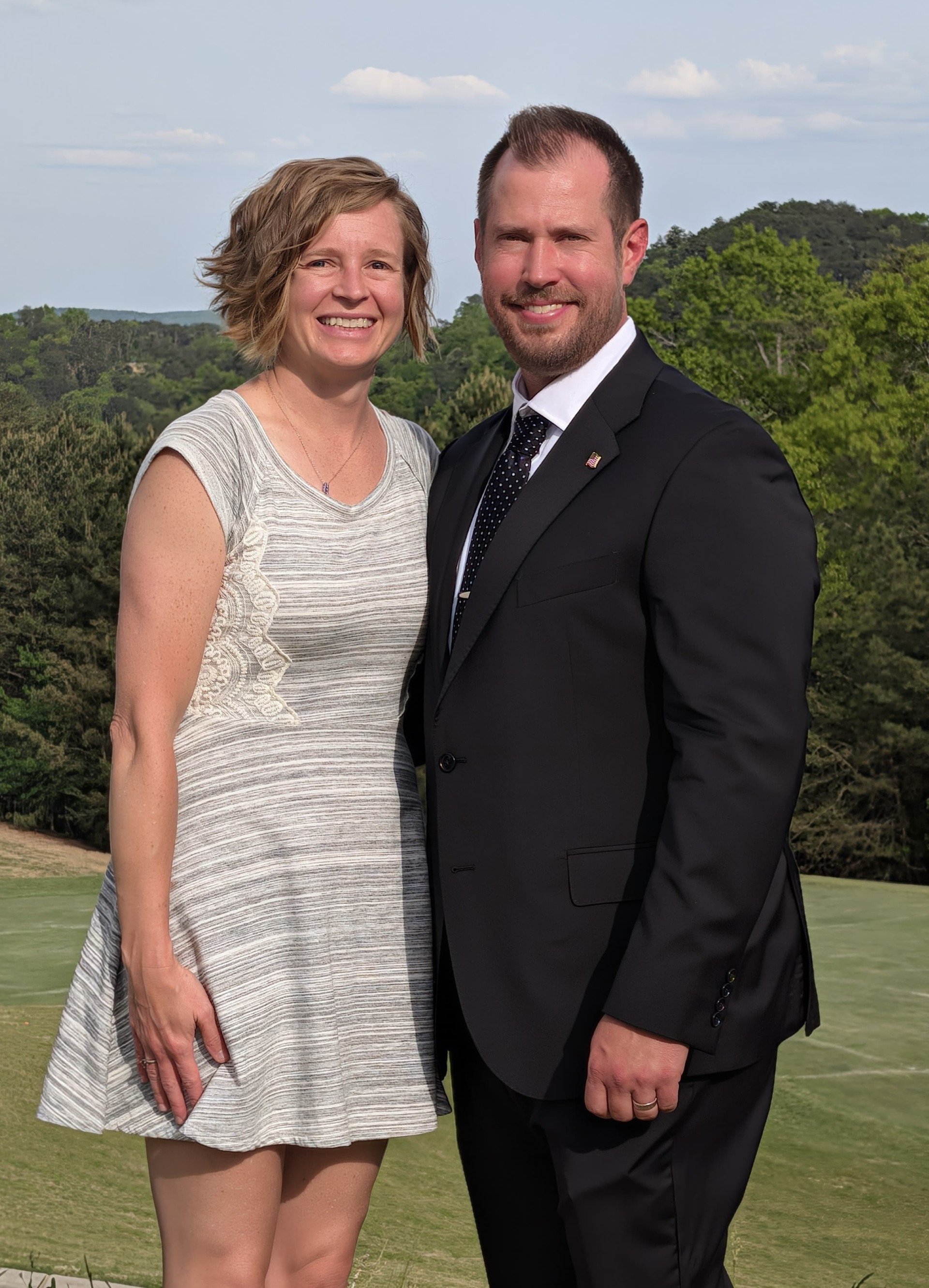
Tyler Jones
Where are you originally from?
Calhoun, GA
What do you do for work (or what keeps you busy during the day)?
I am a mechanical engineer and I lead the special projects group at Printpack Inc.
What made you decide to join CrossFit Bound?
I tried several gyms in the area and CrossFit Bound seemed like the best place for me to grow.
Have you done CrossFit before, or is this your first experience?
I have done CrossFit and even coached for several years, but that was 6 years ago now.
What are a few goals you’re working toward right now?
I just want to get stronger again and lean up.
What’s something fun or interesting about you most people wouldn’t know?
I am a National Parks collector. I have been to more than half of our beautiful National Parks and I plan to visit them all.
Optional:
How long have you been doing CrossFit (if applicable)?
I did CrossFit from 2012 to 2019 and then moved into Olympic lifting for two years.
Bragging Board
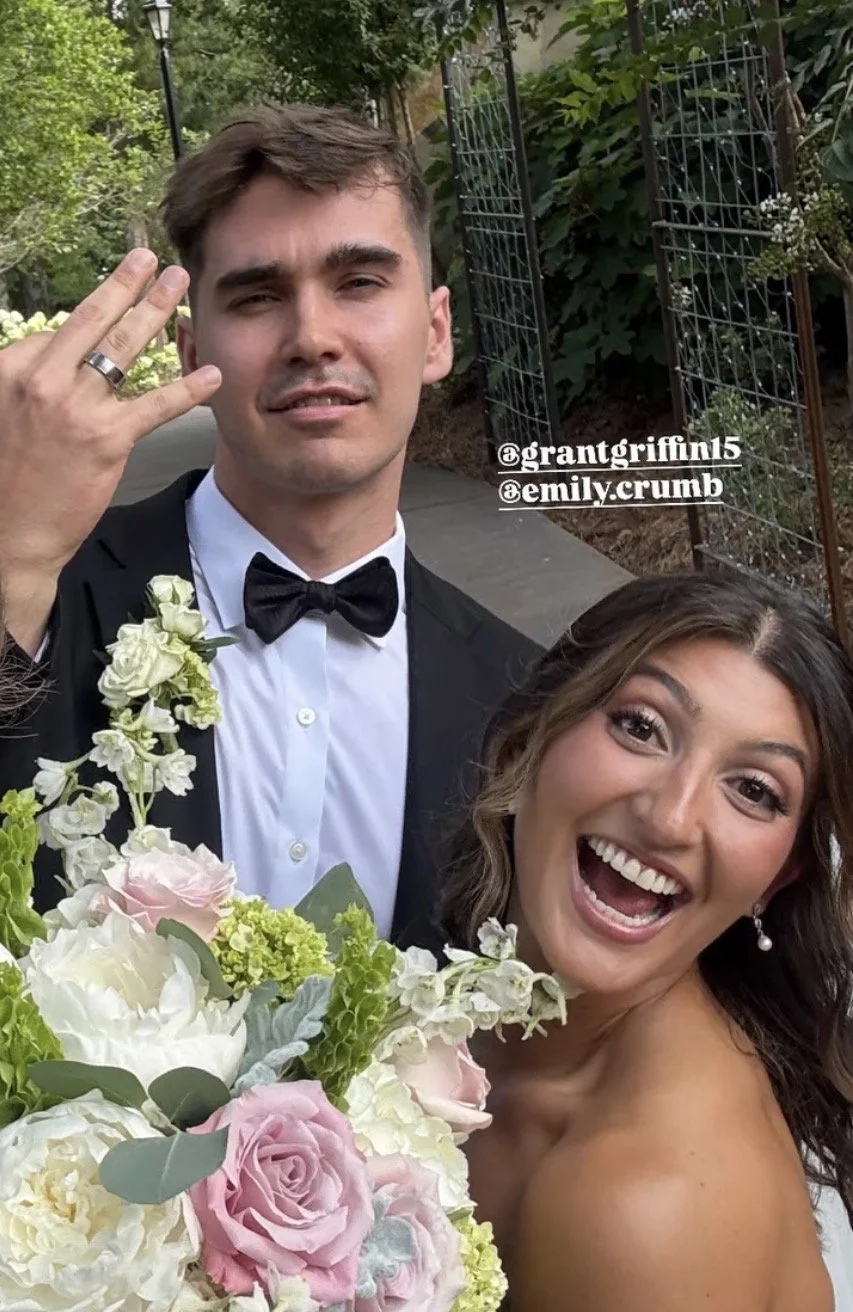
Congratulations to Emily and Grant Griffin on their marriage this weekend!
Excited to have Emily join our community and hopefully see Grant improve from the 3rd fittest in the gym to 2nd.
Upcoming Birthdays & Anniversaries
Anniversaries
1-Year
Wilnette Torres Aug 22
2-Year
Abigail Gerleman Aug 12
Fefe Lawler Aug 14
Kerry & Cris Aponte Aug 15
4-Year
Paul Watson
5-Year
Eric Harvey
6-year
Riley Padgett
Birthdays
Sheri Kindred Aug 3
Jeb Buffington Aug 4
Dylan Dejesus Aug 5
David Stewart Aug 7
Hunter Palmer Aug 8
Ryne Holsomback Aug 13
Luke Mayben Aug 15
Delilah Payton Aug 16
Mary Cox Aug 16
Rep Lattimore Aug 16
Stephen Wilcox Aug 18
Jeff Mayr Aug 21
Andrew Mitchell Aug 22
Eric Harvey Aug 22
Michael Jamorski Aug 26
Noah Daniel Aug 29
Chris Mench Aug 29
Education: CrossFit Journal Article “There's A Reason CrossFit Athletes Never Stop Doing Olympic Lifts.”
By Stephane Rochet, CF-L4
Many programs skip the Olympic lifts because they seem too technical, too risky, or too advanced for everyday athletes. That is exactly the wrong call. Here is what you are leaving on the table when you omit them.
What the Olympic Lifts Actually Develop
No other movement pattern asks the body to produce force this quickly, coordinate this precisely, and absorb that same force on the back end. Speed, timing, power, hip-to-hands-and-feet coordination, landing mechanics: the Olympic lifts train all of these simultaneously in a single rep.
That is not athleticism in the narrow, sports-specific sense. It is athleticism in the most fundamental sense, the kind that has real consequences in everyday life. The ability to move fast, produce force under load, and control it on the way down is exactly what keeps a 75-year-old from a catastrophic fall or a skier from blowing out a knee on the last run of the day.
Pull the Olympic lifts out of CrossFit, and you do not just lose a couple of movements; you lose a category of adaptation that nothing else in the program replaces.
What the Minimum Actually Looks Like
Here is the key clarification: No one needs to look like an Olympic weightlifter to get the benefits of Olympic lifting. The standard is not 300 lb overhead in a rock-bottom squat. It is not repeatedly missing max-effort lifts. It is something far more accessible than that.
The minimum is a high-hang power snatch, executed with speed and solid technique, at whatever load allows it. A PVC pipe counts. A 15-lb bar counts, 2 ½ lb on each side of the bar counts.
What matters is this: a tall, controlled dip. A sharp finish through the hips with a tall shrug. Long, loose arms with elbows high and outside. The bar passing close to the body and locking out overhead as the feet land. That’s it. That’s the movement. Done well at light load, it delivers roughly 90 percent of the benefit you would get from a full lift off the floor.
An athlete who can do that is doing Olympic lifting. The load is almost beside the point.
Start Here. Progress From Here.
The high-hang snatch is also a foundation, not a ceiling. Once an athlete has that pattern dialed in and has been building their overhead squat, front squat, and deadlift capacity alongside it, the next steps become straightforward. Build up to receiving the bar in a squat. Progress to starting the lift from the floor. Each piece already exists. They just need to be assembled.
That process might take a year. Or it might take a lifetime. For an 85-year-old, the high-hang snatch with a light dumbbell might be as far as they advance, and that is a completely legitimate outcome. The goal is never to stop looking for progress, but the pace of progress should reflect the athlete in front of you.
Dumbbells are also worth mentioning here. A dumbbell high-hang power snatch preserves the jump, landing, and coordination pattern. It is an excellent introduction for older athletes, younger athletes, or anyone for whom the barbell is not yet the right tool. The implement is secondary to the movement.
Speed Is the Point
One adjustment coaches often need to make with newer athletes is around the idea of speed itself. Most people come to CrossFit trained by years of fitness culture to move slowly and under control. The Olympic lifts require something different. Speed is not a side effect of good technique. Speed is part of the technique.
Letting your athletes know that fast is the goal, and explaining why, matters. Moving load quickly develops not only the ability to generate power in many athletic scenarios but also a specific kind of resilience that carries over directly to sport, outdoor recreation, and everyday life.
In CrossFit, the worthy fight is to maintain speed and technique as we fatigue through high-repetition Olympic lifting sets. This has direct application to sport and recreation. As an athlete, you do not have the luxury of performing poorly because you’re tired. Late in the game is often the most important time to play at high speed with excellent technique. Rarely do you tear your ACL on the first ski run of the day. You tear it when you are exhausted, and your mechanics break down. Training to maintain technique under fatigue is, in part, training for that exact situation.
Where the Boundaries Are
There is a difference between fatigued Olympic lifting done well and fatigued Olympic lifting done badly. The former is valuable. The latter is where legitimate safety concerns begin.
The technical standard does not change because an athlete is tired. What coaches should be watching for when fatigue sets in is an early arm pull, hips riding a little higher than ideal, and that’s about it. What should not appear is a rounded back, significant position loss in the torso, a slow grinding bar path, or a poor catch position. If those show up, peel weight off. Reduce reps. Slow things down.
Games athletes doing a snatch ladder mid-workout do not look perfect, but they do not look broken either. That is the target. Keep the lifts pure. An athlete can grind a back squat with beautiful mechanics. They cannot grind a snatch and call it a snatch. The bar needs to move fast. If it is not moving fast, something is wrong.
Why This Matters
CrossFit has always believed that what works for an elite athlete, properly scaled, works for everyone. The Olympic lifts are the clearest expression of that principle. The technique has been refined over more than a hundred years of competitive weightlifting. The mechanics are not arbitrary. The hip contact, the timing through the pull, the catch position: these exist because they are the most efficient way to move a load overhead from the floor.
Teaching those mechanics, even with a PVC pipe for a newer athlete, gives that athlete access to something most fitness programs never offer them: coordination, speed, power, and neurological demand.
That is worth protecting. It is worth teaching well. And it is worth keeping in the program for every athlete, regardless of age, background, or how long you’ve been training.
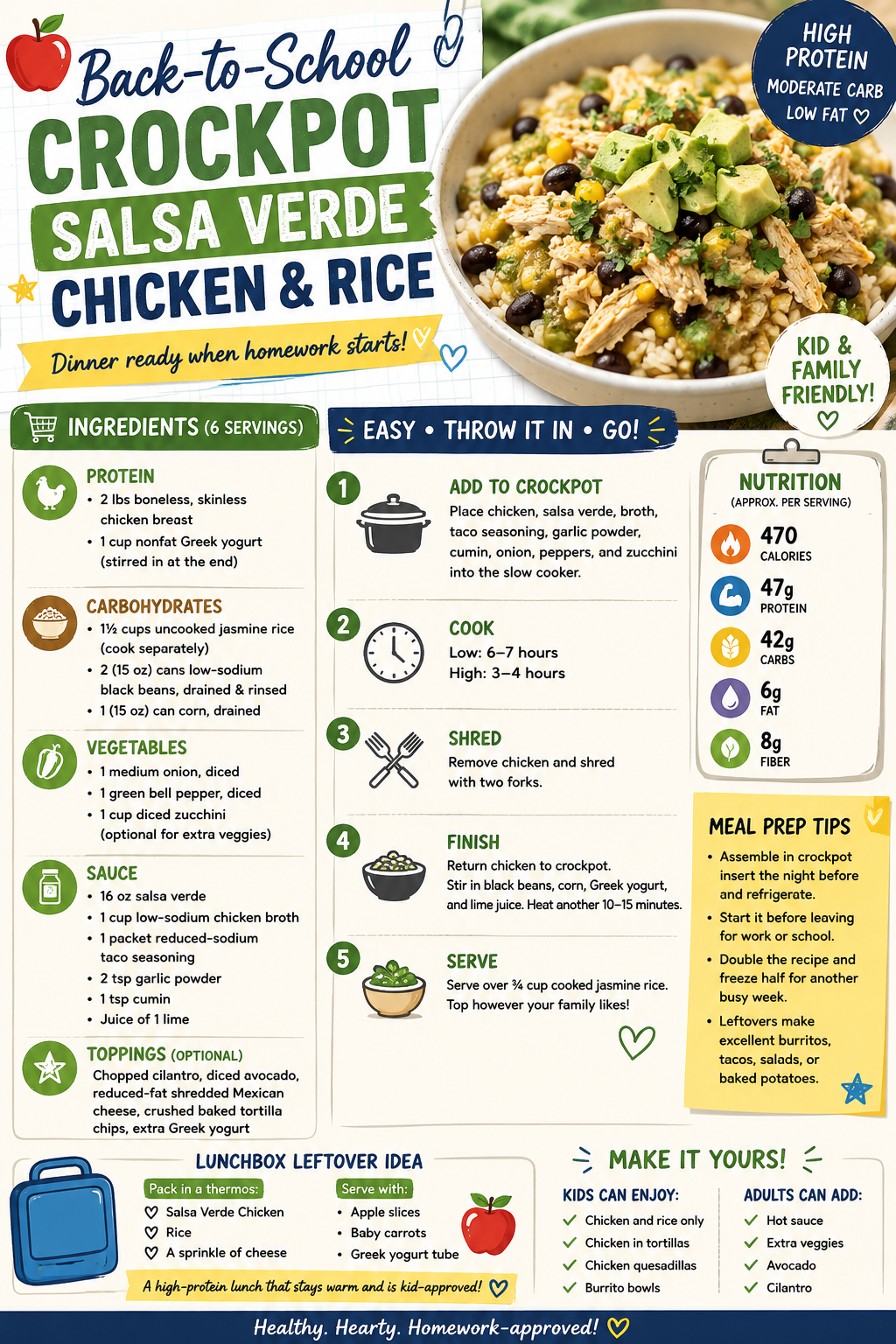
Back-to-School Crockpot Salsa Verde Chicken & Rice
High Protein • Moderate Carb • Low Fat • Family Friendly
Nutrition (Per Serving)
Calories: 470
Protein: 47g
Carbohydrates: 42g
Fat: 6g
Fiber: 8g
Instructions
1. Add to Crockpot
Place chicken, salsa verde, broth, taco seasoning, garlic powder, cumin, onion, peppers, and zucchini into the slow cooker.
2. Cook
· Low: 6–7 hours
· High: 3–4 hours
3. Shred
Remove chicken and shred with two forks.
4. Finish
Return chicken to crockpot.
Stir in:
· Black beans
· Corn
· Greek yogurt
· Lime juice
Heat another 10–15 minutes.
5. Serve
Serve over ¾ cup cooked jasmine rice.
Top however your family likes.
🍴 Meal Prep Tips
Kids can enjoy:
· Chicken and rice only
· Chicken in tortillas
· Chicken quesadillas
· Burrito bowls
Time Saving Tips:
Assemble everything in the crockpot insert the night before and refrigerate.
Start it before leaving for work or school.
Double the recipe and freeze half for another busy week.
Leftovers make excellent burritos, tacos, salads, or baked potatoes.
Lunchbox Leftover Idea
Pack leftovers in a thermos with:
· Salsa Verde Chicken
· Rice
· A sprinkle of cheese
Serve with:
· Apple slices
· Baby carrots
· Greek yogurt tube
It's a high-protein lunch that stays warm and is kid-approved.
Ingredients (6 servings)
Protein
· 2 lbs boneless, skinless chicken breast
· 1 cup nonfat Greek yogurt (stirred in at the end)
Carbohydrates
· 1½ cups uncooked jasmine rice (cook separately)
· 2 (15 oz) cans low-sodium black beans, drained & rinsed
· 1 (15 oz) can corn, drained
Vegetables
· 1 medium onion, diced
· 1 green bell pepper, diced
· 1 cup diced zucchini (optional for extra veggies)
Sauce
· 16 oz salsa verde
· 1 cup low-sodium chicken broth
· 1 packet reduced-sodium taco seasoning
· 2 tsp garlic powder
· 1 tsp cumin
· Juice of 1 lime
Toppings (Optional)
· Chopped cilantro
· Diced avocado
· Reduced-fat shredded Mexican cheese
· Crushed baked tortilla chips
· Extra Greek yogurt
Adults can add:
· Hot sauce
· Extra veggies
· Avocado
· Cilantro
Weekly Training Breakdown