Bound Newsletter 8.9.2026
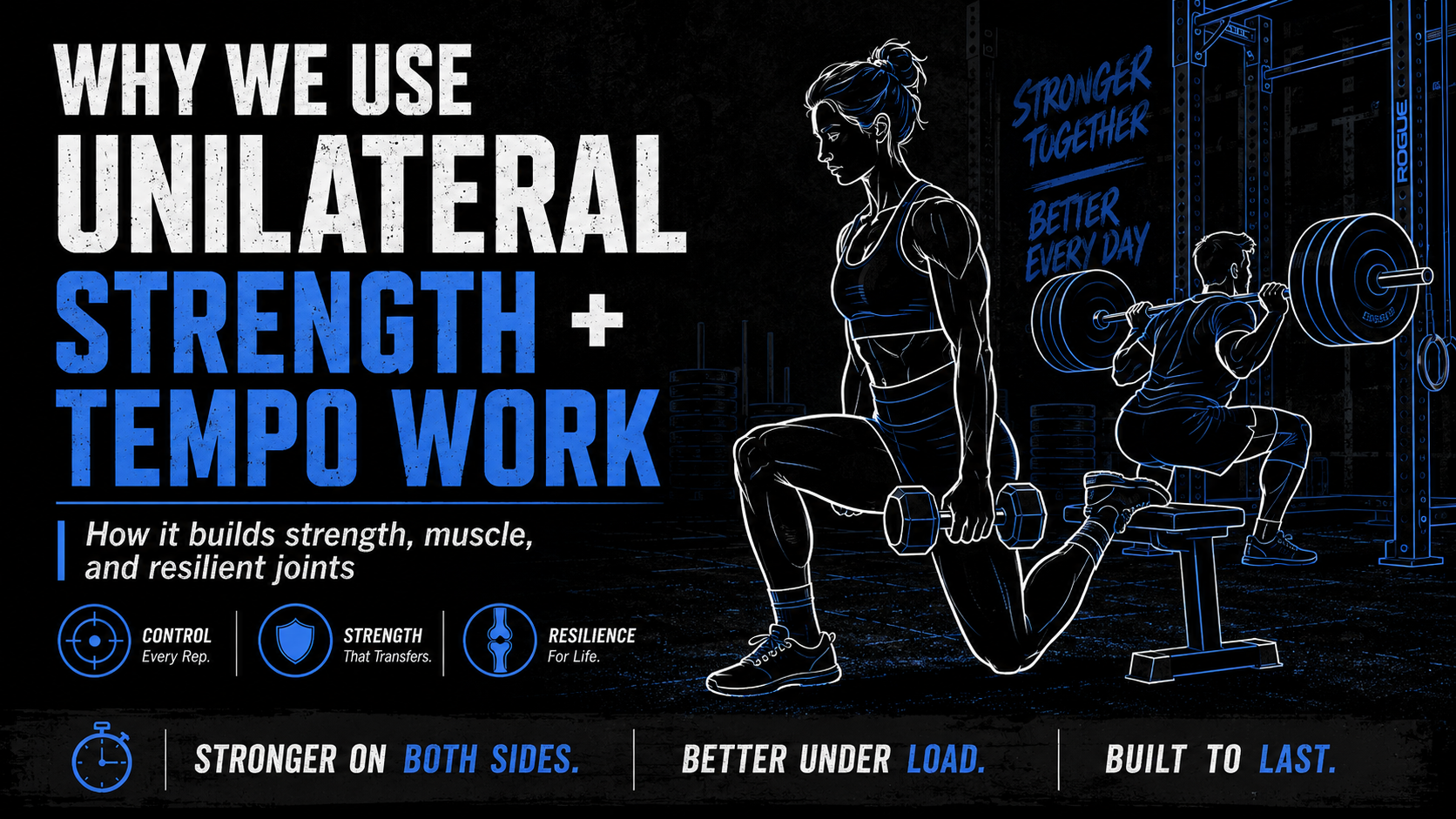
At CrossFit Bound, you’ll often see a heavy compound lift like a back squat, deadlift, bench press, strict press, or Olympic lift followed by exercises that look very different.
You might see:
Bulgarian split squats
Single-leg Romanian deadlifts
Step-ups
Single-arm dumbbell presses
Single-arm rows
Lunges
Cossack squats
Single-arm carries
And sometimes those movements come with a prescribed tempo:
3 seconds down.
1-second pause.
Controlled position.
Then drive up.
There is a reason for all of it.
The goal of strength training isn't simply to move the heaviest weight possible. We want to build a body that can produce force, control force, absorb force, and tolerate training for years.
That's why our programming combines heavy bilateral compound movements with unilateral exercises and controlled-tempo strength work.
Compound Lifts Build the Foundation
Let's start with the big lifts.
Squats, deadlifts, presses, cleans, snatches, and similar compound exercises allow us to train multiple muscle groups simultaneously and expose the body to relatively high levels of force.
They are incredibly effective for developing:
Strength.
Power.
Muscle mass.
Bone-loading capacity.
Neuromuscular coordination.
Heavy resistance training remains one of the most effective tools available for improving maximal strength, with higher loads generally providing an advantage when the goal is specifically maximal strength development.
So we're not replacing the big lifts.
We're building around them.
Because being strong with two feet planted firmly on the ground doesn't automatically mean you have the same strength, stability, and control when only one leg or arm has to do the work.
And real life happens one side at a time much more often than we realize.
Walking.
Running.
Climbing stairs.
Stepping onto something.
Carrying groceries.
Throwing.
Changing direction.
Catching yourself when you stumble.
Most athletic and everyday movement contains a significant unilateral component.
Why We Train One Side at a Time
Unilateral training simply means training one limb independently.
Think:
Split squat instead of only back squatting.
Single-leg RDL instead of only deadlifting.
Single-arm dumbbell press instead of only bench pressing.
Research comparing unilateral and bilateral resistance training suggests something important: both work.
A recent systematic review and meta-analysis found similar muscle hypertrophy between unilateral and bilateral resistance training. However, strength improvements tended to follow the movement being trained—bilateral training improved bilateral strength more, while unilateral training improved unilateral strength more.
That principle is called specificity.
If you want to become better at producing force through one limb, you need opportunities to train one limb.
That's one reason we use both.
Unilateral Training Exposes Weak Links
Imagine performing a heavy back squat.
Your right leg may be slightly stronger than your left.
During a bilateral squat, your body is remarkably good at finding ways to complete the task. A stronger side may quietly contribute a little more without you consciously realizing it.
Now perform a rear-foot-elevated split squat.
Suddenly each leg has to demonstrate what it can do independently.
Weaknesses become much easier to identify.
This doesn't mean every tiny left-to-right difference needs to be “fixed.” Human beings aren't perfectly symmetrical.
But unilateral movements give us opportunities to develop strength and control on each side rather than always allowing both sides to share the workload.
Meta-analyses examining unilateral training consistently show that adaptations are highly specific to the type of strength being trained, with unilateral training particularly effective for improving unilateral force production and some unilateral athletic tasks.
Then We Add Tempo
This is where many members wonder:
“Why are you making me squat so slowly?”
Tempo isn't punishment.
And it isn't there simply to make a lightweight feel miserable.
Tempo gives us another way to manipulate the training stimulus.
Instead of only asking:
How much weight can you move?
We're also asking:
How well can you control it?
A prescription such as:
31X1
might mean:
3 seconds lowering the weight
1 second in the bottom position
X = stand explosively
1 second before beginning the next rep
Now an eight-rep set potentially involves significantly more controlled muscular work than eight fast repetitions.
Research on repetition duration shows that muscle growth can occur across a fairly wide range of repetition speeds, provided the training stimulus is sufficient. In other words, slow tempo isn't a magical hypertrophy technique.
But tempo can be extremely useful because it allows us to deliberately increase control, positional awareness, and sustained muscular tension without constantly adding more weight to the bar.
Muscle Doesn't Only Respond to Weight
Muscle tissue responds to mechanical tension created during resistance exercise.
That means we have several tools available when programming strength:
We can increase weight.
We can increase repetitions.
We can increase sets.
We can change range of motion.
We can increase training frequency.
Or we can manipulate how the repetition is performed.
Using slower eccentric portions of a movement can make moderate loads challenging while giving the athlete more time to maintain muscular tension and control joint position.
That becomes particularly useful with accessory exercises where the goal may be muscular development rather than simply producing a one-rep maximum.
And that's an important distinction.
Your back squat may be programmed primarily to increase force production.
Your Bulgarian split squat afterward may be programmed to develop the quads, glutes, adductors, and surrounding structures through a controlled range of motion.
Different exercise.
Different goal.
Same training session.
We're Also Training the Structures That Transfer Force
Muscles get most of the attention in the weight room, but muscles can't move your skeleton without connective tissue.
Tendons connect muscle to bone and help transfer muscular force.
Ligaments contribute to joint stability.
The extracellular connective-tissue network also plays an important role in maintaining tissue structure and transmitting force throughout the musculoskeletal system.
These tissues respond to mechanical loading too.
Research examining healthy human tendons has found that mechanical loading can increase tendon stiffness, tendon modulus, and—in some circumstances—tendon cross-sectional area. A large systematic review and meta-analysis involving 61 studies found that higher-strain resistance-training protocols produced some of the greatest positive tendon adaptations.
Exercise also stimulates collagen turnover and synthesis within connective tissue, which is part of the remodeling process that allows tissues to adapt to repeated loading.
The evidence is strongest for tendon adaptation. Ligaments are harder to study directly in humans, so we should be careful about claiming that a specific tempo exercise automatically “strengthens your ligaments.” However, ligament biology research also shows that appropriate mechanical loading influences extracellular-matrix organization and tissue homeostasis.
The bigger point is simple:
Your muscles aren't the only tissues adapting to strength training.
Muscles Can Adapt Faster Than Tendons
This is another reason intelligent progression matters.
You might feel dramatically stronger after several weeks of training.
That doesn't necessarily mean every structure involved in producing that strength has adapted at exactly the same rate.
Research examining the time course of strength training has shown that muscular function can improve before some changes in muscle morphology and tendon mechanical properties fully develop.
That's important.
It explains why our goal shouldn't always be:
More weight. More weight. More weight.
Sometimes the better training decision is:
Same weight. Better control.
Same weight. Greater range of motion.
Same weight. Slower eccentric.
Same weight. Stronger single-leg position.
We're still progressing.
We're simply changing what we're asking the body to adapt to.
Why Unilateral + Tempo Can Be Such a Useful Combination
Put the two concepts together.
Take a Bulgarian split squat performed with a three-second eccentric.
Now we have an athlete who must:
Stabilize primarily through one leg.
Control the hip, knee, and ankle.
Maintain trunk position.
Lower the body under tension.
Control the bottom position.
Produce force to stand back up.
That creates a very different stimulus from a heavy back squat.
The back squat allows us to expose the athlete to large amounts of force.
The controlled split squat allows us to develop strength and muscular capacity in a more constrained unilateral position.
One doesn't replace the other.
They complement each other.
Think About Strength as Building a Bigger System
If all we cared about was your one-rep-max back squat, programming would be pretty simple.
Squat heavy.
Recover.
Squat heavy again.
But our goal is bigger.
We want strong quads.
Strong hamstrings.
Strong glutes.
Strong calves.
Capable shoulders.
Strong backs.
Tissues capable of tolerating repeated loading.
Good movement options.
Strength through meaningful ranges of motion.
The ability to produce force bilaterally.
And the ability to control your body unilaterally.
That requires more than one exercise.
Here's What a Strength Session Might Actually Be Doing
Imagine a training day that looks like this:
Back Squat
5 sets of 3
Followed by:
Rear-Foot-Elevated Split Squat
3 sets of 8 each leg with a 3-second eccentric
Single-Leg RDL
3 sets of 8 each leg
Suitcase Carry
3 sets each side
At first glance, you might think the back squat is the “strength work” and everything afterward is accessory work.
Technically that's true.
But don't confuse accessory with unimportant.
The squat develops high-force bilateral strength.
The split squat adds unilateral quadriceps and glute loading.
The single-leg RDL challenges the posterior chain, hip control, and single-leg stability.
The suitcase carry challenges unilateral loading and trunk control.
Together, they develop a more complete athlete than any single exercise could accomplish alone.
And Yes—This Can Help Build Muscle
One of the other major reasons we use these movements is hypertrophy.
More muscle gives us more potential force-producing tissue.
Research consistently supports resistance training as an effective stimulus for skeletal-muscle hypertrophy, and the evidence comparing unilateral with bilateral exercises does not suggest that unilateral training is inferior for building muscle.
That means a set of controlled split squats isn't just “balance work.”
It can be legitimate hypertrophy training for the quadriceps and glutes.
A controlled single-arm dumbbell press isn't merely shoulder stability work.
It can build the pecs, deltoids, and triceps while simultaneously requiring the athlete to resist unwanted trunk movement.
You can accomplish several objectives with one exercise when it's programmed correctly.
The Goal Is Not to Make Training Complicated
Sometimes strength programs become complicated simply for the sake of being different.
That's not what we're after.
We're trying to use the simplest combination of tools that produces the adaptations we want.
Heavy compound movements teach the body to produce large amounts of force.
Unilateral exercises develop strength and control through each side independently.
Tempo gives us a way to manipulate the stimulus without always increasing external load.
Accessory work gives us additional training volume for muscle tissue and specific positions.
Progressive mechanical loading helps muscles and connective tissues adapt to the demands we repeatedly place on them.
Put everything together and you have a much more complete strength program.
Don't Rush the “Easy” Stuff
This is probably the biggest takeaway for our members.
When the workout says:
3-second eccentric
Don't turn it into one second.
When the workout says:
8 reps each leg
Don't rush through the weaker side just to finish.
When your coach gives you a load that feels lighter than what you could technically lift, understand that the number on the dumbbell may not be the primary goal that day.
Control the movement.
Own the position.
Create tension.
Use the intended range of motion.
Then progressively increase the challenge.
There will absolutely be days when we want you moving heavy weight aggressively.
There will also be days when we want you controlling moderate weight extremely well.
Both are strength training.
Train Heavy. Train Controlled. Build Something That Lasts.
The strongest athletes aren't simply the people capable of producing the most force once.
They're the people who can continue producing force consistently.
That's what we're trying to build at CrossFit Bound.
We want the big lifts.
We want strong muscles.
We want unilateral strength.
We want healthy, load-tolerant connective tissues.
We want control.
We want power.
And ultimately, we want a body capable of doing more—not just this month, but years from now.
That's why the heavy squat and the slow split squat can belong in the exact same program.
One builds the engine.
The other helps strengthen the entire system supporting it.
And together, they help us build athletes who aren't simply strong—
but capable.
Welcome New Members
Shanna Pothier
Emily Crumb
Carolina Devia
LJ Johns
Bragging Board
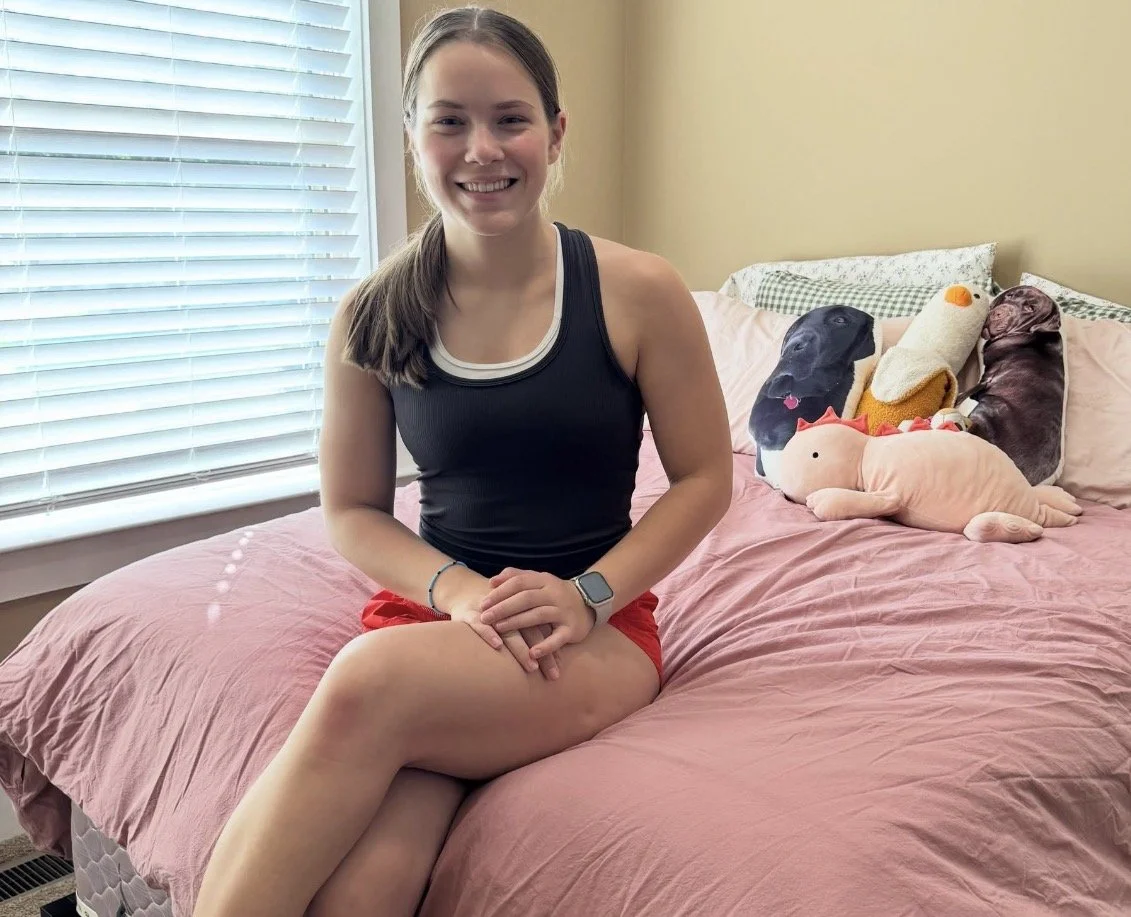
Congratulations Hannah were excited for you and your new adventure at UGA - Go DAWGS!
Upcoming Events, New Shirts, Calendar
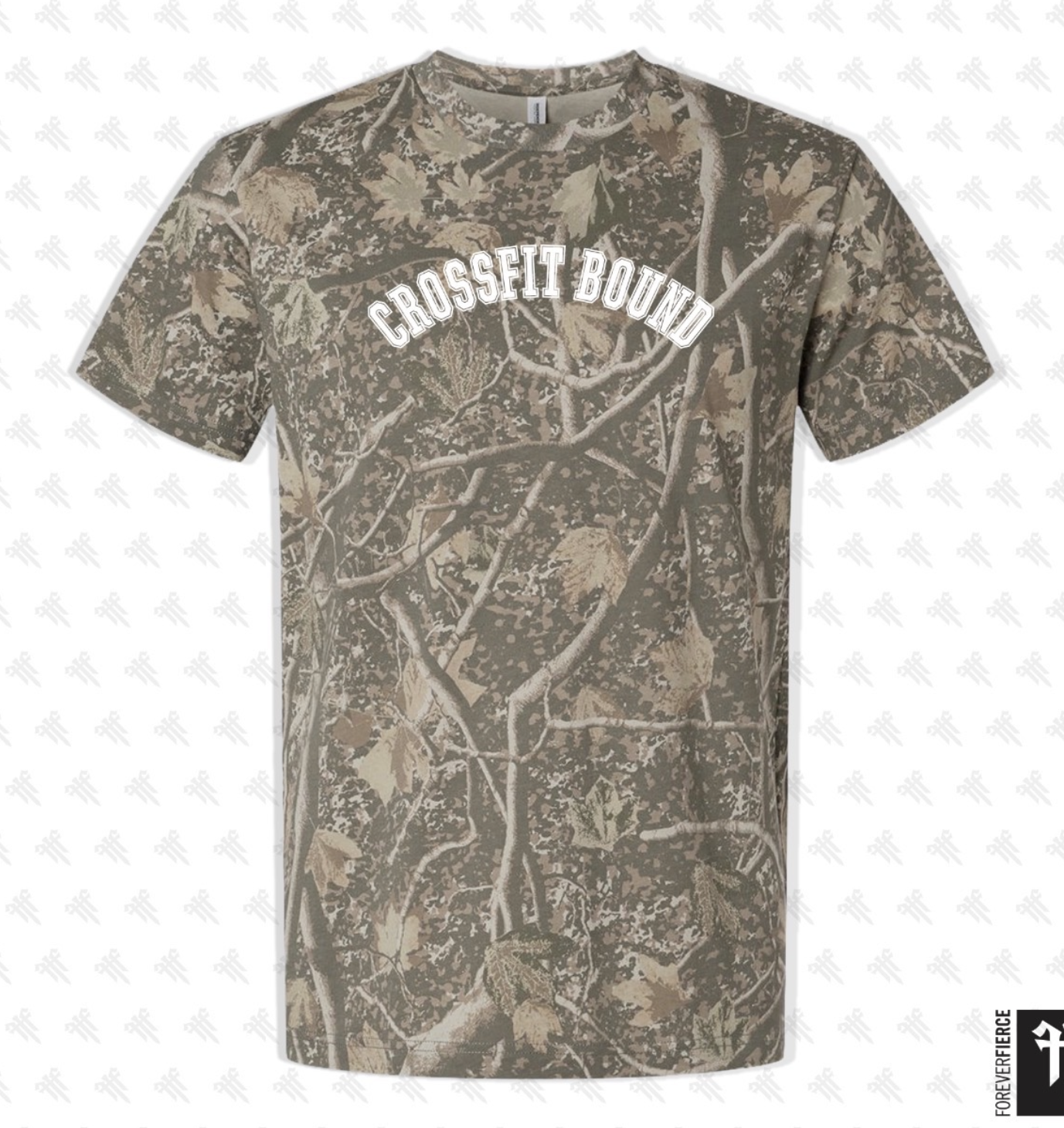
Fall CrossFit Bound Camo Shirt Pre-order is live
$34.99 - Unisex
Order needs to be in by Friday 8/14
Order through the Wodify App under the ‘Buy” tab in bottom right corner of app.
*Sample shirts will be available in lobby this week to see fit and style of shirt it will be.
BRING A FRIEND WEEK - 8/31 THROUGH 9/5
We will have a Free Week for Friends and Family to see what classes are all about.
We will have registration beginning next week.
Upcoming Birthdays & Anniversaries
Anniversaries
1-Year
Wilnette Torres Aug 22
2-Year
Abigail Gerleman Aug 12
Fefe Lawler Aug 14
Kerry & Cris Aponte Aug 15
4-Year
Paul Watson
5-Year
Eric Harvey
6-year
Riley Padgett
Birthdays
Sheri Kindred Aug 3
Jeb Buffington Aug 4
Dylan Dejesus Aug 5
David Stewart Aug 7
Hunter Palmer Aug 8
Ryne Holsomback Aug 13
Luke Mayben Aug 15
Delilah Payton Aug 16
Mary Cox Aug 16
Rep Lattimore Aug 16
Stephen Wilcox Aug 18
Jeff Mayr Aug 21
Andrew Mitchell Aug 22
Eric Harvey Aug 22
Michael Jamorski Aug 26
Noah Daniel Aug 29
Chris Mench Aug 29
Education: CrossFit Journal Article “The Smart CrossFit Athlete's Guide to Training Through Soreness”
By Stephane Rochet, CF-L4
Waking up sore after a hard workout is not a signal to skip the gym. It is a sign your body is adapting, and how you respond determines how fast you recover. Learn when to train through soreness, when to scale, and how to tell the difference between soreness and pain.
Sore is not a stop sign.
You crushed a workout. The next morning, you wake up, and your legs feel like concrete and are sore to the touch. Maybe it’s your shoulders, your back, your everything. The question almost every athlete asks at some point is: Should I train through this or rest?
The short answer is almost always to keep moving. But how you move matters.
If you’d rather watch or listen to this conversation, you can do that here.
Soreness Is Adaptation, Not Injury
Muscle soreness is a sign of adaptation. When you expose your body to new movements, new ranges of motion, or new volumes of work, you create small amounts of tissue damage and inflammation. Your body repairs that damage and comes back stronger. That process involves not only muscle fibers but also fascia, the connective tissue that surrounds your muscle fibers, tendons, and ligaments.
This is especially true for new athletes. A full air squat, for example, demands a range of motion most people have never loaded before. Even a couple of sets of 10 reps at bodyweight can leave a total beginner unable to sit comfortably the next day. That is not a failure of programming. That is the body doing exactly what it is supposed to do: adapting.
One thing worth knowing: Soreness often peaks 48-72 hours after the workout, not the day after. So if you feel fine on day one and wrecked on day two, that is completely normal.
The Couch Is Not the Cure
The instinct to rest is completely understandable, but it is usually the wrong call. Light movement, blood flow, and active recovery consistently outperform doing nothing when it comes to feeling better faster.
Go for a walk. Ride a bike. Do some stretching. Do some bodyweight movements slowly and for just a few reps. These low-intensity activities increase blood flow to the affected tissue and help the recovery process. If squats made you sore, doing some easy squats the next day, with reduced load and volume, will typically leave you feeling better than if you had stayed on the couch.
Let Your Warm-Up Make the Call
The most practical test is simple: Does the soreness change the way you move?
Start your warm-up and pay attention. If soreness begins to ease as you get moving and your mechanics stay clean, you can likely train. Scale the load or volume down from your usual effort, but go.
If, on the other hand, you find yourself compensating, shifting your torso to avoid depth, favoring one side, or losing position under load, that is a signal to adjust. You might skip the squat-heavy elements of the day, choose accessory work that targets less-affected areas, or focus on upper-body movements if your legs are the problem. The goal is to keep the training habit intact without piling more stress onto tissue that has not yet recovered.
Talk to Your Coach
If you are working with a coach, tell them how you are feeling. That information changes the session. A good coach will adjust the stimulus for where you are that day, not where you were last week. And if you are coaching others, check in before class starts. Your athletes are not always going to volunteer this information.
Soreness vs. Pain: Know the Difference
This is worth saying clearly: We are talking about muscle soreness, not pain. There is a meaningful difference.
Muscle soreness is typically diffuse, often symmetrical, and responds to warm-up. You feel it when you press on the tissue. It improves with movement and tends to fade over two to four days.
Pain around joints, tendons, or ligaments is something else entirely. Sharp pain, pain that worsens with movement, pain localized to a joint rather than a muscle belly, swelling, or stiffness that does not improve with warm-up, all warrant a different response. In those situations, you do not push through. You work around it, manage the load carefully, and monitor for any worsening after training. Keeping that effort at a two-out-of-10 discomfort or less is a reasonable standard.
Confusing the two is where people get into trouble. Soreness will make you uncomfortable. Pain that involves connective tissue can sideline you for weeks if ignored.
Play the Long Game
Here is the thing about soreness: It is not permanent. Athletes who train consistently and progressively, and who manage their intensity intelligently, stop getting severely sore over time. Their bodies adapt. The tissues become more resilient. The deep muscle soreness after a hard workout becomes manageable rather than debilitating.
That adaptation only happens if you keep showing up.
One missed session is not going to derail your progress. But making a habit of skipping whenever you are sore will. Think about the 50-year arc of your training life. One easy day because your legs are thrashed from Karen is completely inconsequential. What matters is that you come back, move, and stay in the process.
The Practical Summary
Soreness is normal. It is a sign your body is adapting. Keep moving through it with reduced load and volume. Use your warm-up as a diagnostic tool. Foam roll, walk, bike, and stretch. Make sure you are eating and hydrating well. And learn over time to distinguish muscle soreness from joint pain, because those two things require very different responses.
The goal is not to avoid soreness. The goal is to manage it well enough that it never stops you from training.
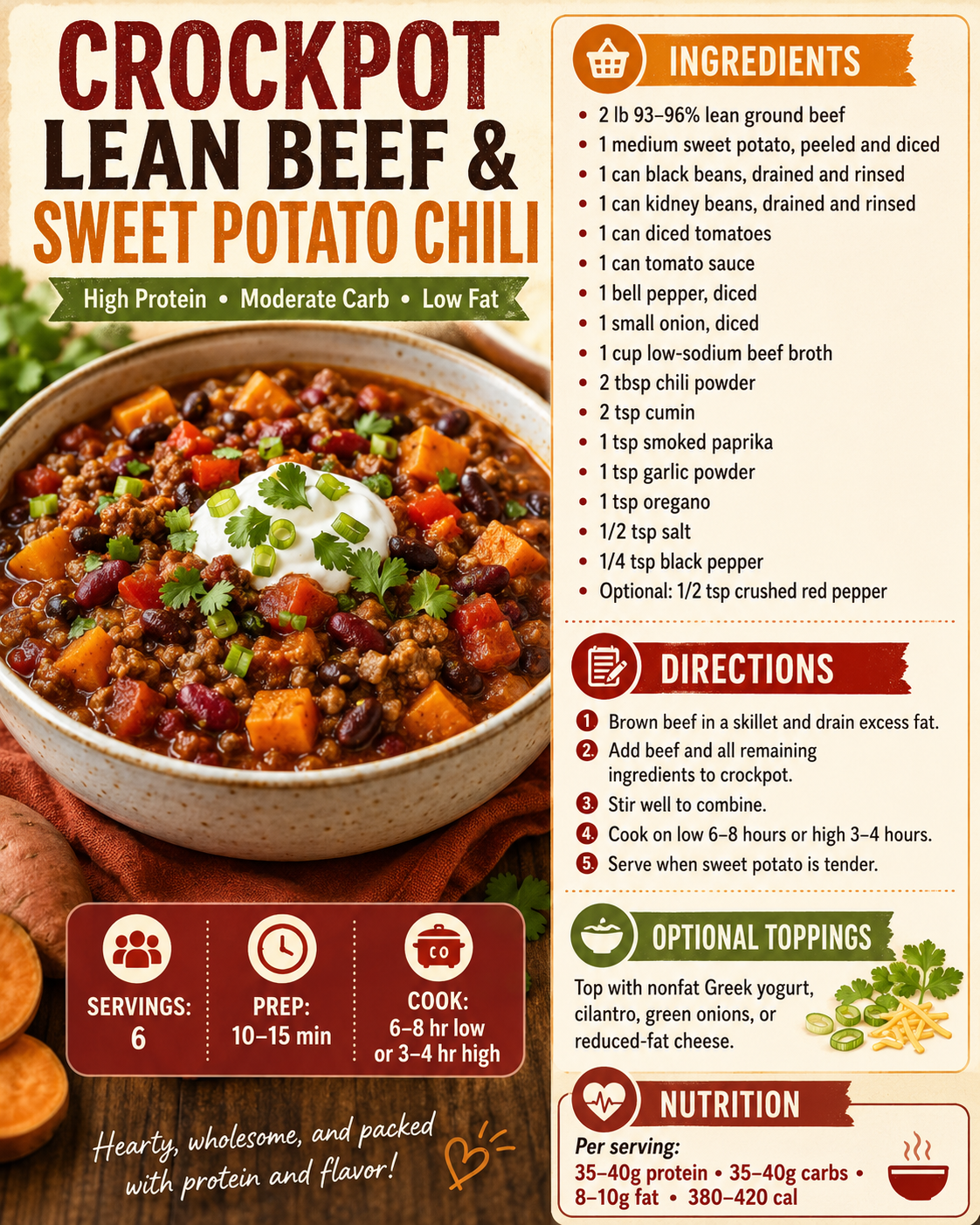
Crockpot Lean Beef & Sweet Potato Chili
Nutrition (Per Serving)
Protein: 35–40g
Carbohydrates: 35–40g
Fat: 8–10g
Calories: ~380–420
Directions
Brown the lean ground beef in a skillet and drain any excess fat.
Add the beef and all remaining ingredients to the crockpot.
Stir until everything is well combined.
Cook on Low for 6–8 hours or High for 3–4 hours, until the sweet potato is tender.
Taste and adjust seasoning before serving.
High-Protein Toppings
Top each bowl with nonfat Greek yogurt, chopped cilantro, green onions, or a small amount of reduced-fat shredded cheese.
Approximate Nutrition
Per serving:
Protein: 35–40g
Carbohydrates: 35–40g
Fat: 8–10g
Calories: ~380–420
For a lower-carb version, cut the beans in half and add diced zucchini or extra peppers. For a higher-carb training-day version, serve it over rice or add another sweet potato.
Servings: 6
Prep: 10–15 minutes
Cook: 6–8 hours on Low or 3–4 hours on High
Ingredients
2 lb 93–96% lean ground beef
1 medium sweet potato, peeled and diced
1 can black beans, drained and rinsed
1 can kidney beans, drained and rinsed
1 can diced tomatoes
1 can tomato sauce
1 bell pepper, diced
1 small onion, diced
1 cup low-sodium beef broth
2 tbsp chili powder
2 tsp cumin
1 tsp smoked paprika
1 tsp garlic powder
1 tsp oregano
½ tsp salt
¼ tsp black pepper
Optional: ½ tsp crushed red pepper for heat
Weekly Training Breakdown