Bound Newsletter 8.16.2026
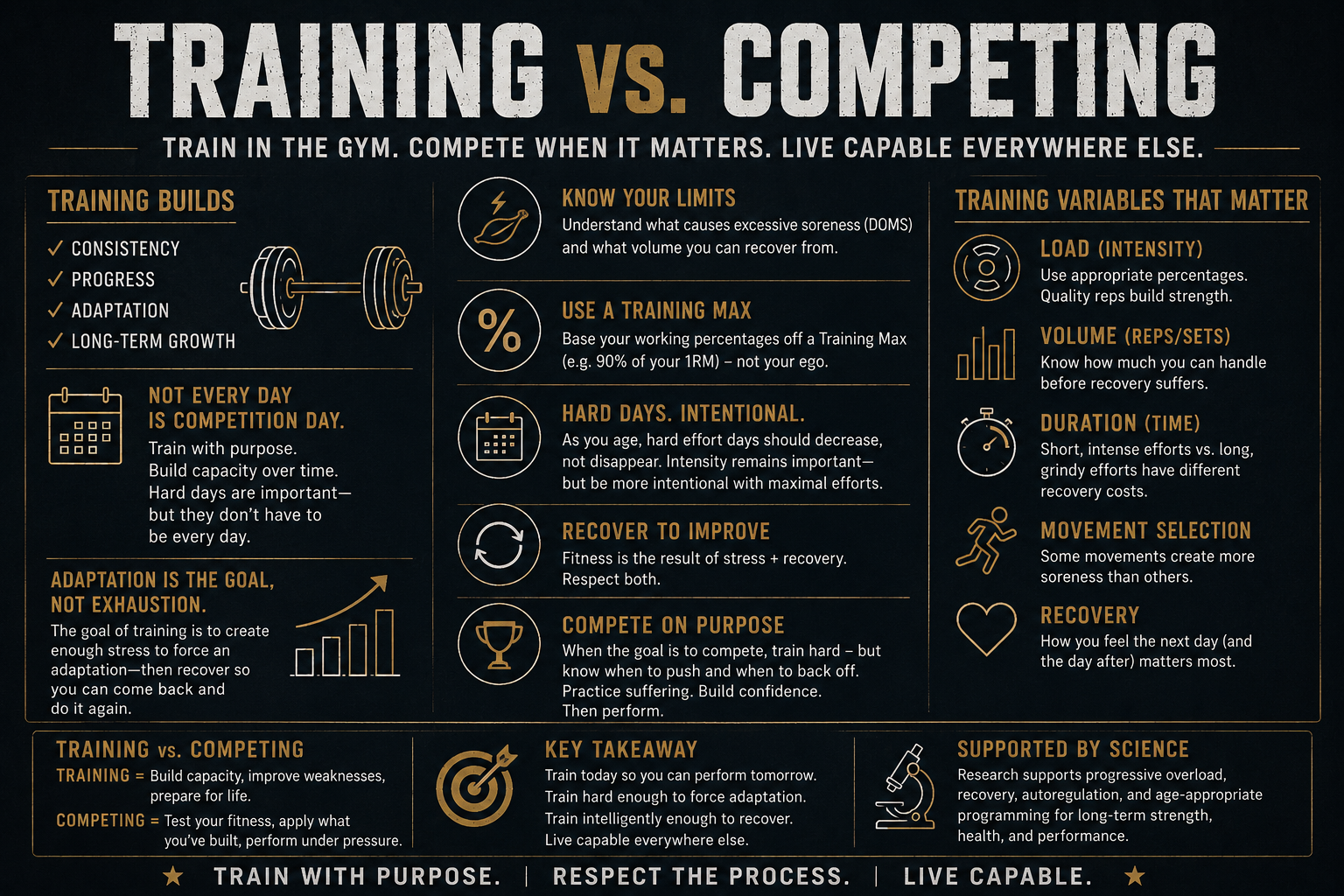
Training vs. Competing: Know When to Push and When to Back Off
There is a major difference between training to improve your fitness and competing to prove your fitness.
That distinction matters.
Inside the gym, the goal should not be to win every workout, beat everyone on the leaderboard, or walk out completely destroyed. The goal of training is to create enough stress to force an adaptation—then recover from that stress so you can come back and do it again.
Competition is different.
Competition is where you find out what your training has prepared you to do.
Training builds the weapon. Competition is where you use it.
And the longer you train—and especially as you get older—the more important it becomes to understand the difference.
Training Should Prepare You for Life Outside the Gym
For most of us, the gym isn't the final destination.
We train so we're capable outside of it.
We want to pick up our kids without worrying about our back. Carry luggage through an airport. Move furniture. Run around with our family. Hike, bike, ski, play sports, compete in a CrossFit competition—or simply continue doing the things we enjoy as we get older.
That means your training has to make you more capable, not constantly beat you down.
A good training session challenges the body enough to stimulate improvements in strength, aerobic capacity, muscular endurance, power, coordination, and skill.
Research and longstanding resistance-training guidelines support progressive overload—gradually manipulating load, volume, frequency, and exercise selection—as a fundamental principle for continued adaptation.
But progressive overload doesn't mean maximum overload every day.
There is a difference.
Not Every Day Is Competition Day
One of the easiest mistakes to make in CrossFit is turning every workout into a competition.
The clock starts.
Someone beside you moves faster.
You see another person's score on the board.
Suddenly the training plan disappears.
Now you're racing.
There are absolutely days when I want athletes to push hard. Those sessions are important. You need opportunities to learn how your body responds when breathing gets uncomfortable, your muscles fatigue, and your brain starts telling you to slow down.
But you don't need to experience that every day.
Think about training intensity on a spectrum.
Some days should feel relatively easy.
Some should be moderate.
Some should be hard.
And occasionally, you should go to the well.
The mistake is believing every workout should end at the bottom of the well.
The purpose of training isn't to demonstrate your maximum capacity every day.
It's to increase your maximum capacity over time.
Know What Makes You Sore
Another important part of becoming a mature athlete is learning what types of training create excessive soreness for you.
Delayed-Onset Muscle Soreness—DOMS—typically appears after unfamiliar or unusually demanding exercise. Eccentric contractions, where a muscle produces force while lengthening, are particularly associated with exercise-induced muscle damage and soreness.
Think about movements like:
High-volume walking lunges
Romanian deadlifts
Heavy negatives
GHD sit-ups
High-rep pull-ups
Box step-downs
Running downhill
High-volume squatting when you haven't squatted recently
That doesn't mean those exercises are bad.
It means dose matters.
There isn't a scientific formula saying that 75 reps causes DOMS while 60 doesn't. Your response depends on your training history, exercise selection, volume, intensity, range of motion, eccentric loading, and how accustomed you are to the movement.
Repeated exposure also matters. The body tends to become more resistant to exercise-induced muscle damage after it has experienced similar training—a phenomenon commonly called the repeated-bout effect. Gradually increasing exposure to eccentric work is therefore one of the most practical ways to reduce excessive soreness.
This is why you should learn your own thresholds.
Maybe you know:
100 walking lunges will destroy your legs for three days.
But 50-60 gives you a productive training stimulus without affecting the rest of your week.
Maybe 30 deadlifts at 225 pounds is manageable, while 45 causes your back and hamstrings to stay sore for days.
Maybe an eight-minute workout at 90% effort allows you to recover quickly, while 25 minutes at that intensity completely buries you.
That knowledge matters.
Because soreness isn't the goal.
Adaptation is the goal.
DOMS can temporarily reduce force production and affect movement and athletic performance. If Monday's workout destroys you so badly that Tuesday, Wednesday, and Thursday are compromised, you need to ask whether Monday actually made your week better.
Ask Yourself: Is the Cost Worth the Benefit?
Every workout has a cost.
The harder the session, the larger that cost can become.
That doesn't mean difficult workouts should be avoided.
It means difficult workouts should have a reason.
If you're preparing for a CrossFit competition, Hyrox, marathon, weightlifting meet, powerlifting meet, or another athletic event, there will absolutely be periods where you need to train harder.
You need exposure to the intensity you're eventually going to encounter.
That's the principle of specificity: training adaptations are strongly influenced by the movements, loading, contraction types, velocities, volumes, and energy systems being trained.
But even competitive athletes aren't competing every day.
They train.
They practice.
They build.
They recover.
Then they test themselves.
Use a "Training Max," Not Your Ego Max
One concept I really like comes from Jim Wendler's 5/3/1 strength-training system.
Wendler uses what he calls a Training Max, or TM.
Instead of calculating every workout from the absolute heaviest weight you have ever lifted, you intentionally use a lower number as your working maximum.
Historically, 5/3/1 commonly started with a Training Max around 90% of an athlete's actual maximum, although Wendler's own material notes that the TM can also be adjusted lower—such as 85% or 80%—depending on the athlete and the program.
Let's say your best back squat is:
400 pounds.
Instead of using 400 as your programming max, your Training Max might be:
400 × 90% = 360 pounds.
Then your workout percentages come from 360, not 400.
So:
70% TM = 252 lb
75% TM = 270 lb
80% TM = 288 lb
85% TM = 306 lb
90% TM = 324 lb
95% TM = 342 lb
Notice what happened.
Even 95% of your Training Max is only about 85.5% of your actual 1RM.
That gives you room.
Room to move well.
Room to accumulate quality reps.
Room to have a bad night's sleep and still train.
Room to build momentum.
And room to eventually demonstrate your real strength when it matters.
Wendler's basic philosophy here fits beautifully with functional-fitness training:
You don't have to train at your absolute limit to get stronger.
Applying the Training Max to CrossFit
We can take that same idea and apply it beyond traditional strength work.
Suppose a workout says:
5 rounds
10 Deadlifts
15 Box Jumps
200m Run
And the deadlift is prescribed at 225/155.
Your question shouldn't automatically be:
"Can I deadlift 225?"
You might have a 405-pound deadlift.
Of course you can deadlift 225.
The better question is:
"What load allows me to achieve the intended stimulus of this workout?"
If the workout is supposed to involve five mostly unbroken sets while maintaining consistent running pace, but 225 turns your deadlifts into singles by Round 3, you've fundamentally changed the workout.
Using the philosophy of a Training Max helps remove ego.
Instead of asking:
What's the most I can survive?
Ask:
What's the right amount for today's training?
That applies to gymnastics too.
Maybe you can perform 15 chest-to-bar pull-ups when you're fresh.
That doesn't necessarily mean doing sets of 15 during a 20-minute workout is intelligent.
Your training capacity may be sets of 6-8.
And your competition capacity may be different.
That distinction is valuable.
Training as We Get Older
This becomes even more important as we age.
But there's an important distinction here.
Getting older does not mean you should stop training hard.
Resistance training remains extremely valuable as we age. Recent research continues to show meaningful improvements in strength, muscle mass, gait speed, and physical function from resistance exercise in older adults.
We need strength.
We need power.
We need muscle.
We need cardiovascular fitness.
And we still need intensity.
The adjustment is often in how frequently we expose ourselves to maximal stress.
Research on Masters athletes suggests that aging can influence recovery kinetics, although individual responses vary considerably and the scientific picture isn't as simple as "older always equals slower recovery."
In fact, a recent systematic review and meta-analysis found that advancing age by itself was not associated with greater exercise-induced muscle damage compared with younger adults.
So I wouldn't tell a 50-year-old:
"You're older now. Stop training hard."
I'd tell them:
"You're experienced enough now to know which hard efforts actually move you forward."
Older athletes may benefit from additional recovery between demanding sessions while maintaining appropriately intense resistance training to preserve strength, power, and muscle.
That's a very different message.
Hard Days Should Become More Intentional
When you're 22, you may be able to make some questionable training decisions and recover quickly enough to get away with them.
As you accumulate training years, responsibilities, old injuries, kids, jobs, stress, and less-than-perfect sleep, that margin can shrink.
So rather than automatically thinking:
Hard effort days must disappear as I get older,
think:
Hard effort days need to become more intentional.
Maybe your training week once contained four or five redline sessions.
Now perhaps it contains one or two truly hard days, several moderate training days, and an easier aerobic or recovery day.
That's not weakness.
That's programming.
One of the most important lessons experienced athletes learn is that fitness improves from the combination of stress and recovery—not stress alone.
Autoregulation: The Workout Is Written in Ink, Your Body Isn't
Another useful idea is autoregulation.
Your program might say:
5 × 5 @ 80%.
But that percentage doesn't know:
You slept four hours last night.
Your child was sick.
Your legs are sore.
You worked a 12-hour shift.
You haven't eaten enough.
Or maybe the opposite is true.
You slept nine hours.
You've eaten well.
You're feeling incredible.
Training readiness changes from day to day.
Recent resistance-training research has continued to investigate autoregulation—adjusting training load or volume based on readiness and performance rather than blindly following predetermined percentages. Reviews suggest autoregulatory approaches can be useful for managing fatigue while still producing strong training adaptations.
A 2026 randomized crossover study also found that both fixed percentage-based and autoregulated programming improved strength, reinforcing that there is more than one effective way to prescribe loading.
Sometimes following the plan means doing exactly what's written.
Sometimes following the intent of the plan means taking 10 pounds off the bar.
That isn't quitting.
That's training.
What If Your Goal Is Competition?
Now let's flip the conversation.
What if you actually want to compete?
Then yes.
You need to train hard.
You cannot prepare for difficult competition without experiencing difficult training.
You need days where you're uncomfortable.
You need heavy barbells.
You need high heart rates.
You need workouts where you're forced to keep moving when you'd rather stop.
You need to practice transitions.
You need to develop pacing.
You need to understand what happens when your grip goes, your legs fill up, and your heart rate gets high.
And occasionally you need to find the edge.
Because competition will expose whatever you haven't prepared.
But here's where experienced competitors separate themselves from inexperienced ones:
Good competitors don't try to prove their fitness every training session.
They build it.
There will be times to push.
There will be times to back off.
There will be times to attack a workout at 100%.
There will be times when 80-90% effort creates everything you need.
And there will be days when scaling the load, reducing the volume, or stopping early is the decision that allows you to train hard again tomorrow.
Learn Your Own Training Numbers
Over time, you should know yourself.
You should have an idea of:
Load:
What percentage of your strength allows you to accumulate good repetitions?
Volume:
How many repetitions can you tolerate before your movement quality or recovery falls apart?
Intensity:
How frequently can you truly redline without compromising subsequent training?
Duration:
Do you recover differently from a six-minute sprint compared with a 30-minute grinder?
Movement selection:
Which movements create disproportionately high soreness for you?
Recovery:
What happens the next day? And two days later?
That's training maturity.
It isn't simply becoming fitter.
It's understanding how you become fitter.
Train Today So You Can Perform Tomorrow
There will always be people who believe a good workout should leave you lying on the floor.
Sometimes it will.
And sometimes those sessions are memorable.
But lying on the floor isn't the measurement of an effective training program.
Progress is.
Can you lift more?
Can you run faster?
Can you sustain a pace longer?
Can you perform skills you couldn't perform before?
Can you train consistently?
Can you stay healthy?
And most importantly:
Is the fitness you're building inside the gym improving what you're capable of doing outside the gym?
That's the purpose.
Train hard enough to force adaptation.
Train intelligently enough to recover.
Use a Training Max instead of constantly chasing an absolute max.
Know the volume that beats you up.
Know when soreness is going to interfere with the rest of your week.
Understand that as you age, intensity remains important—but maximal efforts should become increasingly purposeful rather than automatic.
And if you're preparing to compete?
Train hard.
Prepare yourself.
Practice suffering.
Build confidence under pressure.
But still understand when to push and when to back off.
Because the best athlete isn't necessarily the person who can destroy themselves the hardest on Monday.
It's the person who can train consistently enough to become better month after month, year after year.
Train in the gym. Compete when it matters. Live capable everywhere else.
Research & Further Reading
American College of Sports Medicine. Progression Models in Resistance Training for Healthy Adults. Evidence-based recommendations regarding progressive overload, intensity, volume, frequency, and specificity.
Hody S, et al. Eccentric Muscle Contractions: Risks and Benefits. Frontiers in Physiology, 2019.
Hotfiel T, et al. Advances in Delayed-Onset Muscle Soreness (DOMS): Treatment and Prevention. 2019.
Hickmott LM, Butcher SJ, Chilibeck PD. Review of load and volume autoregulation in resistance training. European Journal of Applied Physiology, 2025.
Barnes MJ, et al. Comparison of traditional and autoregulated periodized strength training. Journal of Strength and Conditioning Research, 2026.
Fell J, Williams AD. Age-Related Changes in Performance and Recovery Kinetics in Masters Athletes. 2015.
Systematic review and meta-analysis examining advancing age and exercise-induced muscle damage, 2025.
Li GQ, et al. Meta-analysis of resistance exercise and sarcopenia outcomes in older adults, 2026.
Jim Wendler. The Training Max: What You Need to Know and 5/3/1 programming resources.
Welcome New Members

Kaitlin Michals
Where are you originally from?
Augusta, GA
What do you do for work (or what keeps you busy during the day)?
Physical Therapist
What made you decide to join CrossFit Bound?
Wanting to step up my training!
Have you done CrossFit before, or is this your first experience?
Many years ago, in college
What are a few goals you’re working toward right now?
Increasing my cardio health. Learning proper lifting techniques so I can better treat my patients.
What’s something fun or interesting about you most people wouldn’t know?
I have a third-degree black belt in Taekwondo and I have climbed Mount Kilimanjaro.
Jonathan Lemons
Bragging Board
Eric Robinson completed 30 unbroken double unders. Conquering the devils rope one workout at at time.
Upcoming Events, New Shirts, Calendar

Fall CrossFit Bound Camo Shirt Pre-order is live
$34.99 - Unisex
Order needs to be in by Monday 8/17
Order through the Wodify App under the ‘Buy” tab in bottom right corner of app.
*Sample shirts will be available in lobby this week to see fit and style of shirt it will be.
BRING A FRIEND WEEK - 8/31 THROUGH 9/5
We will have a Free Week for Friends and Family to see what classes are all about.
We will have registration beginning next week.
Junior Jumpers Class
Mondays 3:30-4:30pm
Interested email info@crossfitbound.com
Upcoming Birthdays & Anniversaries
Anniversaries
1-Year
Wilnette Torres Aug 22
2-Year
Abigail Gerleman Aug 12
Fefe Lawler Aug 14
Kerry & Cris Aponte Aug 15
4-Year
Paul Watson
5-Year
Eric Harvey
6-year
Riley Padgett
Birthdays
Sheri Kindred Aug 3
Jeb Buffington Aug 4
Dylan Dejesus Aug 5
David Stewart Aug 7
Hunter Palmer Aug 8
Ryne Holsomback Aug 13
Luke Mayben Aug 15
Delilah Payton Aug 16
Mary Cox Aug 16
Rep Lattimore Aug 16
Stephen Wilcox Aug 18
Jeff Mayr Aug 21
Andrew Mitchell Aug 22
Eric Harvey Aug 22
Michael Jamorski Aug 26
Noah Daniel Aug 29
Chris Mench Aug 29
Education: CrossFit Journal Article “Setting the Record Straight on CrossFit, Part 1: Why ‘Our Specialty Is Not Specializing’”
By Stephane Rochet, CF-L4
A well-known strength coach recently posted a list of things he doesn't love about CrossFit and got more than a few of them wrong. In Part 1 of this two-part response, we set the record straight on his claims about endurance athletes, work capacity, isolation exercises, and mixed-modality training, and explain why "our specialty is not specializing" isn't just a slogan; it's the whole point.
I recently came across a video from a strength coach whose content I usually enjoy, in which he listed “some things about CrossFit that he didn’t love.” I was dismayed to hear him regurgitate and expand on tired, unwarranted criticisms that so many hacks have used to discredit CrossFit for their own gain. To his credit, he opened by acknowledging that positive CrossFit content gets fewer clicks than negative CrossFit content, and that his framing reflected that reality. Points for honesty. But honesty about his incentives does not make his subsequent claims accurate, and several were not.
This is a direct response — not because criticism of CrossFit is unwelcome, but because criticism built on misrepresentation deserves a clear reply.
What He Got Right
To be fair, his opening comments were supportive of CrossFit. He acknowledged that before CrossFit, mainstream fitness meant bodybuilding, machines, isolation exercises, and a hard separation between lifting and cardio. CrossFit changed that. It brought Olympic lifting, gymnastics, mixed-modality training, performance tracking, and the concept of measurable fitness to the general population. Methods previously available only to elite athletes became accessible to everyday people. That is an accurate summary of CrossFit’s significant contribution to the fitness industry, and it deserves to be mentioned.
But then things went sideways.
Does CrossFit Disrespect Endurance Athletes?
The claim: CrossFit disrespects endurance athletes.
The reality: CrossFit uses endurance specialists as an example, which is not the same as disrespecting them. The feats accomplished by elite endurance athletes are mind-boggling. However, this level of specialization in one area does not match our definition of fitness.
When CrossFit was emerging, the prevailing cultural narrative was that marathon runners and triathletes represented the pinnacle of human fitness. CrossFit offered a different definition: work capacity across broad time and modal domains. Under that definition, a specialist in any single domain, whether endurance, powerlifting, or anything else, inevitably has identifiable gaps in their overall fitness.
Imagine an athlete who runs a 2:30 marathon. Now picture what their deadlift looks like. On the flip side, imagine an athlete who deadlifts 800 lb, and picture what they look like running just a mile. Neither scenario is pretty, and that kind of deficiency, caused by specializing in one area, is unacceptable to a CrossFit athlete. We aim to be really good at everything, not just one thing; our specialty is not specializing.
None of this is meant as a criticism of athletes who choose to become world-class in one area. It is a statement about the cost of specialization. And when CrossFit’s actual definition of fitness is explained clearly, most endurance athletes agree with it. That has always been the point, and it has never been a personal attack on anyone who runs marathons, powerlifts, or specializes in anything else. It’s just that our goals are very different. CrossFit is about making people fit throughout their entire lives; specializing in one sport is not.
Does Work Capacity Equal Athleticism?
The claim: CrossFit says work capacity defines athleticism.
This one produced an audible laugh because it demonstrates that the critic has not read the foundational CrossFit literature. CrossFit defines fitness as work capacity across broad time and modal domains. The word athleticism does not appear in that definition. Others have imported the concept of athleticism into CrossFit conversations because CrossFit is an excellent general physical preparation program for athletes, but CrossFit has never claimed that work capacity and athleticism are synonymous. CrossFit provides the underlying general physical preparation that allows athletes to practice their sport more and better, resulting in greater skill. But CrossFit will not teach anyone how to dominate on the football field or basketball court.
Stating something false as a definitive fact is not a critique; it is a mistake, and it is the kind of mistake that would not survive 10 minutes of reading the actual source material.
Does CrossFit Condemn Isolation Exercises?
The claim: CrossFit condemns isolation exercises.
CrossFit has always compared isolation exercises to compound functional movements and found functional movements more efficient for developing broad fitness qualities. That is a defensible position supported by physics, physiology, and over two decades of results. It is also not the same as saying isolation exercises are evil or should never be performed.
The context matters here. When CrossFit emerged, the dominant training paradigm was built almost entirely on isolation movements and machines. Educating people on why compound movements are more effective for developing fitness required direct comparison. If you have limited training time and want the most efficient path to improved fitness, a back squat delivers more than a leg extension and a leg curl combined. That is not ideology. That is basic exercise science.
In rehabilitation contexts, isolation movements have genuine value. CrossFit has never denied that. Yet once compound movements can be incorporated into the rehab process, they should replace isolation movements to bring the athlete back to, and even past, their preinjury fitness level. The argument is about efficiency, priority, and results, not moral judgment.
Is CrossFit Too Reliant on Mixed-Modality Training?
The claim: CrossFit leans too heavily on mixed-modality programming.
Guilty as charged, and proud of it.
Mixed-modality training is not a design flaw. It is the core mechanism by which CrossFit produces broad, general, and inclusive fitness. Anyone who has trained running and lifting separately, gotten reasonably good at both in isolation, and then combined them in a single workout knows exactly what happens. The demand is nothing like what either movement produces alone. The body is forced to adapt in ways that segmented training simply cannot replicate.
CrossFit also includes dedicated strength days, endurance days, and skill practice days. The program is not exclusively mixed-modality. But the mixing is intentional, validated by results, and mirrors the demands of real life more honestly than any segmented training approach ever could.
One more thing worth saying: listen to any fitness guru, and it seems the science is catching up. Rhonda Patrick, Gabrielle Lyon, Thomas DeLauer, and Andrew Huberman consistently cite research on longevity, cognitive health, and physical resilience that points toward complex movement, heavy loading, and intensity as the variables that move the needle. CrossFit identified and systematized those variables 25 years ago. The criticism has not aged well.
What’s Next in Part 2
In Part 2, we take on the remaining criticisms: the Olympic lifts under fatigue, CrossFit’s community and culture, and perhaps the most frustrating mischaracterization of all: what CrossFit actually means when it uses the word “intensity.” That one deserves its own answer.

Family-Friendly Honey Garlic Chicken Thighs
A simple high-protein, moderate-carb, lower-fat dinner that’s sweet enough for kids but still flavorful for adults.
Serves: 6
Prep: 10 minutes
Cook: 25–30 minutes
Chicken + sauce, per serving:
Protein: 34–38g
Carbs: 12–15g
Fat: 8–10g
Calories: ~300
Instructions
Preheat oven to 400°F.
Arrange chicken thighs in a lightly sprayed baking dish.
Whisk together broth, soy sauce, honey, ketchup, vinegar, garlic, ginger, and pepper.
Pour the sauce over the chicken.
Bake for 25–30 minutes, or until the chicken reaches 165°F internally.
Transfer the cooking liquid to a small saucepan. Mix cornstarch with 2 tablespoons water, stir it into the sauce, and simmer for 2–3 minutes until thickened.
Spoon the honey-garlic sauce over the chicken and serve.
Make It a Family Meal
Serve each portion with ¾ cup cooked jasmine rice and steamed broccoli, green beans, or carrots. For younger kids, slice the chicken into strips and serve the sauce on the side.
Meal-prep bonus: The chicken reheats well and is also great chopped into rice bowls or wraps the next day.
Ingredients
2½ lb boneless, skinless chicken thighs, trimmed of excess fat
½ cup low-sodium chicken broth
¼ cup low-sodium soy sauce
3 tbsp honey
2 tbsp ketchup
1 tbsp rice vinegar or apple cider vinegar
4 cloves garlic, minced
1 tsp ground ginger
½ tsp black pepper
1 tbsp cornstarch
2 tbsp water
Optional: sliced green onions and sesame seeds
Weekly Training Breakdown