Bound Newsletter 8.23.2026
We spend a lot of time talking about training.
How much weight should you lift? How hard should you push? How many days per week should you train? What workout should you do next?
But training is only one half of the equation.
Training provides the stimulus. Recovery is when your body adapts to that stimulus.
If you continually add training stress without allowing your body to recover from it, eventually something has to give. Performance stalls. Motivation drops. Soreness sticks around. Sleep gets worse. Little aches begin showing up. The workout that normally feels manageable suddenly feels much harder than it should.
That doesn't mean you need to spend half your week lying on the couch.
It means recovery needs to become part of your training plan.
And the amount of recovery you need isn't determined only by your workout.
Your job matters.
Your kids matter.
Your sleep matters.
Your nutrition matters.
Your age matters.
Your training experience matters.
Your stress level matters.
Your goals matter.
A 22-year-old athlete preparing for competition and a 42-year-old parent who worked ten hours, coached baseball practice and slept six hours shouldn't necessarily approach Tuesday's workout the same way.
The goal is to learn how to match your training to your ability to recover from it.
Recovery Isn't the Absence of Training
One misconception we need to get rid of is that recovery means doing nothing.
Sometimes complete rest is exactly what you need.
But recovery can also look like:
A 30-minute walk
Easy Zone 1-2 cardiovascular work
Stretching
Mobility
Light cycling or rowing
Playing outside with your kids
An intentionally scaled workout
Technique work
Eating a good meal
Going to bed an hour earlier
There is a major difference between avoiding training and making a smart training decision.
Turning today's workout into a recovery session because your body is telling you that you're under-recovered isn't weakness.
It may be what allows you to train consistently for the next six months.
Start With the Biggest Recovery Tool: Sleep
If you're trying to decide where to invest your recovery efforts, start here.
Sleep should probably be your No. 1 priority.
Adults are generally advised to consistently get at least seven hours of sleep, while athletes may require additional sleep depending on their individual training demands. Athlete-specific sleep experts also caution against treating one number as perfect for everyone; individual sleep needs can increase during periods of heavy training.
Young athletes may need even more. Research focused on younger athletes recommends roughly 8-9 hours per night for most young athletes, while recognizing individual differences.
Sleep isn't simply about whether you're tired.
Your sleep influences your ability to train, recover, concentrate and perform.
And here's where things can snowball.
You increase your training.
Recovery becomes inadequate.
Sleep quality begins decreasing.
Now you're trying to recover from tomorrow's training on top of yesterday's training while already sleep deprived.
A 2024 systematic review and meta-analysis examining endurance athletes found that periods of training overreaching were associated with reductions in objectively measured sleep efficiency. Interestingly, athletes didn't necessarily perceive the change themselves—which is another reminder that "I feel fine" isn't always the best recovery assessment.
A simple sleep goal
Don't immediately try to create the world's greatest nighttime routine.
Start with:
Move bedtime 30 minutes earlier.
Do that consistently.
Then reassess.
If you're regularly getting five or six hours of sleep, I would put far more energy into fixing that than worrying about the newest recovery supplement.
Recovery Is About Total Stress
Your body doesn't put stress into perfectly separated boxes.
Training stress.
Work stress.
Financial stress.
Relationship stress.
Poor sleep.
Travel.
Kids.
Illness.
All of it contributes to the total load you're asking your body to handle.
This is especially important for recreational athletes.
Someone might say:
"But I only trained four days this week."
That's true.
But you also worked 50 hours, slept poorly three nights, spent Saturday at a tournament and have been living on caffeine.
Your training volume may not be excessive.
Your total stress load might be.
Research surrounding overreaching and overtraining consistently identifies fatigue, stress and mood changes as useful pieces of the recovery puzzle. Researchers therefore recommend looking at multiple factors—including effort perception, soreness, mood and sleep—rather than relying on one recovery metric alone.
That gives us a very practical daily check.
Before training, ask yourself:
How am I sleeping?
How sore am I?
How motivated am I to train?
Does my normal warm-up feel unusually difficult?
How stressful has life been outside the gym?
One bad answer doesn't automatically mean you shouldn't train.
Five bad answers probably deserve your attention.
Nutrition Is Recovery
Recovery isn't just foam rolling and stretching.
Your body needs resources to rebuild.
That means adequate calories, protein, carbohydrates, micronutrients and fluids.
Protein is particularly important for repairing and remodeling muscle after training. Sports nutrition research generally supports approximately 1.4-2.0 grams of protein per kilogram of bodyweight per day for exercising individuals, depending on the athlete and circumstances.
Carbohydrates matter too—particularly for athletes performing frequent high-intensity training.
CrossFit relies heavily on glycogen.
If you're constantly training hard while severely restricting carbohydrates, don't be surprised when workouts begin feeling flat.
Hydration also matters before, during and after exercise. Sports nutrition guidance has long emphasized adequate food and fluid intake surrounding training to support performance and improve recovery.
What about sugar?
I'm less interested in making people afraid of a specific food than I am in improving the overall quality of their diet.
For most people, the better goal is:
Eat more real, nutrient-dense food and reduce the amount of highly processed food you're consuming.
The current Dietary Guidelines for Americans emphasize foods such as protein sources, fruits, vegetables, dairy, healthy fats and whole grains while recommending less highly processed food, refined carbohydrates and added sugars.
Instead of obsessing over eliminating every gram of sugar, start by reducing the obvious sources:
Soda.
Sweet tea.
Candy.
Desserts every night.
Highly processed snacks.
Then replace some of those calories with food that actually supports training and recovery.
Three Different People Need Three Different Recovery Plans
This is where recovery becomes individualized.
1. The Busy Parent or Adult
This might describe the majority of our members.
You're working.
You're raising kids.
You're driving somewhere every afternoon.
You're trying to maintain relationships.
And you're trying to fit training into whatever space remains.
Your goal probably shouldn't be to recover like a professional athlete.
Your goal should be to create a training schedule that fits your life well enough that you can maintain it.
Your Recovery Priorities
1. Sleep
Aim for 7+ hours whenever possible.
If you have to choose between staying up until midnight watching television and getting an additional hour of sleep, take the sleep.
2. Train 3-5 days instead of trying to win seven days a week.
Three or four quality training sessions performed consistently will accomplish far more than six hard workouts followed by burnout.
3. Walk.
Walking is one of the most underrated recovery tools available.
It's low stress, gets you moving, and can easily be incorporated into family life.
Try:
20-40 minutes on recovery days.
4. Eat like you're trying to recover.
Build meals around:
Protein + vegetables/fruit + quality carbohydrates + healthy fats.
It doesn't need to be complicated.
5. Manage life stress where possible.
You may not be able to remove your stressors.
But you can build small periods where you're not adding more stimulation.
Go outside.
Take a walk without your phone.
Read.
Spend time with your family.
Sit quietly for ten minutes.
Recovery isn't always physiological.
Sometimes your nervous system simply needs fewer inputs.
Example Week
Monday: CrossFit
Tuesday: CrossFit
Wednesday: 30-minute walk + mobility
Thursday: CrossFit
Friday: Optional CrossFit or rest
Saturday: CrossFit / recreational activity
Sunday: Rest + family walk
That's a very productive week.
2. The Younger Athlete Who Wants to Compete
Your situation is different.
You may be able to tolerate—and eventually need—a larger training volume.
But here's the mistake young athletes make:
They think becoming competitive means doing more of everything all the time.
More metcons.
More lifting.
More gymnastics.
More running.
More volume.
More intensity.
Eventually they're doing two or three sessions a day without understanding why.
Training volume should be earned gradually.
Before adding more training, ask:
Are you sleeping enough?
Are you eating enough?
Are you recovering between sessions?
Are your numbers improving?
Are your gymnastics improving?
Are you still excited to train?
If the answers are no, additional volume probably isn't the first solution.
Competitive Athlete Recovery Priorities
1. Sleep: 8-9 hours when possible.
This should become part of your training program.
Not optional.
Research suggests sleep problems are common among athletes, and heavy training periods can be associated with reductions in sleep duration and efficiency.
2. Fuel your workload.
If you're training five, six or seven times per week, your nutritional needs aren't the same as someone exercising casually three days per week.
Eat enough.
Prioritize protein.
Eat carbohydrates around training.
Hydrate.
3. Have at least one intentional low-stress day.
That doesn't necessarily mean sitting still.
Something like:
30-45 minutes Zone 1-2
+
10-15 minutes mobility
can be perfect.
4. Separate high-intensity days from easy days.
Everything shouldn't be moderate-to-hard.
You want training sessions that create enough stress to cause adaptation and recovery periods that actually allow that adaptation to happen.
5. Watch performance trends.
If your normal percentages suddenly feel heavy for several sessions…
Your heart rate is unusually high…
Your motivation is disappearing…
You're constantly sore…
Your sleep is deteriorating…
Or performance has stalled despite increasing training…
Don't automatically add another workout.
You may need recovery.
Example Competitive Week
Monday: Hard training
Tuesday: Moderate/hard training
Wednesday: Lower intensity aerobic + skill work
Thursday: Hard training
Friday: Strength + moderate conditioning
Saturday: Competition-style training
Sunday: Rest / walk / mobility
That recovery day isn't taking something away from your program.
It's allowing the previous six days to actually work.
3. When Today's Training Day Needs to Become a Recovery Day
This might be the most important skill to learn.
Some days you show up planning to train hard.
Then you start warming up and realize:
Today's not the day.
That doesn't necessarily mean go home.
Change the objective.
Instead of:
Train → compete → suffer
make today:
Move → recover → leave feeling better.
Try This Recovery Session
5 minutes
Easy bike, row or walk
Then:
20-30 minutes
Easy conversational-pace walking, biking or rowing.
Keep the intensity low enough that you could comfortably maintain a conversation.
Then:
10-15 minutes mobility
Focus on:
Hips
Hamstrings
T-spine
Shoulders
Calves/ankles
Finish with a few minutes of slow breathing.
Then go eat a good meal and get to bed.
That's still training.
You simply changed the training objective.
When Should I Consider Backing Off?
One symptom doesn't always mean much.
Patterns matter more.
Consider reducing training intensity or volume when several of these start appearing together:
Persistent soreness
Performance decreasing
Poor sleep
Elevated fatigue
Unusually high perception of effort
Irritability or mood changes
Lack of motivation to train
Small aches becoming more frequent
Repeatedly feeling "flat"
Illness
Life stress dramatically increasing
A useful rule:
One bad day?
Probably train and see how the warm-up feels.
Several bad days?
Modify something.
Several bad weeks?
You need to address the bigger recovery problem.
The Recovery Hierarchy
People love recovery tools.
Saunas.
Cold plunges.
Compression boots.
Massage guns.
Supplements.
Wearables.
And those things can absolutely have a place.
But don't let the small things distract you from the big things.
If I were ranking recovery priorities for the average person, I'd start here:
1. Sleep
Get enough of it.
2. Nutrition
Eat enough high-quality food and protein to support your training.
3. Training Management
You don't need to train maximally every day.
4. Stress Management
Recognize that life stress affects your ability to recover from training stress.
5. Daily Movement
Walking and easy aerobic activity can be excellent recovery tools.
6. Mobility / Body Maintenance
Address the areas that need attention.
7. Recovery Tools
Sauna, compression, massage, cold exposure and similar strategies can complement the foundation.
But they're the icing.
Not the cake.
A Simple Weekly Recovery Checklist
At the end of each week ask yourself:
Sleep: Did I average at least seven hours?
Nutrition: Did I consistently eat enough protein and quality food?
Hydration: Was I drinking enough water throughout the day?
Training: How many truly hard training days did I have?
Movement: Did I walk or perform some easy aerobic work?
Stress: Was this an unusually stressful week outside the gym?
Performance: Are normal weights and workouts feeling normal?
Motivation: Do I still want to train?
Your answers help determine what next week should look like.
Train Hard. Recover Hard Enough to Do It Again.
The goal of recovery isn't to avoid discomfort.
Training should challenge you.
There will be workouts that make you sore.
There will be weeks when you're tired.
There will be periods when competitors intentionally push training volume higher.
That's part of getting better.
But the goal isn't to prove how tired you can become.
The goal is to expose your body to enough stress that it adapts—and then give it enough recovery to make that adaptation possible.
Sometimes discipline means pushing through a difficult workout.
Sometimes discipline means turning a hard training day into a 30-minute walk.
Learning the difference is part of becoming a better athlete.
Whether you're a competitive athlete trying to reach the next level, a parent trying to stay healthy while juggling a family and career, or someone who simply wants to keep training for the next twenty years, remember:
You don't get stronger from the workout alone.
You get stronger when your body has the opportunity to recover from it.
Train Hard. Live Capable.
Welcome New Members
Darius Guinyard
Bragging Board
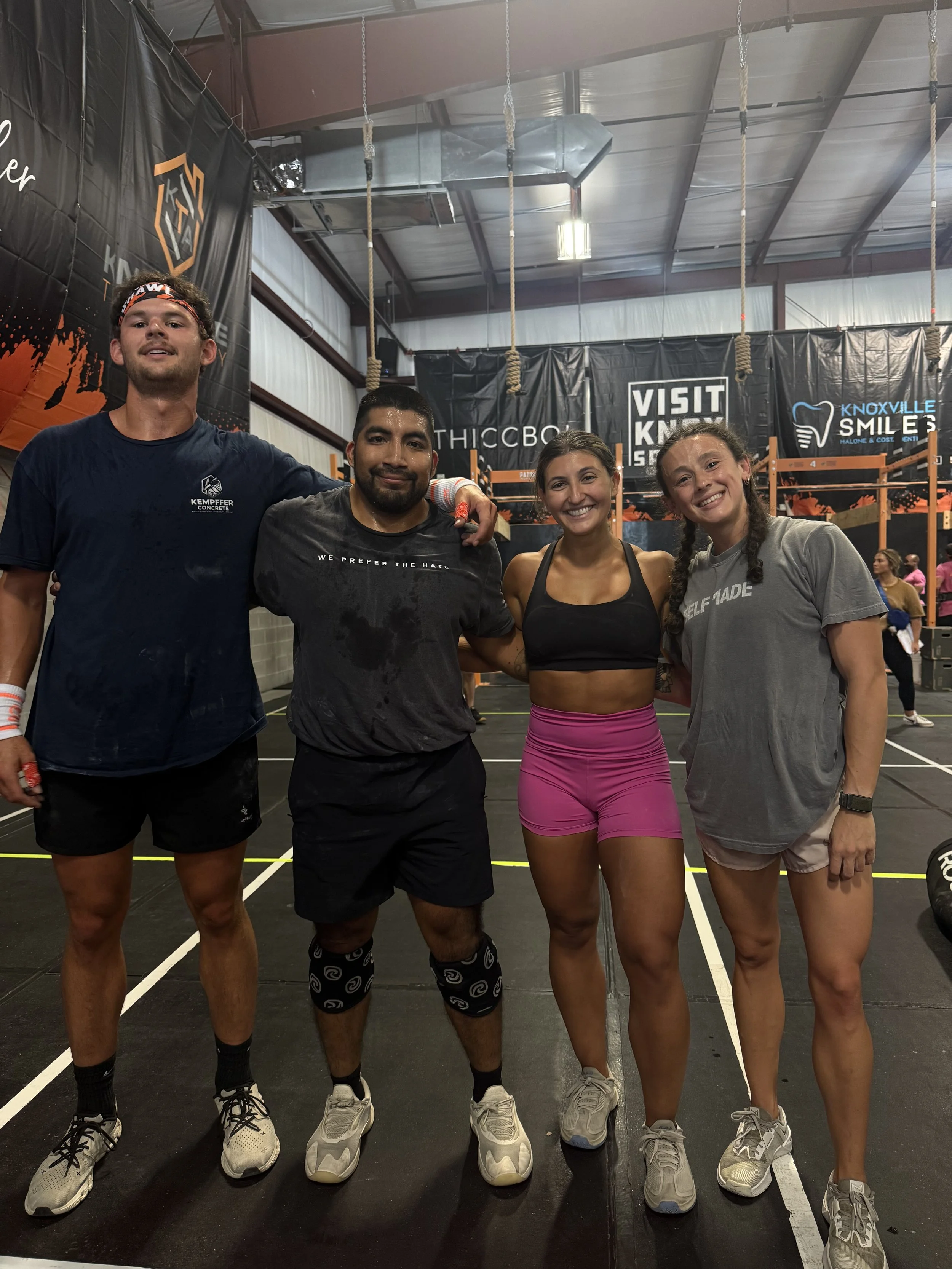
Bean and the Crumbs finished in 1st place - Rx Division this past weekend at the Orange Brawl Competition
Congratulations to Jesus Mundo and Emily Griffin!
Upcoming Events, New Shirts, Calendar

Fall CrossFit Bound Camo Shirt Pre-order is live
$34.99 - Unisex
Order needs to be in by Monday 8/17
Order through the Wodify App under the ‘Buy” tab in bottom right corner of app.
*Sample shirts will be available in lobby this week to see fit and style of shirt it will be.
BRING A FRIEND WEEK - 8/31 THROUGH 9/5
We will have a Free Week for Friends and Family to see what classes are all about.
We will have registration beginning next week.
2026 Patriot Day - Truist Park Stair Climb - September 5th from 8am-12pm
Join us for our annual stair climb at Truist Park!
Please join us for our annual 9/11 Memorial Stair Climb at TRUIST PARK, home of the Atlanta Braves!
Each year the Terry Farrell Firefighters Fund of Georgia hosts a stair climb event to honor the sacrifice and legacy of the 343 firefighters who died on 9/11/2001 in a heroic effort to save those trapped in the World Trade Center towers.
This year marks 25 years of honor and remembrance of that tragic day.
We will have support from around the globe as 343 first responders from the United Kingdom and Ireland will join us as we honor the legacy of the FDNY 343.
Communities and families from around Georgia are welcome and encouraged to join us for this special event.
ALL PROCEEDS will benefit first responders in need and their families throughout the state of Georgia.
Junior Jumpers Class
Mondays 3:30-4:30pm
Interested email info@crossfitbound.com
Upcoming Birthdays & Anniversaries
Anniversaries
1-Year
Wilnette Torres Aug 22
2-Year
Abigail Gerleman Aug 12
Fefe Lawler Aug 14
Kerry & Cris Aponte Aug 15
4-Year
Paul Watson
5-Year
Eric Harvey
6-year
Riley Padgett
Birthdays
Sheri Kindred Aug 3
Jeb Buffington Aug 4
Dylan Dejesus Aug 5
David Stewart Aug 7
Hunter Palmer Aug 8
Ryne Holsomback Aug 13
Luke Mayben Aug 15
Delilah Payton Aug 16
Mary Cox Aug 16
Rep Lattimore Aug 16
Stephen Wilcox Aug 18
Jeff Mayr Aug 21
Andrew Mitchell Aug 22
Eric Harvey Aug 22
Michael Jamorski Aug 26
Noah Daniel Aug 29
Chris Mench Aug 29
Education: CrossFit Journal Article “Setting the Record Straight on CrossFit, Part 2: Olympic Lifts, Community, and the Truth About Intensity’”
By Stephane Rochet, CF-L4
In Part 2 of our response to a viral CrossFit critique, we tackle the toughest claims yet: Olympic lifts are too dangerous to train under fatigue, CrossFit culture looks down on other athletes, and intensity is just about how destroyed you feel afterward. Here's what the critique got wrong, and what CrossFit actually teaches.
In Part 1, we addressed the opening rounds of a popular fitness influencer’s critique of CrossFit, covering his claims about endurance athletes, work capacity, isolation exercises, and mixed-modality training. If you have not read Part 1, start there.
In Part 2, we get into the remaining criticisms. These are the ones that are harder to dismiss as simple misunderstandings. Some of them reflect genuinely widespread misconceptions about CrossFit. All of them deserve a direct answer.
Are the Olympic Lifts Too Risky for CrossFit Athletes?
The claim: Olympic lifts were never meant to be done for high reps, should not be performed under fatigue, and carry excessive injury risk for the general population.
That’s a load of crap.
First, the history. Coaches like Mike Bergner and Jim Schmitz, who have trained Olympic lifters at the highest level in the world, have long advocated for high-rep Olympic lifting as a legitimate and valuable training tool. This is not a CrossFit invention; it is a well-established methodology with deep roots in American and international weightlifting history. The criticism that high-rep Olympic lifting is inherently dangerous or outside the tradition of the sport simply does not hold up against the historical record.
Second, the fatigue argument. The critic in question is a former Army Ranger. He understands better than most what happens to human performance under extreme fatigue. In that context, the argument that complex skills should only be trained in fresh, controlled conditions is worth examining carefully. No sport in the world lets its athletes perform to a lower technical standard once they get tired. Every sport trains the skill of maintaining technique under fatigue, because that is the only way to develop the capacity to do it, and the only way to win.
CrossFit is no different. When mechanics degrade during a workout, coaches intervene. Load gets reduced. Speed gets managed. Volume gets adjusted. That is the coaching process. The goal is never to grind through broken movement. The goal is to push the threshold of clean movement under increasing fatigue, which is exactly what conditioning means.
Third, the coach’s convenient example, an athlete going from a PVC pipe to near-maximal loads in four days, is a coaching failure, not a CrossFit failure. It does not reflect what CrossFit teaches, how CrossFit coaches, or what the program prescribes. Mechanics and consistency before intensity is not a footnote in CrossFit’s methodology; it is a founding principle. Such anecdotes are not a critique of the program. They are a critique of individual coaching decisions. The use of such stories by our critics makes us question how authentic these scenarios really are.
We have found strength training, complex movement patterns, and intensity are the variables that matter most for long-term health outcomes, capacity and quality of life. CrossFit built a program around those variables 25 years ago. A 75-year-old doing a dumbbell power clean variation is not a liability. That athlete is jumping, landing, absorbing external load, and coordinating hips and arms in a pattern that has direct carryover to every physical challenge life presents. That is the point. That has always been the point.
Does CrossFit Look Down on Other Athletes?
The claim: CrossFit athletes think that if you are not doing CrossFit, you are not really getting fit.
CrossFit athletes are proud of what they do. They have earned that pride. The program produces extraordinary results across a wide range of populations, ages, and ability levels, and the community built around it is among the most welcoming in fitness. CrossFit athletes routinely celebrate powerlifters, Olympic lifters, gymnasts, and endurance athletes. Many CrossFit affiliates have hosted athletes from those communities and helped them address the gaps in their fitness while respecting what they had already built.
Is there occasional tribalism? Sure. Every community has it. But characterizing CrossFit culture as exclusionary or arrogant misses what is actually happening on the floors of affiliates around the world every day. These are gyms full of regular people doing remarkable things because someone believed in their capacity to do them and built a program that delivered on that belief.
There is also something worth naming directly: People are far more capable than the fitness industry has traditionally given them credit for. One of CrossFit’s most important contributions is refusing to treat everyday athletes as fragile. The assumption that regular people cannot learn the snatch, cannot get inverted, or cannot handle complex loading under fatigue is both insulting and demonstrably wrong. The evidence is in every affiliate gym in the world, every day of the week. Damn right, we’re proud.
What CrossFit Actually Means by ‘Intensity’
The claim: CrossFit defines intensity as how hard you are working, how much you are sweating, and how destroyed you feel afterward.
This is perhaps the most frustrating inaccuracy in the entire critique, because it is the exact opposite of what CrossFit actually teaches.
CrossFit defines intensity as power output. Power is the rate at which work is performed: force multiplied by distance divided by time. That is a physics definition, not a feeling. An athlete can be sweating through their shirt and emotionally spent and still be producing low power output. Another athlete can look relatively composed and be producing twice the power. The former is not more intense in the CrossFit sense. The latter is.
This definition matters because it is measurable. CrossFit’s insistence on tracking loads, times, reps, and distances is directly tied to this definition of intensity. If you cannot measure it, you cannot manage it. Intensity is power, and power is something you can observe, record, and improve over time. Yelling, tearing up your hands, and lying on the floor after a workout are not measures of intensity. They may be after-effects, but they are not what produce results. Intensity is.
Confusing perceived exertion with actual output is a fundamental misunderstanding of the program. A CrossFit Level 1 Certificate Course would clear this up in about 45 minutes, which is precisely the invitation we would extend to any critic willing to actually study what they are critiquing.
The Bigger Point
CrossFit is not perfect and has never claimed to be. The program has evolved over 25 years, incorporating new research, refining methodologies, and continuously improving its coaching education. If something genuinely increases work capacity across broad time and modal domains, it belongs in the program. That openness to refinement is a feature, not a weakness.
What CrossFit will not do is accept criticism that is built on misreading, misquoting, or simply not doing the homework. The foundational literature is publicly available. The Level 1 curriculum is rigorous and transparent. The results speak across millions of athletes over decades.
Do the reading. Take the course. Train the program honestly for a year. Then offer a critique. That critique will be worth having.
Until then, the fundamentals stand. Move well. Train hard. Define fitness precisely. Earn the intensity. And do not mistake clicks for credibility.

Lean Beef & Rice Family Bowls
A simple, kid-friendly dinner that is high in protein, moderate in carbs, and lower in fat while still feeling like a full family meal.
Serves: 4–5
Prep: 10 minutes
Cook: 20 minutes
Using 5 oz cooked lean beef + ¾ cup cooked white rice + vegetables + sauce:
480–520 calories
40–45g protein
50–55g carbs
10–13g fat
Directions
Cook the white rice according to package directions.
Heat a large skillet over medium-high heat. Add the lean ground beef and cook until browned, breaking it into small pieces.
Drain any excess liquid or fat if needed.
Add soy sauce, Worcestershire, garlic powder, onion powder, paprika, salt, pepper, and water. Stir and cook another 2–3 minutes.
Steam or roast the broccoli and heat the corn.
Mix the Greek yogurt sauce ingredients together.
Build each bowl with white rice + seasoned lean beef + broccoli + corn + cucumber. Drizzle with the yogurt sauce.
Family Serving Idea
For kids, serve everything separately on the plate: rice, beef, corn, broccoli, and cucumber. They can build their own bowl or eat each item individually.
For adults wanting a little more volume, use ½–¾ cup rice and load up on broccoli and cucumber. For growing kids or athletes, increase the rice to 1–1½ cups.
*A little reduced-fat cheese on top also works really well without pushing the fat too high.
Ingredients
Lean Beef
1½ lb 93–96% lean ground beef
1 tbsp low-sodium soy sauce
1 tbsp Worcestershire sauce
1 tsp garlic powder
1 tsp onion powder
1 tsp smoked paprika
½ tsp salt
½ tsp black pepper
2 tbsp water
Rice
2 cups cooked white rice
Sides
2 cups broccoli florets, steamed or roasted
1½ cups corn
1 cup diced cucumbers
Optional: sliced avocado, shredded reduced-fat cheese, green onions
Easy Sauce
½ cup nonfat Greek yogurt
1 tbsp light mayo
1 tbsp lime juice
½ tsp garlic powder
Pinch of salt
Weekly Training Breakdown