Bound Newsletter 3.29.2026
Introducing the CrossFit Bound Member Vault
Your Complete System for Training, Nutrition, and Results
At CrossFit Bound, we’ve always believed that results don’t come from workouts alone.
They come from consistency, habits, and having the right system in place.
That’s why we created something new for our members:
Why We Created the Member Vault
Over time, we’ve seen a pattern.
Members who get the best results don’t just show up to class—they:
• build strong daily habits
• understand how to train
• fuel their bodies properly
• stay consistent over time
The challenge is that most people don’t have a clear structure to follow outside of the gym.
The Member Vault solves that.
It gives you:
✔ A clear starting point
✔ A system to follow
✔ Resources you can come back to anytime
This is everything we coach—now organized in one place.
What Is the Member Vault?
The CrossFit Bound Member Vault is a living, evolving ebook and resource center designed to support your fitness journey.
Inside, you’ll find:
🏋️ Training education and foundations
📅 30 Day Habit Tracker
🥗 Nutrition guides and meal plans
🛒 Grocery and meal prep systems
🧠 Mindset and discipline training
📚 Exercise library and skill development
📈 Progress tracking tools
This is not just information.
It’s a system designed to help you take action.
Who Is This For?
The Member Vault is built for every member at CrossFit Bound.
If You’re a Beginner
This gives you a clear path forward.
Start with:
• New Member Orientation
• How Classes Work
• 30 Day Habit Tracker
Focus on:
• showing up consistently
• building simple habits
• learning movements
You don’t need to know everything.
You just need to start.
If You’re an Experienced Athlete
This is where you refine your process.
Use the vault to:
• improve your nutrition
• dial in recovery
• better understand programming
• build structure outside the gym
The difference between good and great comes from consistency and execution.
How to Use the Member Vault
This is not something you read once.
This is something you use.
We recommend starting with:
1️⃣ 30 Day Habit Tracker
2️⃣ 90 Day Transformation Roadmap
3️⃣ Training Foundations
From there, explore the areas that apply to your goals.
Use the vault when you:
• feel stuck
• need direction
• want to improve
• want to stay accountable
This Is a Living System
The Member Vault is not static.
It will continue to grow and evolve.
We will be adding:
• new training resources
• updated nutrition guides
• additional meal plans and recipes
• new habit systems
• more tools to support your progress
This is a living ebook designed to improve your experience as a member.
Member Access Only
The CrossFit Bound Member Vault is exclusive to members.
To access it, you’ll need the password that was sent out in Friday’s email.
If you did not receive access:
📧 Email us at: info@crossfitbound.com
The Bigger Picture
This is about more than workouts.
This is about helping you:
• build consistency
• develop discipline
• improve your health
• become more capable in everyday life
The CrossFit Bound Standard
Lift Heavy
Breathe Heavy
Develop Skill
But more importantly:
Build habits.
Stay consistent.
Trust the process.
We’re excited for you to explore the vault and start applying it.
— CrossFit Bound
Bragging Board:

Welcome Audrey Grace Venable
Happy for Melanie and Hayden Venable
Gotta brag on Matt Schuster for completing CFG AQ workout 3 in under 12 minutes with double unders and deadlifts. 300 double unders is a huge accomplishment.
CrossFit Open 26.3 Photos: Follow this link and be sure to tag Coach Brittany if you post on social media
Weekly Training Highlight Reel is in the Works
Upcoming Brithdays & Anniversaries
Anniversaries
5-Years
Brooklyn Shaw April 14
Laura Rutland April 28
4-Years
Alex Willis April 3
2-Year
Kalob Apodaca April 2
Birthdays
Nicolas White March 29
Brian Chambers March 30
Jim Blackhall April 5
Rod Banks April 6
Kelsey Merlo April 11
Fatih Sen April 13
April Zacharis April 14
Katherine Garey April 15
Elizabeth Tillman April 19
Sabrina Melo April 20
Nick Hadley April 23
Mary Lubbers April 24
Ken Wysocki April 25
Missy Ureda April 26
Upcoming Events & Clinics
Nutrition Challenge beginning April 13th (week after spring break through Hero Month)
Details coming soon
HERO MONTH begins May 1st
be sure to write down your the Hero WOD you want to do and the Hero Wod you do not want to do on the white board in the gym.
Power From Position - Bound Build Program Description
Over the next 4 weeks, we’re focusing on one thing:
building strength in the right positions—and turning it into real power.
This cycle is designed around four key lifts:
Hang Snatch – speed, timing, and control
Back Squat – total lower body strength
Split Jerk – overhead stability and confidence
Deadlift – raw pulling power
Each session is built to help you:
Develop stronger, more stable positions
Move the bar more efficiently
Increase confidence under heavier loads
Translate strength into explosive performance
This isn’t just about lifting heavier—
it’s about lifting better, faster, and with more control.
By the end of the cycle, expect:
Stronger legs and pulling power
Sharper barbell mechanics
More confidence overhead
Better carryover into workouts
Own the position. Unlock the power.
Education: CrossFit Journal Article “Why CrossFit's Range of Motion Standards Will Keep You Moving for Life”
by: Stephane Rochet, CF Lvl 3
The Real Reason CrossFit Demands Full Range of Motion
If you’ve been doing CrossFit for any length of time, you’ve had a coach make you redo a rep. Maybe your hip didn’t break parallel on that squat, or you didn’t fully extend at the top of a thruster. It’s easy to think these range-of-motion standards are just about competition rules or making workouts “count.”
But here’s the truth: the range-of-motion demands in CrossFit existed long before any fitness competition was ever organized. There’s competition range of motion, and there’s life range of motion, and 99% of us should be far more interested in the latter.
If you’d rather watch and listen to this conversation, you can do that here.
You can also find our other information on common movement themes here:
Balance About the Frontal Plane (Coming soon)
Effective Stance and Grip (Coming soon)
Sound Hip Function (Coming soon)
What Full Range of Motion Really Means
When we talk about a full range of motion, we mean training and moving your joints through their natural anatomical end ranges. This isn’t arbitrary. It’s not about making workouts harder. It’s about preparing your body for the full spectrum of positions life might demand of you.
Think about it: the gym is a controlled environment. When you’re doing air squats, you know exactly what’s coming. But life doesn’t work that way. Life doesn’t care about your comfort zones or preferred ranges. You might slip getting off a boat onto a dock. You might fall down stairs. You might need to catch yourself in an awkward position. Having put your joints through full ranges of motion and having developed strength in those ranges could be the difference between walking away fine and getting injured.
The Best Mobility Work You’ll Never Do
Here’s something that might surprise you: if you’re doing CrossFit movements through a full range of motion, you’re already doing the best mobility work possible. People often ask what they should do for mobility training. The answer is simple: move through the full range of motion when you’re in the gym.
That’s it. That’s the best mobility work you can do, and you’re getting it in the context of actual movement patterns.
This doesn’t mean you never need targeted mobility work. If you have significant limitations preventing you from accessing these ranges, then yes, you might need to piece it together with additional drills. But for most people, the path to better mobility is straightforward: squat all the way down, press the bar all the way overhead, and work in those end ranges.
We’ve seen this play out countless times. Athletes who couldn’t squat below parallel could suddenly, after months of working full-range squats, without ever doing a single dedicated mobility drill. Their ankles got more mobile. Their hips opened up. They stopped feeling as beat up. And it happened because they consistently worked in those challenging positions.
Working the Ranges vs. Just Touching Them
Here’s the key: you have to actually work in these positions, not just touch them briefly. Take the bottom of a squat. You need to spend time down there. Pull yourself into that position, push your knees out, lift your chest, and feel what it’s like to be there. Some of this work can be passive, but a lot of it needs to be active.
Just bouncing up and down in a squat, barely touching your current end range, won’t improve your mobility. But if you’re dedicated and spend real time in those uncomfortable positions where you’re at your limit, you’ll see significant gains in your range of motion.
The beauty of this approach? If you just show up to the gym a few times a week and move with intention, you’re getting mobility training without having to carve out extra time for boring, time-consuming mobility drills that most people hate and that lose their effects quickly anyway.
Full Muscular Development
There’s another crucial benefit to working through the full range of motion that has nothing to do with flexibility: complete muscular development.
When you squat below parallel, you recruit an entirely different set of muscles than when you stay above parallel. Your glutes and hamstrings engage far more deeply. You develop strength in musculature that barely activates in partial ranges.
This matters for performance, yes. But it also matters for joint health and balanced development. When you move through full ranges of motion, you develop the musculature around the joint in the way we were designed to move. This creates stability, strength, and resilience throughout the entire range, not just in the comfortable middle portions.
New Range Is Weak Range
There’s a saying in CrossFit that should stick with you: new range is weak range.
Any range of motion you haven’t worked is vulnerable. It lacks capacity. It’s weak. If you always squat to parallel or just below, but life suddenly demands that your butt goes all the way down to your ankles, that’s where you’re most likely to get injured, feel pain, or be unable to handle the situation.
This is especially important as we age. Range of motion naturally decreases with time, so you need to fight to hang onto it, just like everything else worth preserving.
The Longevity Component
Let’s talk about what might be the most important reason to train the full range of motion: your ability to live independently decades from now.
If you train full-range-of-motion squats today, you’re investing in yourself 30 years down the road. Recently, an 85-year-old woman was able to get her hips almost down to her ankles and stand back up. That ability directly correlates to her capacity to live independently, to get off the ground if she falls, and to handle the physical demands of daily life.
We never know what positions life will put us in, especially as we age. But if you’ve consistently trained through full ranges of motion and you’ve developed strength in those positions, you’re far better equipped to handle whatever comes.
As we get older, we naturally begin to limit our range of motion. Fight to keep it. The discomfort you feel working through the full range of motion today is a small price to pay for the long-term payoff.
The CrossFit Culture of Range of Motion
In the CrossFit community, range of motion is a point of pride. Walk into any affiliate, and people understand it, value it, and will call out a less-than-ideal range of motion when they see it. This cultural emphasis matters.
Compare this to traditional strength training environments, where you might see someone squatting 700 lb to barely parallel, or not even that deep. Yes, some athletes can handle enormous loads through a full range of motion. But when we’re talking about real athleticism, about handling the demands of life, about moving well, whether you’re a competitive athlete or a regular person trying to stay healthy, full range of motion is the great equalizer.
It connects the entire spectrum from elite sport performance to everyday independence.
Don’t Sacrifice Range for Ego
Here’s the hard truth: the first thing to go when you don’t check your ego at the door is range of motion.
Want to add more weight to the bar? Decrease your range of motion a little. Want a better time on the workout? Cut your squats by a few inches. It’s the easiest way to game the system.
But you’re only cheating yourself.
How do you know if a weight is too heavy? Here’s a simple test: does your warm-up set look different from your working set? If your range of motion changes as the weight increases, the weight is too heavy.
Range of motion should not be weight-dependent. It should not be speed-dependent. Yes, it takes longer to sit all the way down and stand all the way up. But you shouldn’t shave time off your workout by barely meeting depth standards. You should be obsessed with proper range of motion and with moving the way your body was designed to move.
This isn’t about being hypermobile. When you’re doing functional movements, there are clear end ranges: top and bottom, fully extended, or fully flexed. Just be able to move through those ranges while preserving all the points of performance: proper midline position, good mechanics, everything intact.
When you can do that, you’re starting to master the movement.
Go all the way down. Stand all the way up. Move the way you were designed to move. Your 85-year-old self will thank you.
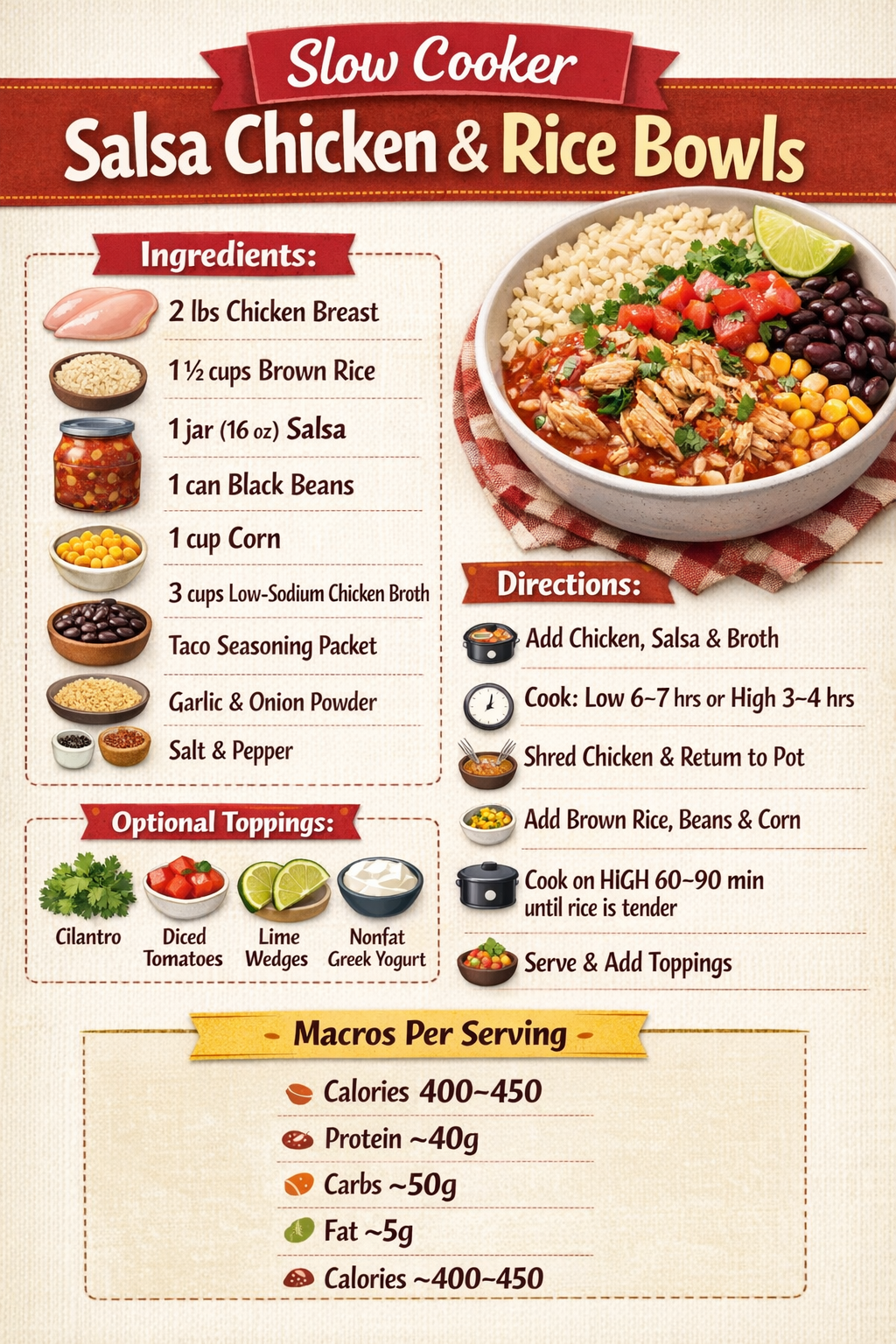
Recipe of the Week: Slow Cooker Salsa Chicken & Rice Bowls
Serves: 4 | Time: ~35 minutes
Nutrition Highlights (per serving approx.)
Protein: ~40–45g
Carbs: ~45–55g
Fat: ~4–6g
Calories: ~400–450
Instructions:
Add to Crockpot:
Place chicken breasts on bottom
Pour salsa, chicken broth, and seasoning over top
Cook:
Low for 6–7 hours OR High for 3–4 hours
Shred Chicken:
Remove chicken, shred with forks, return to pot
Add Rice & Extras:
Stir in uncooked brown rice, black beans, and corn
Cook Again:
Cook on HIGH for 60–90 minutes (until rice is tender)
Stir occasionally if possible
Serve:
Portion into bowls and add toppings
Ingredients:
2 lbs boneless, skinless chicken breast
1 ½ cups brown rice (uncooked)
3 cups low-sodium chicken broth
1 jar (16 oz) salsa (choose low sugar if possible)
1 can (15 oz) black beans, drained & rinsed
1 cup corn (fresh, frozen, or canned)
1 packet taco seasoning (or homemade low-sodium)
1 tsp garlic powder
1 tsp onion powder
Salt & pepper to taste
Optional toppings (keep it lean):
Chopped cilantro
Diced tomatoes
Lime juice
Nonfat Greek yogurt (instead of sour cream)
Why this works:
High protein: Lean chicken breast base
Moderate carbs: Brown rice + beans for sustained energy
Low fat: No added oils or heavy sauces
Family-friendly: Mild flavors + customizable toppings
WTB - Coming Monday