Bound Newsletter 4.5.2026
Why Being Present in Your Training Changes Everything
The Science Behind Mindfulness, Performance, and Real Results
Walk into any gym and you’ll see it—people moving, sweating, grinding through workouts. But look closer, and you’ll notice something else:
Some are fully engaged…
Others are just going through the motions.
The difference between the two isn’t always strength, conditioning, or skill.
It’s presence….
In recent years, social behavior research and sports psychology have uncovered something powerful: how you pay attention during training may matter just as much as what you do.
What Is Mindfulness in Training?
Mindfulness is often defined as:
Paying attention “on purpose, in the present moment, and non-judgmentally.”
In the context of fitness, that means:
Feeling each rep instead of rushing through it
Controlling your breath instead of reacting to fatigue
Staying focused on the task instead of your phone, stress, or surroundings
This isn’t just philosophy—it’s physiology and psychology working together.
The Science: Why Presence Improves Performance
1. Better Focus = Better Output
A 2024 meta-analysis on athletes found that mindfulness training significantly improved:
Attention control
Flow state (complete task immersion)
Overall performance
When athletes are fully present, distractions fade. This allows the brain to allocate more resources to movement efficiency, coordination, and decision-making.
In simple terms:
→You perform closer to your actual potential.
2. Reduced Anxiety and Mental Noise
Training isn’t just physical—it’s emotional.
Research shows mindfulness-based interventions:
Decrease performance-related anxiety
Improve emotional regulation
Reduce cognitive interference (overthinking mid-workout)
That means fewer missed lifts due to hesitation, fewer breakdowns under fatigue, and more consistent execution.
3. Lower Stress = Higher Recovery and Output
Exercise itself is a stressor. Add life stress, and performance can suffer.
A large 2024 randomized study found mindfulness exercises significantly reduced self-reported stress levels across participants.
Why does that matter?
Because high stress:
→Impairs recovery
→Disrupts sleep
→Limits performance adaptation
Mindfulness helps regulate that stress response, allowing your body to actually benefit from the training you’re doing.
4. Improved Physiological Response to Training
Emerging research shows mindfulness can:
→Reduce inflammatory markers
→Regulate stress hormones
→Improve overall mind-body balance
This directly impacts:
→Endurance under fatigue
→Recovery between sessions
→Long-term performance sustainability
5. Enhanced Cognitive Function and Awareness
Mindfulness training has also been linked to improvements in:
→Cognitive performance
→Awareness
→Task execution in complex environments
In a gym setting, this translates to:
→Better movement quality
→Faster learning of new skills
→Increased body awareness (proprioception)
The “Flow State” Advantage
One of the most powerful outcomes of mindfulness is entering a flow state—where:
→Time disappears
→Movement feels automatic
→Effort feels controlled
The same meta-analysis found mindfulness significantly increases this state of “fluency” in athletes.
This is where breakthroughs happen.
Beyond the Gym: Real-Life Carryover
The benefits don’t stop when the workout ends.
Studies show mindfulness and exercise together:
→Improve overall wellbeing
→Reduce negative thinking patterns
→Enhance emotional resilience
When you train with presence, you’re also training:
→Discipline
→Awareness
→Control under stress
That shows up in your work, relationships, and decision-making.
Why Most People Don’t See Results
Here’s the hard truth:
Many people train distracted.
→Thinking about work
→Scrolling between sets
→Rushing through movements
They complete the workout…
But they don’t experience it.
And that limits results.
Because adaptation isn’t just mechanical—it’s neurological.
How to Apply Mindfulness to Your Training (Starting Today)
You don’t need meditation apps or 30 minutes of silence.
Start here:
1. Control Your Breath
Before each set:
→Inhale through the nose
→Exhale slowly
→Center yourself
2. Focus on One Cue
Instead of overthinking:
“Drive through the floor”
“Stay tight”
“Breathe and move”
3. Eliminate Distractions
→Put your phone away
→Stay engaged between sets
4. Feel the Movement
Where is the tension?
Are you stable?
Are you rushing?
5. Reset Between Efforts
Treat each set like its own event—not part of a chaotic workout.
Final Thought: Train Your Mind Like You Train Your Body
Strength, conditioning, and skill matter.
But they’re only fully expressed when your mind is aligned with your body.
Mindfulness isn’t soft.
It’s a performance tool.
And the athletes who learn to be fully present?
They don’t just work out harder.
They get more out of every rep, every session, and every day.
References
Si, X. W., Yang, Z. K., & Feng, X. (2024).
A meta-analysis of the intervention effect of mindfulness training on athletes’ performance.
Frontiers in Psychology, 15.Found that mindfulness training significantly improves performance, focus (flow state), and reduces anxiety in athletes.
Systematic Review (2024).
Impact of mindfulness-based interventions on sports performance and mental health outcomes.
ScienceDirect.Analysis of over 10,000 athletes showing positive trends in performance and mental health with mindfulness training.
Bühlmayer, L., et al. (Referenced in 2025 review).
Mindfulness and attention in athletes.Demonstrates improvements in selective attention and cognitive performance through mindfulness-based training.
Wang, Y., et al. (Systematic Review).
Effects of mindfulness-based interventions on athletic performance, psychological components, and mental health.
International Journal of Environmental Research and Public Health.Shows improvements in flow state, stress reduction, and overall athletic wellbeing.
Li, J., Cochrane, K. A., & Leshed, G. (2024).
Everyday mindfulness practices and their impact on mental and physical well-being.Highlights the benefits of consistent mindfulness on emotional regulation and long-term behavior.
Fox, K. C. R., et al. (2016).
Functional neuroanatomy of meditation: A meta-analysis of neuroimaging studies.Demonstrates measurable brain changes linked to attention control, emotional regulation, and awareness.
Mindfulness & Psychological Health Research (Meta-analysis, 44,000+ participants).
Shows strong correlations between mindfulness, reduced stress, and improved emotional outcomes.
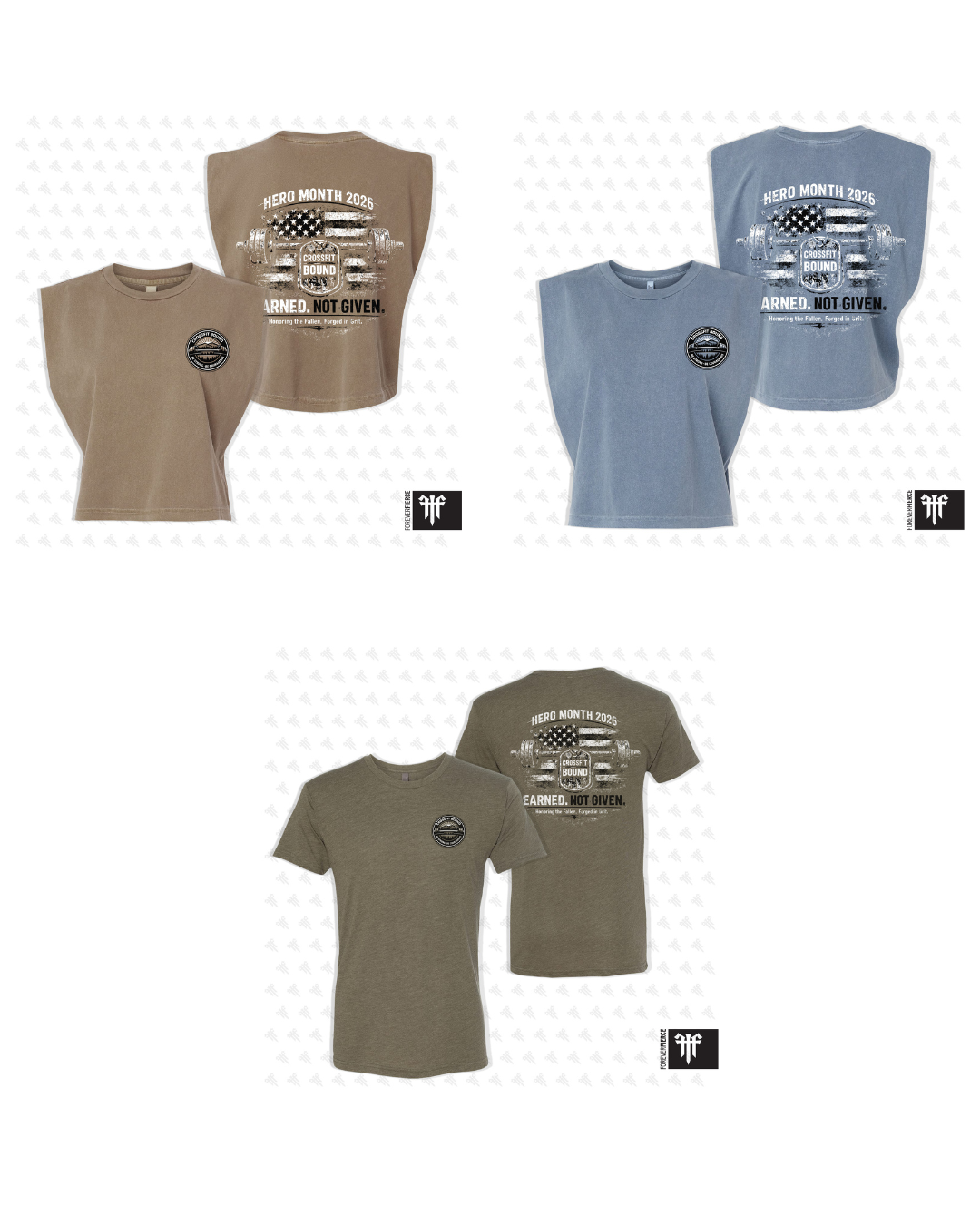
2026 Hero Month shirts
Here is our 2026 Hero Shirts - I have samples in the front area hanging on the bottom right Tshirt rack for you to look at to determine the size you may need. These are available for pre-order through wodify (you can purchase directly through app under the ‘buy’ tab on home screen).
We will have the option between navy blue and army green for both womens crop tops and a tri blend t shirts.
Any questions please reach out to info@crossfitbound.com
Deadline to order is April 25th
Crop Tops - $32.99
Tri Blend Tshirts - $29.99
Bragging Board:
Erin Adams
BCOE Outstanding Teaching Award at Kennesaw State University: Dr. Erin Adams
Dr. Erin Adams was selected for the Bagwell College of Education (BCOE) Outstanding Teaching Award in recognition of her sustained excellence and impactful contributions to teaching. Dr. Adams has made significant contributions through innovative course design and curriculum development that enhance teacher preparation and student learning. Her commitment to meaningful, high-quality teaching over many years has led to invitations to facilitate preservice teacher workshops at the Museum of History and Holocaust Education, where she provided professional development for educators. She also mentored faculty and connected students with professional conferences and national networks that extend their learning beyond the classroom. These accomplishments are complemented by numerous national and international invitations to speak and lead workshops. Moreover, Dr. Adams’s teaching is grounded in research and best practices, and her students consistently describe how her teaching has shaped their professional growth and deepened their learning.
Jen Wells
BCOE Outstanding Online Teaching Award: Dr. Jennifer Wells
Dr. Jennifer Wells was selected for the BCOE Outstanding Online Teaching Award in recognition of her exemplary online teaching practices. Her instruction reflects strong alignment with research-based principles and best practices in online education, along with sustained attention to student engagement, participants, This was for demonstrating online teaching practices aligned with research and best practice in addition to close attention to student’s activity, engagement, and performance throughout her courses. Students consistently recognize Dr. Wells’s commitment to their learning, as evidenced by nearly perfect course evaluation scores and numerous student comments documenting the meaningful impact of her teaching on their academic and professional development.
Natalie Gordon completed her first 2 bar muscle ups during the quarterfinals this year!
Weekly Training Highlight Reel is in the Works
Member Vault Updates
Updated Performance Tracking Tools
LIFTING PERCENTAGE CHART
How to read the percentages based off of your 1RM Back Squat and Close Grip Bench Press
WORKOUTS PDFS & PROGRAMS
This section provides customized and general workout programs for specific movements, 30 row & bike workouts, and 75 body weight workouts to use while traveling or at home!
The Member Vault is password protected. If you are a member and need access please email info@crossfitbound.com for pass word (or ask a friend/member/coach in class)
Upcoming Brithdays & Anniversaries
Anniversaries
9-Years
Alex & Meg Willis April 3
5-Years
Brooklyn Shaw April 14
Laura Rutland April 28
2-Year
Kalob Apodaca April 2
Birthdays
Jim Blackhall April 5
Rod Banks April 6
Kelsey Merlo April 11
Fatih Sen April 13
April Zacharis April 14
Katherine Garey April 15
Elizabeth Tillman April 19
Sabrina Melo April 20
Nick Hadley April 23
Mary Lubbers April 24
Ken Wysocki April 25
Missy Ureda April 26
Upcoming Events & Clinics
Nutrition Challenge beginning April 13th (week after spring break through Hero Month)
Details:
• Length: 6 weeks (Monday April 13 - Sunday May 24)
• Cost: $159 per participant
• Focus: Fat loss + lean body mass through 6 foundational weeks of nutrition and lifestyle habits
• This challenge offers structured guidance, weekly education, and a community forum all built into our custom Breakthrough Coaching App to build accountability.
• Minimum enrollment: 12 participants so grab a friend and sign up
*The goal is to make nutrition feel simple, sustainable, and aligned with the hard work Crossfit Bound members already put in at the gym.
HERO MONTH begins May 1st
be sure to write down your the Hero WOD you want to do and the Hero Wod you do not want to do on the white board in the gym.
Education: CrossFit Journal Article “Why Stance and Grip Are CrossFit's Critical Performance Details”
by: Stephane Rochet, CF Lvl 3
The Setup Nobody Checks: Why Stance and Grip Matter More Than You Think
Here’s a question: what’s the first thing you do when you set up for a lift?
If your answer isn’t “check my stance and grip,” you’re missing the foundation of every movement you do in CrossFit. And you’re not alone. This is one of the most overlooked aspects of training, even among experienced athletes.
But here’s the truth: sometimes a movement looks inefficient or demonstrates faulty mechanics not because the athlete lacks strength or mobility, but simply because their feet or hands are in the wrong position. Adjust the foot placement and hand position, and suddenly the movement clicks.
If you’d rather watch and listen to this conversation, you can do that here.
You can also find our other information on common movement themes here:
Sound Hip Function (Coming soon)
What We’re Really Talking About
Establishing an effective stance and grip means having foot placement and hand position that are ideal for the task at hand. This allows you to:
Complete the movement.
Execute the points of performance correctly.
Transfer force efficiently.
Maintain proper balance and stability.
Access the range of motion you need.
It sounds simple, but it’s surprisingly specific. We’re not talking about “somewhere around here.” We’re saying your feet need to be exactly here, and your hands need to be exactly here.
Why This Gets Overlooked
Even experienced athletes will walk up to a barbell and set up with their feet in the wrong position.
As a coach, if you’re not in charge of checking stance and grip, you’ll find yourself adjusting every single athlete’s setup for every single rep. It should be automatic. It should be part of your setup routine for every movement, right alongside taking a breath and bracing your core.
But people just don’t see the importance of it. They don’t realize how specific it needs to be. Or they know intellectually that it matters, but they don’t actually check it consistently.
The result? You’re leaving performance on the table. You’re making movements harder than they need to be. And in some cases, you’re creating the exact faults you’re trying to fix.
The Two Home Bases for Foot Placement
While stance will vary slightly based on the movement and your individual build, we have two general “home bases” for foot placement that apply to most movements.
1. Feet Under the Hips
This position is your foundation for:
All pressing movements overhead (strict press, push press, push jerk).
All pulling movements from the ground (deadlift, clean, snatch).
Jumping movements (box jumps, broad jumps, vertical jumps).
Why this position? Because it allows for the most direct and efficient transfer of force into the ground. Think about it: if you wanted to jump as high as possible, where would you naturally place your feet? Probably under your hips, right? That’s because this position maximizes your ability to generate and transfer power.
In this stance, there are no range-of-motion limitations that will affect your movement. There are no balance issues. You can focus entirely on pushing force into the ground as efficiently as possible, whether that’s to drive a barbell overhead, pull it off the floor, or propel your body into the air.
2. Heels Roughly Under the Shoulders (Shoulder-Width Stance)
This position is your foundation for:
All squatting movements (back squat, front squat, overhead squat, air squat).
Why wider for squats? You sacrifice a small amount of power transfer, but you gain something more important for this particular task: range of motion and stability.
A shoulder-width stance allows your hips to move through their full range of motion more easily. It lets you sit between your legs rather than behind them (like a skier in a tuck position). This position enables you to:
Maintain a more upright torso.
Keep your knees tracking over your toes.
Achieve full depth without excessive forward lean.
Maintain midline stabilization throughout the movement.
There’s a common tendency, especially among newer athletes, to squat with feet too narrow, under the hips. This requires significantly more mobility and often results in excessive forward torso lean. The wider stance opens up the hips and makes the movement more accessible.
These Are Starting Points, Not Rules
Here’s the important caveat: these home bases are starting points. Depending on how you move, how you’re built, and what specific variation you’re doing, you might adjust these positions.
For example:
Some people might squat slightly wider than shoulder-width.
Others might find a narrower stance works better.
Front squats and overhead squats are often slightly narrower than back squats (partly because you’re typically receiving these positions after an Olympic lift, where you have limited time in the air to move your feet).
The true test is: Are you executing the movement as efficiently as possible for your body?
This is something you’ll experiment with over time. Your ideal stance might shift as your mobility improves, your technique develops, and your experience grows. We’re often talking about fractions of inches and small adjustments that make a significant difference.
But you have to actually check. You have to pay attention. You have to make it consistent.
Hand Position: The General Guidelines
For grip, we also have general home bases.
Outside the Shoulders, Outside the Legs
This is your starting point for most movements. Why?
When picking things off the ground, your arms stay out of the way of your legs. You’re not fighting your own limbs for space.
When pressing overhead, a grip outside your shoulders allows you to achieve full range of motion at the top without pinching or compromising your shoulder position. Your arms have room to move efficiently.
In the rack position, you’re not cramping your hands or creating unnecessary restriction in how the bar sits on your shoulders.
Find What’s Natural, Then Mark It
Here’s a simple test for pull-ups: reach up and grab the bar without thinking about it. Just hang. That natural grip width? That’s probably where you should be most of the time.
Yes, you’ll experiment with different widths — narrow grips, wide grips, everything in between. But your most commonly used grip should feel natural.
The key is consistency. Once you find your grip, mark it. Use the knurling on the bar as your reference point. Know exactly where your hands go every time.
Why? Because it’s surprisingly easy to be off-center, with one hand in a different position than the other. Asymmetry creates inefficiency and can lead to compensation patterns.
Task-Specific Adjustments
While our home bases apply to most movements, some exercises demand different positions.
Sumo deadlifts or sumo deadlift high pulls: Wider stance with hands inside the legs.
Snatches: Significantly wider grip to allow the bar to reach the overhead position.
Overhead squats: Wider grip than you’d use for a clean.
Sandbag cleans: Wider stance to accommodate the object.
The task dictates the setup. There’s no one-size-fits-all, but you should know why you’re using a particular stance or grip for each movement.
Grip Isn’t Passive
Here’s something else that deserves its own emphasis: Grip isn’t just about where you put your hands; it’s about how you hold the bar.
Active Grip Principles
Wrap your thumb around the bar —no false grip unless you’re a bench presser who knows exactly what you’re doing.
Squeeze the bar hard — create tension through your hands.
Consider hook grip for Olympic lifts and heavy pulls if appropriate.
Position matters — on pull-ups, aim for knuckles on top of the bar rather than behind it.
Even on back squats — wrap your thumb and squeeze the bar.
Why does active grip matter so much? Because your hands are the conduit for force transfer. Power generated by hip extension travels through your core, shoulders, and hands to the object you’re moving.
A weak, passive grip leaks power. A strong, active grip transfers it efficiently.
Gymnastics Applications
Grip considerations extend to gymnastics movements:
Hanging movements: Maintain active engagement with the bar.
Ring work: Consider a false grip for movements like ring muscle-ups, where it’s mechanically advantageous.
Kipping movements: Yes, it’s harder to be precise when you’re moving fast, but the principles still apply.
Know what type of grip is appropriate for the task. Some movements simply can’t be completed without the right grip. For example, try doing a ring muscle-up without understanding false grip, and you’ll see what I mean.
Make It Part of Your Routine
The setup should be automatic. Every single time you approach a movement:
Set your feet in the appropriate position.
Set your hands in the appropriate position.
Check your setup before you begin.
Use reference points (knurling, floor markers, etc.) for consistency.
This applies whether you’re warming up with an empty barbell or attempting a PR. The patterns you practice with light weight are the patterns you’ll execute with heavy weight.
Why This Matters
Getting stance and grip right is about:
Efficiency: Proper setup allows force to transfer directly rather than leaking through poor positioning.
Accessibility: Sometimes, athletes can’t hit proper positions simply because their feet or hands are in the wrong place. Once they adjust the setup, they can do the movement correctly.
Consistency: When your setup varies every rep, your movement quality varies, too.
Performance: Small adjustments in stance or grip can be the difference between making and missing a lift.
Safety: Proper setup reduces compensation patterns that lead to injury.
So, before you worry about bar speed, hip extension timing, or any other technical detail, check your stance and grip.
Get the setup right, and everything else becomes easier. Miss the setup, and you’re fighting an uphill battle from the start.
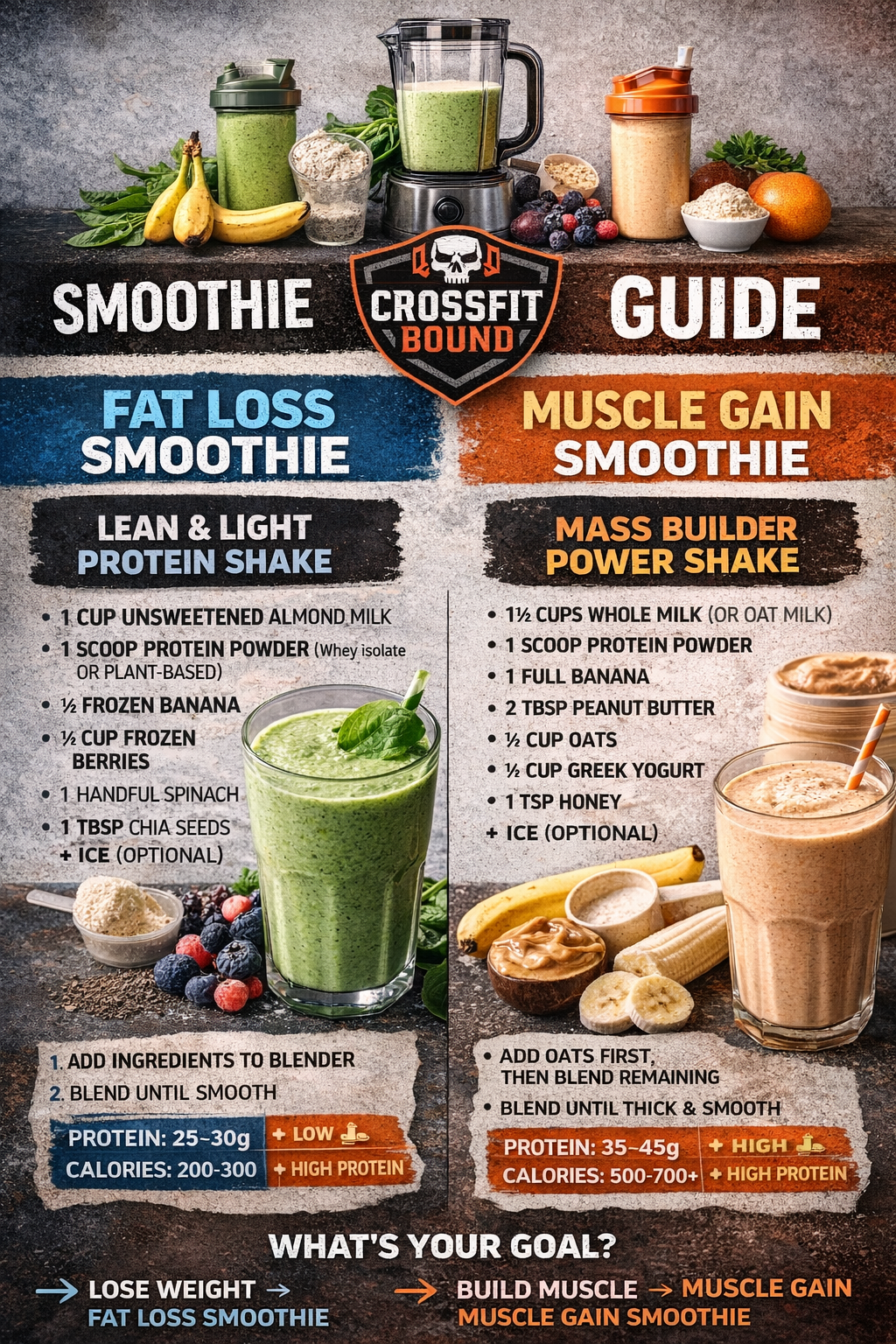
Recipe(s) of the Week: Smoothie Guide
QUICK GUIDE: WHICH ONE SHOULD YOU USE?
Trying to lose weight? → Fat Loss Smoothie
Trying to build muscle? → Muscle Gain Shake
Training hard but not recovering? → Muscle Gain
Need something light + filling? → Fat Loss
RECIPE CARD #2: MUSCLE GAIN SMOOTHIE
“Mass Builder Power Shake”
Goal: High calorie, high protein, recovery + growth
Time: 5 minutes
Serving: 1
Ingredients:
1½ cups whole milk (or oat milk)
1 scoop protein powder
1 full banana
2 tbsp peanut butter
½ cup oats
½ cup Greek yogurt
1 tsp honey (optional)
Ice (optional)
Instructions:
Add oats first and blend briefly (helps texture)
Add remaining ingredients
Blend until thick and smooth
Macros (Approx):
Protein: 35–45g
Calories: 500–700+
Balanced carbs + fats = optimal recovery
Why It Works:
Calorie surplus = required for muscle growth
Carbs replenish glycogen post-workout
Protein supports muscle repair
RECIPE CARD #1: FAT LOSS SMOOTHIE
“Lean & Light Protein Shake”
Goal: High protein, low calorie, keeps you full
Time: 3 minutes
Serving: 1
Ingredients:
1 cup unsweetened almond milk
1 scoop protein powder (whey isolate or plant-based)
½ frozen banana
½ cup frozen berries
1 handful spinach (optional)
1 tbsp chia seeds
Ice (optional)
Instructions:
Add all ingredients to a blender
Blend until smooth (30–45 seconds)
Drink immediately
Macros (Approx):
Protein: 25–30g
Calories: 200–300
Low sugar, high fiber → keeps you full longer
Why It Works:
High protein = preserves muscle while losing fat
Fiber + volume = appetite control
Low calorie = supports calorie deficit